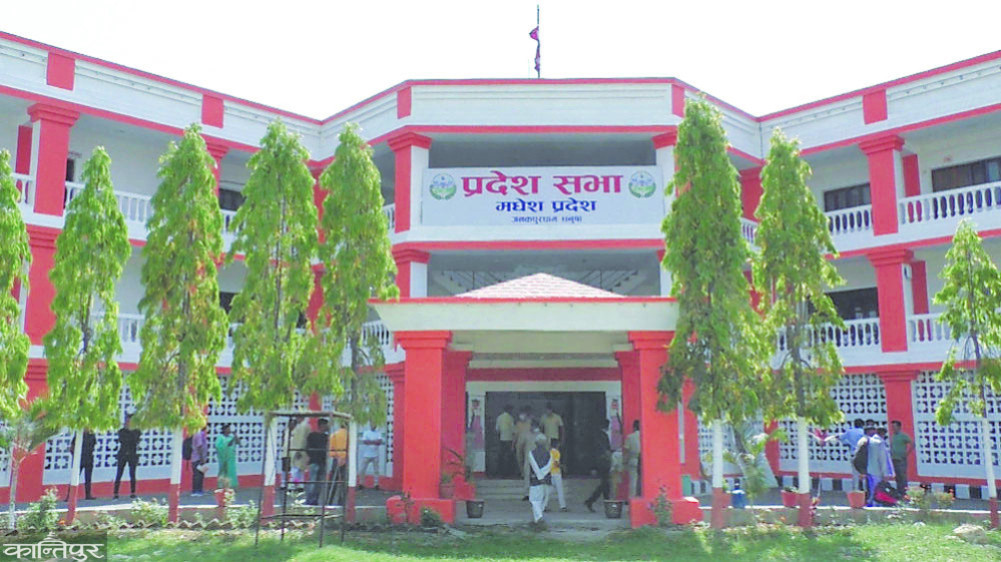
What Balen said about the provinces in Janakpur and Damak should be honestly taken to the implementation level, and an environment should be created where the provinces and local levels feel like 'government'.
We use Google Cloud Translation Services. Google requires we provide the following disclaimer relating to use of this service:
This service may contain translations powered by Google. Google disclaims all warranties related to the translations, expressed or implied, including any warranties of accuracy, reliability, and any implied warranties of merchantability, fitness for a particular purpose, and noninfringement.
Balen had addressed Janakpur on Magh 5 as his first public event. In his address, he had said, ‘I am not going to Kathmandu to demand rights, I am going to go sightseeing, to visit Pashupatinath Temple and Swayambhunath, I am not pleading with Kathmandu to demand a Chief Administrative Officer, the province will manage it.’
He also made reference to the Chief Administrative Officer in relation to rights. When he was the mayor of Kathmandu Metropolitan City, he was not able to work easily. He did not receive support from the federal government in work ranging from removing encroachers around the Bagmati River to expanding the sidewalks on New Road and managing garbage.
The constitution does not prevent the province and local levels from making laws not only within their exclusive rights, but also within their shared rights. However, even for making laws within their exclusive rights, they avoid saying ‘first make a federal law and then make it’, and do not help in raising the file. He also did not have ease in implementing the sole rights of the local levels including education, health, drinking water, bus park management. Due to the non-cooperation of the Chief Administrative Officer sent by the federal government in a arbitrarily manner, he was not able to work as expected. When the Chief Administrative Officer was in dispute, the federal government did not even say, ‘Go back, send another one’, but instead, it did not cooperate. The city police chief was even removed by being surrounded on all sides for ‘supporting the mayor’.
Balen expressed his pain in Janakpur. What he meant was, ‘Janakpur no longer has to go to Kathmandu to demand rights. That right is in Janakpur. It is in the province. It cannot be deprived of exercising the constitutionally granted rights.’
The constitution has given the province and local levels the right to state power. The constitution itself has defined state power as the right related to the executive, legislature and judiciary. There are so many rights. However, the province and local levels are deprived of exercising their rights. The constitution has the power of the state. However, if an employee is needed, they have to work in Singha Durbar. The employees who have left the union at the provincial and local levels do not cooperate in making laws within the exclusive right.
The constitution does not prevent the making of laws within the exclusive right, not only at the provincial and local levels, but also within the common right. However, they avoid making laws within the exclusive right by saying, ‘First make a federal law and then make it’, and do not help in raising the file.
It has been 10 years since the constitution was promulgated. The federal civil service act has not been introduced yet. Even after being registered in the parliament after the 2074 elections, this bill did not move forward. Due to disputes in the then ruling NCP government over issues such as the appointment of the chief administrative officer of the municipality, it could not take shape. When the then Prime Minister KP Sharma Oli said, ‘All chief administrative officers and provincial secretaries should be from the union,’ Shashi Shrestha, who led the then State Affairs Committee of the Maoist faction, opposed it. In that spirit, the Oli government withdrew the bill from parliament.
After the 2079 elections, this bill was re-registered in the House of Representatives in 2080 Falgun. The House of Representatives passed the bill in Asad 2082 and sent it to the National Assembly, sending the Chief Administrative Officer and the Provincial Secretary from the union for 10 years. However, this bill did not move forward smoothly regarding the cooling-off period of the employees. Prime Minister KP Sharma Oli himself delayed this bill by appointing the Chief Secretary and Secretaries.
When the National Assembly sent it with amendments, there was a Gen-G rebellion. Due to the dissolution of the House of Representatives, the bill was reduced to zero. This bill is such that it undermines the rights of the provincial and local levels. The School Education Bill also failed in the same way. The constitution has given the right to secondary education to the local level. However, it was a bill that infringed on the rights of the local level. The bill was brought to revive the previously abolished District Education Office and Department of Education. The bill was brought to reduce the rights of the municipalities on issues such as the examination system, teacher recruitment, and the formation of management committees.
The federal government has been reducing the jurisdiction of the provincial and local levels through acts. When I was a member of the National Assembly, I voted against the bills on public transport and Nepal Police, among others. The rights of the provinces and local levels have been violated in all areas, administrative, political, financial, etc. They have not been able to exercise their rights. Balen's Janakpur address was/is based on reality. Now that he is becoming the Prime Minister, I believe he will implement the issues he spoke about in Janakpur.
He assured voters that the country has been weakened not by taking salaries and allowances, but by corruption. The Rashtriya Swayamsevak Sangh (RSS) has mentioned in its pledge to improve the current form of the province. However, most of the leaders and workers of the Rashtriya Swayamsevak Sangh (RSS) have an established view that ‘provincial structure is expensive’. Along with discussing rights, he said 'federalism is needed' in the Janakpur program on Magh 5. On Magh 20, he defended the province structure, which was said to be expensive, with voters. While talking to voters, he expressed the view that sufficient budget is needed to work in the education and health sectors as per the provisions of the constitution. In response to which, a voter expressed the view that 'if there is a budget shortage, sufficient resources will be generated if the province structure is abolished.'
Then Balen had said, ‘No, no, there is low expenditure on provincial structure. The low expenditure goes to salaries. That is also a misconception. This situation has not come about because of the salaries received by ministers and MPs.’ He had assured the voters that the country has been weakened not by salaries and allowances, but by corruption. The RSS has mentioned in its pledge to improve the current form of the province. However, most of the leaders and workers of the RSS have an established view that ‘provincial structure is expensive’.
As Balen said, the province’s expenditure is very low. As per the consolidated financial statement of the federal, provincial and local levels for the financial year 081/82, made public by the Office of the Comptroller and Auditor General a few weeks ago, the total administrative expenditure of officials and employees at all three levels is Rs 310 billion. The federal accounts for 50.47 percent of this expenditure, while the local level accounts for 44.84 percent.
The provincial expenditure is only 4.69 percent. In the expenditure of all three levels, not even 5 rupees out of 100 rupees is spent on the salaries and allowances of the provincial Chief Minister, ministers, members of the provincial assembly and employees. Therefore, there is no point in saying that the provincial structure has become expensive. Balen has talked about the rights of the provincial and local levels. He has defended the provincial structure. Hopefully, what he said will be done.
The RSVP had made the election pledge public as a resolution to establish the situation. The pledge, which is called 100 bases of policy departure for transformation, mentions preparing a debate paper on constitutional amendment within three months of forming the government as the 10th base and moving forward with a directly elected executive, a fully proportional parliament, a system where MPs are not ministers, non-partisan local governments and a reformed provincial structure as the minimum bases. Similarly, as the 18th base, it mentions limiting the number of federal ministries to 18 and establishing a new standard of expert ministers and expertise-based staff administration.
When discussing the number of ministries, the Administration Reform Commission formed in 2048 under the chairmanship of the then Prime Minister Girija Prasad Koirala had recommended increasing the number of ministries from 21 to 18. However, it was not implemented. In 2070, an Administration Reform Suggestion Committee was formed under the coordination of administration expert Kashiraj Dahal. The committee had recommended, among other things, maintaining a maximum of 12 ministries in the union after the federal structure. This report was also not implemented.
In Baishakh 2074 BS, a powerful Federal Administrative Restructuring Committee was formed under the chairmanship of the then Minister of General Administration. The committee had proposed 15 ministries. However, 22 were created. Constitutionally, about 60 percent of the work done by the previous Nepal government has gone to the provincial and local levels. There is a global principle and practice that work should be followed by value and organizational structure. If this belief is to be assimilated, a maximum of 12 ministries at the federal level is sufficient.
If we take this fact as a basis, the 18 ministries mentioned by the RSSS should be natural. However, if we really want to reduce administrative expenses and make them work according to the workload, then no more than 15 should be created. The National Assembly's Special Parliamentary Committee for Monitoring the Implementation of Federalism has also recommended that no more than 15 ministries are needed in the union. If we take this fact as a basis, the 18 ministries mentioned by the Rashtriya Swayamsevak Sangh (RSS) should be natural. However, if we really want to reduce administrative expenses and make them work according to the workload, then no more than 15 should be created. The National Assembly committee has recommended that the current five dozen departments be reduced by half.
When discussing the reformed provincial structure, the number of ministers in the constitution is 20 percent of the provincial assembly. The National Assembly's Federalism Special Committee recommends that it be reduced to 10 percent, not less than five. Second, there is no difference in reforming the provincial electoral system and creating a directly elected chief minister system. The constitution considers provinces as the vehicle of development. Directly elected chief ministers bring stability. Development accelerates.
Third, the number of provincial assemblies is 550. It can be reduced to 330. Inclusive representation can be ensured in a directly elected system. Fourth, the post of provincial chief is not necessary. The job of the provincial chief is only to administer the oath to the Chief Minister and provincial ministers, read out the policies and programs of the provincial government, and convene and end the meetings of the provincial assembly. The oath-taking is done by the Chief Justice of the High Court. The policies and programs are read out by the Chief Minister, and the meetings are called and ended by the Speaker on the recommendation of the provincial government.
In the fifth reform, the organizational structure should be streamlined. Sixth, the province should do inter-municipal level work rather than small tasks. If this kind of reform can be done, public confidence in the province will increase. There will also be stability. However, along with the reform, it is equally important to implement the constitutionally granted provincial rights. The province should be able to feel the government. The police should be adjusted. It should have its own employees. The financial base is weak. Its scope should be broadened. What Balen said in Janakpur and Damak should be taken to the implementation level with honesty. An environment should be created where the province and local levels can feel the government.