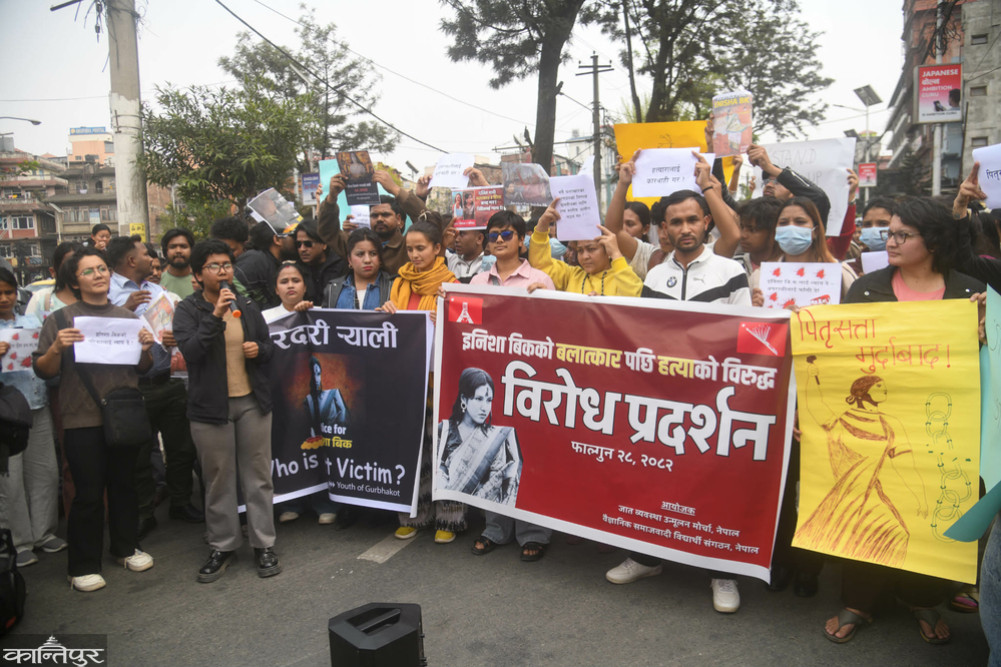
JB Vishwakarma writes - Due to the helplessness of the state, irresponsible administration, and the influence of the dominant class and community, Dalits and marginalized communities are forced to continue fighting against injustice.
We use Google Cloud Translation Services. Google requires we provide the following disclaimer relating to use of this service:
This service may contain translations powered by Google. Google disclaims all warranties related to the translations, expressed or implied, including any warranties of accuracy, reliability, and any implied warranties of merchantability, fitness for a particular purpose, and noninfringement.
It is clear to us that until the structure, policy and justice delivery methods are made inclusive, it is difficult for Dalits and oppressed communities to get justice. 16-year-old Inisha BK of Surkhet Birendranagar-4 was brutally murdered after being raped on 23 Falgun. Even in such a heinous crime, there is a situation where we have to fight for justice on the streets saying, 'Do a fair investigation, take action against the guilty'. If the state was responsible and the citizens believed in getting justice, then there would be no need to take to the streets demanding justice. But, here, justice is determined by power, wealth and access. As the saying goes, 'Law for the small, peace for the big', even if the big, powerful, capitalist and those with access are involved in heinous crimes, the state protects them. But the poor, oppressed, Dalits, women and the marginalized have to face thousands of hurdles and stumbling blocks for justice. Unable to overcome difficulties and challenges, they are brought to a state of having to give up the fight for justice.
Not only the state structure, but also the discriminatory social power stands against the justice of the weak and marginalized communities. In Magh 2081, 17-year-old Rinkukumari Sadaya of Nawarajpur Rural Municipality-1 in Siraha was gang-raped. However, the village panchayat decided to give Rinku's family 140,000 rupees but not to file a police complaint about the incident. A few days after this decision, she was found hanging at home. In that incident too, a situation arose where it was necessary to fight on the streets for an impartial investigation and justice. Be it the case of 21-year-old Maya Bik of Gauriganga Municipality-11 in Kailali, who was murdered by gang rape, or Angira Pasi of Rupandehi. Whether it is Shreya Sunar from Kaski or Niru Bik from Kalikot, Samjhana Kami from Bajhang, in most cases of rape and murder, there is a situation where one has to fight for justice on the streets. Due to the helplessness of the state, irresponsible administration, and the influence of the dominant class and community, Dalits and marginalized communities are forced to continue fighting against injustice.
Anti-weak power
In a democracy, the state should actually protect the rights and privileges of the weak and marginalized communities. However, the dominant class and the bourgeoisie are continuously oppressing the oppressed all over the world. Since the 15th century, European and American rulers have subjected African citizens to extreme exploitation, oppression, and tyranny. Apartheid rulers not only treated African citizens as slaves, but also made them objects of purchase and sale. Black citizens had to fight a great battle against the madness of imperialist powers and apartheid rulers. Blacks who fought against slavery have been fighting for basic civil rights for a long time. Apartheid has decreased in the United States due to the freedom, justice and equality movements after 1950. However, the practice of apartheid has not ended.
In the course of expanding empires, powerful countries such as the Dutch, French, British, etc. entered South Africa in the seventeenth century. On the one hand, they seized the important diamonds, pearls, gold, minerals, etc. there, and on the other hand, they seized the state power and started exploiting the natural resources. Not only this, they subjected African citizens to extreme violence, discrimination and oppression. They could not go anywhere without a ‘passbook (identity card)’. If they did not have a passbook, they would be arrested and prosecuted. After such control, oppression and oppression by the state power in their own country, thousands of Africans gathered in Sharpeville on March 21, 1960 and peacefully protested against the ‘Pass Law’. However, the brutal state shot and killed 69 people. March 21 is remembered all over the world as that resistance movement.
Similar brutal and oppressive governance practices have been in place in South Asian Hindu society for the past 3,500 years. In India, where the casteist state is dominant, crimes against Dalits occur every 18 minutes, and at least 13 Dalits are killed every week because of their caste, according to an Indian government study. With the arrival of the populist, religious extremist, and right-wing Modi in India, violence and crimes against Dalits, women, and Muslims have increased. Such criminal incidents are also increasing due to the restrictions imposed by the government on the voices of resistance against the Indian regime.
In Nepal too, the incidents of exclusion, violence, and atrocities on the basis of caste are similar. The traditional dominant ruling class and community continue to play a decisive role in the operation of the state. It does not really assimilate social diversity strongly. It ignores the issue that the state belongs to everyone and should be an inclusive state with the belonging of all classes, genders and communities. It does not show any awareness of the atrocities and crimes committed against Dalits in the past. Instead, it is arrogant and proud of being the ruling and dominant caste. Hundreds of Dalit women like Inisha Bik are subjected to violence, rape and murder. However, the police do not accept complaints, do not conduct objective investigations and the courts are slow to provide justice. The state ignores serious crimes against Dalits and does not facilitate the right of the victim to get justice, but misuses power and authority. From the perspective of justice, even now the state has not been able to belong to the Dalits, the poor, the oppressed classes and communities. The character of the state that protects the powerful and oppresses the weak has not changed or the state of Nepal has not been able to become a state of the weak.
Incommunicado state
A monopolistic state dominated by only one caste or community cannot promote social justice. Therefore, Nepal has been struggling for more than 50 years for an inclusive democracy with representation of all classes and communities in all components of the state. Due to those movements, the state has gradually moved towards being inclusive. However, effective practice of inclusion in the structure, policies and practices of the state has not been possible. The election results from 2064 to 2082 also seem to be increasing the dominance of the Khas Aryas. In the recently concluded elections, the representation of the Khas Aryas, who constitute 30 percent of the population, has reached 48.5 percent, while that of the Dalits, who constitute 14 percent, is only 6.18 percent. Out of 182, the Rashtriya Swayamsevak Sangh (RSS), which emerged as the largest party in the elections, 92 (52.20 percent) of the 182 members (4.95 percent) are from the Khas Aryas, while the representation of Dalits is only 9 (4.95 percent). This also clearly shows that Dalits have not been given legal representation in the political structure of Nepal.
In most cases of discrimination and crime against Dalits, the state has had to play a huge role in getting justice. However, Dalits have not been able to get justice easily and in a tangible way. The court, the body that dispenses justice, has become a club of a certain community. 88 percent of the judges in the district court and 78 percent in the high court are from the Khas Arya community. Similarly, about 84 percent of the government lawyers are also from the same community. Such an incomprehensible justice system has not created a situation where Dalits can easily get justice. It is clear to us that until the structure, policy and justice delivery method are made inclusive, Dalits and oppressed communities are facing difficulties in getting justice.
Continuous struggle
Along with political restructuring in the Constituent Assembly elections, the agenda of social justice, equality and liberation of oppressed communities was strongly raised. Political parties had also prioritized these issues, and community-based movements had also strongly raised them. In the 2082 elections, the issues of economic-political transformation of oppressed communities and social justice were not prioritized. This shows that political parties are not serious about the agenda of liberation of Dalits and oppressed communities. However, if there is political will and a sense of responsibility, the next government can work to resolve the issues raised by the Dalit community.
As discussed above, the Nepali state is still incoherent, which continues to exclude the majority of oppressed castes, classes, and communities. The Nepali state cannot be truly inclusive and just unless the dominance of only certain castes and communities in political leadership, state structure, and opportunities is ended. Therefore, there is a need for a national resolution, strategy, plan, and program to make the entire political-administrative structure meaningful and proportionally inclusive. Only politics dedicated to social diversity, inclusion and justice can make the state proportionally inclusive. Given the current political environment, the continuous vigilance and struggle of the oppressed community is essential to build a proportionally inclusive state with the rights of the oppressed community.
The situation of economic inequality is becoming alarming all over the world. With the prevalence of globalized capitalism, the richest 1 percent have captured 45 percent of the world's wealth. The richest 12 people own more than half of the world's wealth. Such capitalism is rapidly making the rich richer, while the poor are increasingly falling into a vicious cycle of poverty. Nepal's economic system has also transformed into a capitalist economic system. But the gap between poverty and inequality is growing rapidly. The average poverty in the country is 20.27 percent. However, the poverty of Dalits, who have been historically made landless, subjected to extreme labor exploitation, and deprived of education, health, and employment, is very alarming. According to the 2078 data, 36 percent of Dalits are in the very lowest class and 24.4 percent are in the lowest class. Such poverty of Dalits is due to an economy based on the caste system. Dalit poverty cannot be solved without developing a socialist economic system by analyzing this historical background, extreme poverty and the current situation of crisis. A clear economic-political system must be developed to build such an economic system. At least a socialist economic system with an inclusive character that will destroy the economy built by the caste system is the need of the hour.
Nepali society is still socio-culturally casteist. The way we view and behave towards indigenous peoples, Dalits, Madhesis, Tharus, etc. is still guided by the caste system. The culture of insulting women, Dalits, minorities, etc. and considering ourselves as superior is still dominant. This actually prevents people from becoming good people or motivates them to celebrate crimes. It does not allow society to move towards justice, equality and progress. Therefore, ending the historical discrimination, violence, atrocities and crimes against Dalits is an essential condition for social transformation. The Rashtriya Swayamsevak Sangh (RSS) party, which is now leading the government, has announced in its pledge to apologize for historical discrimination. In the past, the state had declared untouchability-free. If the current government apologizes to Dalits, it will send a positive message, but it will be a slogan that is consumed for public approval. Dalits cannot get justice without a comprehensive strategy, plan and program for restructuring the state power and socio-cultural transformation. The Dalit community is not looking for a slogan of liberation, but for results. Therefore, it is necessary for the Dalit community and progressive communities committed to ending the caste system to continue their struggle for a life with social justice and self-respect, making the state accountable and responsible.
@JBBiswokarma