All Nepalis should remember - history does not die when memory is suppressed. Rather, it returns stronger. Only politics can create fear. And, politics based on fear can never build an inclusive nation.
We use Google Cloud Translation Services. Google requires we provide the following disclaimer relating to use of this service:
This service may contain translations powered by Google. Google disclaims all warranties related to the translations, expressed or implied, including any warranties of accuracy, reliability, and any implied warranties of merchantability, fitness for a particular purpose, and noninfringement.
There is a sentence that has been around for a long time and is being voiced even louder these days – ‘We are all Nepalis.’ When heard, this sentence, which seems like a beautiful symbol of national unity, imagines a civic unity and a common future with common values. Sometimes this declaration is also found to be a weapon to silence the many different experiences, pains and identities within the country. However, when we delve into its inner layer, we realize that this sentence does not carry the essence of national unity. As beautiful as this language of national unity sounds when heard, it also needs to be examined carefully.
Nepal is known as the country of ‘unity in diversity’. There is no doubt about its reality. But the irony is that when the real claim of diversity, i.e. language, culture, history and territorial rights, arises, then the voices of diversity are viewed with suspicion in the name of unity. The Himalayas, the hills and the Terai are not just parts of geography. These are the layers of memory – the living record of the relationship with the state, the experience of injustice, and the different ways of remembering history. This is where the politics of memory begins.
French sociologist Maurice Halwach said – memory is social. That is, we do not remember alone. Our memory is intertwined with the community. However, in the Nepali context, it should be modified a little and said – memory is social, but the question of which memory to consider national is always political. When the state gives the memory of only one group the status of official history, other groups become invisible in their own country.
Nation-building is not completed by geography alone. Only when the rainbow stories within it are woven with patterns and patterns does the overall shape of the entire country take shape. Irish political scientist Benedict Anderson has explained a nation as an imagined community, where citizens connect with each other through a common story. Such a story was created in Nepal too, but the problem was that the narrator was the same, while the audience was many. The unification of the Gorkha state was made a center of national pride - repeated in textbooks, on national days and in official speeches. However, for the indigenous communities of Nepal Mandal, Madhesh, Limbuwan, Khambuwan, Kirat, Karnali, Tharuhat or the Far West, this unification was a different experience - sometimes the end of self-government, sometimes cultural displacement. The state considered one memory as an image of nationality and reduced others to regional or emotional expressions. This process is the practice of 'selective amnesia', i.e. the state remembers only memories that are favorable to it and forgets uncomfortable memories.
The Madhesh movements of 2063/64 and 2072 are often limited to the dispute over federalism or demarcation. However, if we look deeper into it, it was a rebellion of memory. The Madhesi collective memory has had repeated experiences for generations.
The continuous struggle of grandparents for citizenship, the humiliation of being labeled a foreigner for speaking Hindi or Maithili as their mother tongue, the oppression they have endured from time to time by state security personnel, the racial nationalism of the hill tribes who see the residents of the Terai/Madhesh as Indians, the humiliation and shame they have suffered from the people for a long time when they have to go from their places to work in other places within the country for a living, etc. are some of the representative parts of the unpleasant collective memory that has been embedded in the Madhesi psyche.
Historian Pierre Nora has given the concept of places of memory. According to his concept, some of the places that come to mind for Madhesh are not museums. For example, the birthplace of the Madhesh rebellion, Lahan Chowk, Shahid Gate and the demonstration platforms, where the historical memory is not a quiet record, but a loud resistance.
In Catalonia, Spain, where some of the contexts are similar to Nepal's Madhesh, the state's suppression of language and history has further strengthened regional identity. In Europe, such memories are accepted as a political source, but in Nepal they are often dismissed as extremism. An important fact to keep in mind in the context of changing political environments along with changing public opinion is that when the collective memory of a linguistic, geographical or cultural community with a specific identity is doubted, the distance between them and the state increases within the nation. When it is ignored or delayed in addressing it, that very void becomes the seed of new rebellions.
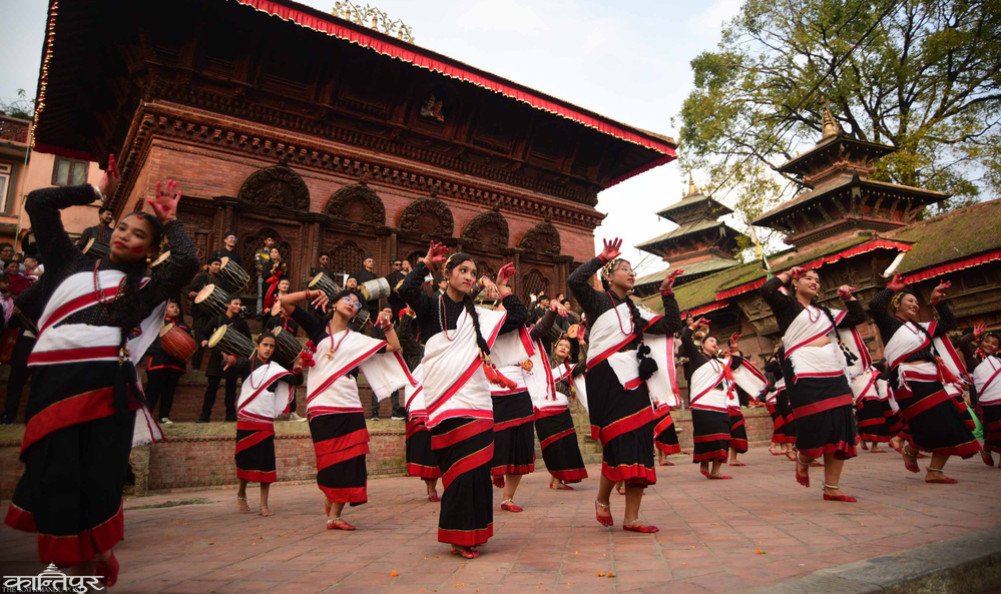
In the ancient Nepal Mandal, i.e. Kathmandu Valley, history is not just in books - it is alive in the turns of jatras, guthis and gallis. The collective memory of the Newar community has survived in the cultural cycle and guthis system. The movement against the Guthi Bill in 2019 was considered by some to be anti-development, but for the Newar community, it was a question of preserving living memory. Guthi is not just a social institution, it is a language of collective existence in which the celebrations of birth, death and life are all tied together. In Kyoto, Japan, the state protects traditions as tourist assets, while in Kathmandu, the community has to struggle with the state to preserve its own traditions. Here, ‘living heritage’ is not just heritage, but a means of resistance.
The collective memory of the Tharu community is deeply intertwined with the Kamaiya system. The practice has been legally abolished, but its pain lives on in memory in folk songs, stories and political speeches. Justice is not just about changing the law. It is also about giving pain a place in the national memory. The history of slavery in the United States has been made a part of museums, curricula and public debate. In Nepal, the memory of Kamaiya is mostly limited to NGO/INGO reports and regional movements. Until suffering is made into a national story, justice remains incomplete.
Describing the Far West as backward is not only an indicator of development, it is also a memory of collective humiliation. For the majority of its citizens, Singha Durbar is a distant, almost mythical structure. Employment means a ticket to India, development means a promise to come before the elections. This neglect is not accidental, it is a structural neglect that has been giving the same message for generations – your place is not at the center. This kind of continuous neglect also creates a memory that is not silent.
Memory does not survive only in serious debate. It also survives in ‘memes’, satire and social media comments. American political scientist James C. Scott has coined the concept of ‘hidden transcripts’, where suppressed voices are expressed symbolically rather than directly. In Nepal, many suppressed memories survive in the form of jokes and songs. This proves that when formal history does not give space to collective memory, informal culture preserves it for generations.
Nepal's problem is not a lack of memory. It is a one-sided mentality that denies or prohibits the plurality of memories. The idea that a single official story makes a nation strong is misleading. Rather, multiple stories, multiple memories, and dialogue between different identities make a nation resilient and just.
South Africa showed through its Truth and Reconciliation Commission that publicly acknowledging the wounds of the past does not weaken a nation, but rather makes it stronger. The phrase 'We are all Nepalis' can be used in two ways - to suppress different voices or to invite different memories to be heard. We need a perspective and understanding that includes the second meaning. The reason is that regional identity is not anti-national. It is a process of making a nation equally honest with its citizens.
All Nepalis should remember – history does not die when memory is suppressed. Rather, it comes back stronger. Only politics can create fear. And, politics based on fear can never build an inclusive nation. If we choose dialogue instead of silence in the name of unity, a multi-memory Nepal is possible. (Rijal is pursuing a master's degree in 'Political Communication' from Erfurt University in Germany.)