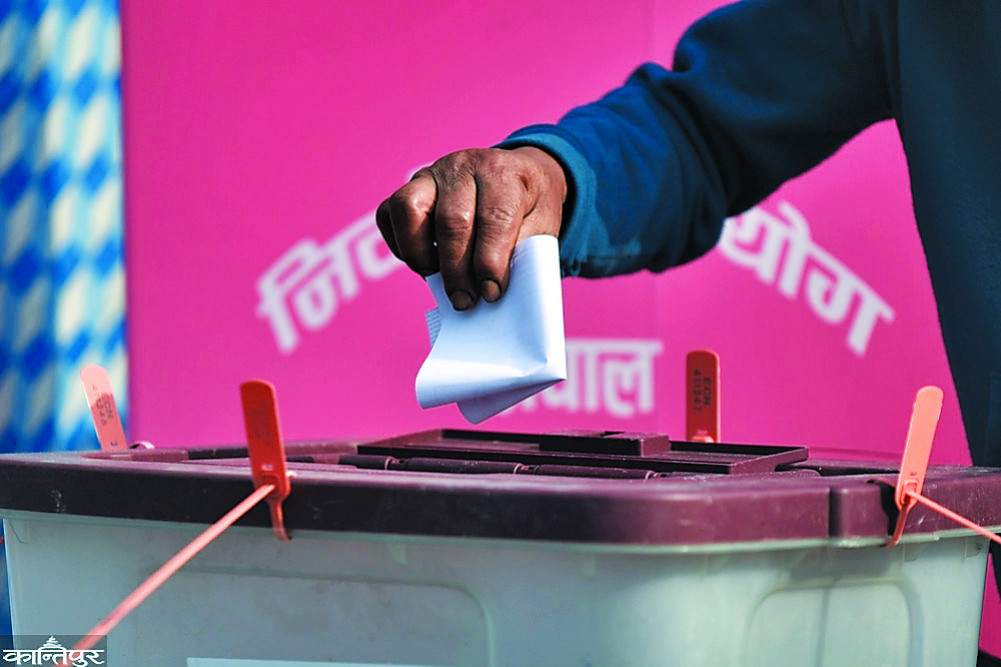
The question is not only who formed or will form the government after the election results, but also who will protect democracy. The role of representatives in protecting democracy is as important as the role of conscious citizens.
We use Google Cloud Translation Services. Google requires we provide the following disclaimer relating to use of this service:
This service may contain translations powered by Google. Google disclaims all warranties related to the translations, expressed or implied, including any warranties of accuracy, reliability, and any implied warranties of merchantability, fitness for a particular purpose, and noninfringement.
The general Nepali electorate celebrated the recently concluded elections in a festive manner. There were rallies, debates, and slogans. The media gave ample space to the candidates and voters. Waves of support and criticism were seen on social media.
Misinformation on social media has become a headache, but there was no shortage of creative content on social media. The wait is on after the vote – whose agenda will be established now?
Many may be interested in the political alliances that will develop with the election results, but the general public is interested – now they should be getting a return on their vote investment. Therefore, the role of democracy does not end with voting alone. Rather, the journey of civic responsibility begins from here. Now, not only those who do politics, but also those who vote must play a different role. This election, which was conducted at a government expense of nearly 19 billion, will certainly be accounted for in the coming days with proper questions and vigilance.
Voting is not just the process of choosing representatives, but the beginning of a campaign to warn and support their representatives. After investing their votes, all parties have a role to play in getting a good return on that investment. The responsibility of holding those in power accountable is not locked in the ballot box for five years, this responsibility is transferred to the voters. In a democracy, the power of voters should be manifested not only on election day, but even more so after the elections.
Trust in democracy is not built only by institutional structures, but also by the behavior of citizens. Maintaining trust in the system even if the candidate you support is defeated, and showing humility and inclusiveness by the winning party also strengthens democratic culture. Voting is not just a process, it is an investment by voters. Voters should be interested in its return.
The role of voters after the results
The role of voters in democracy does not end with reaching the polling station, it actually begins there. Voting is not just the exercise of rights, but also a declaration of consciousness. Therefore, voters should also self-evaluate their decisions after the results. For example: Did we vote based on policy or on emotion and influence?
Questioning the government is not only a civic responsibility, it is also a way to promote public debate and raise the level. When voters remain aware, restrained and continuously involved even after the election, then the governance process also matures and develops. Democracy is ultimately a system that is maintained not only by institutions, but also by the continuous interest, memory and moral determination of citizens. Otherwise, the role of voters is limited to making one party win and the other lose in the election.
Therefore, the real test of democracy is not on the day of voting, but in how aware and continuously active citizens are after voting. Therefore, it is important for voters to understand that the promises made in elections are not just for speeches. Manifestos, public commitments, and assurances in television debates are social contracts. If citizens do not remember those commitments, politics is limited to slogans. And, this cycle repeats in the next election.
In many democratic countries of the world, citizen groups, research institutions, and the media conduct 'commitment tracking' after elections. It is necessary to run such a campaign after this election in Nepal. Monitoring is necessary after being elected rather than evaluating at the outset of the election. After the representatives are elected, they must be accountable to the citizens.
Post-election need: conscious monitoring
The biggest risk in democracy is citizen silence after voting. Although voting itself is a great contribution to strengthening democracy. However, it should not be limited to a one-day celebration. If citizens remain silent for five years and express dissatisfaction only in the last year, then that is reactive politics, not constructive politics. After voting, voters should not only prepare for the next election. However, if the role of voters is limited to voting alone, it is not enough to strengthen democracy.
There are some important things that voters can do as conscious voters. If voters develop a culture of continuous questioning, politics will also become more serious, responsible and accountable. Even after the election, citizens should monitor the work of elected representatives, to what extent have the commitments they have made been fulfilled? It should be seriously evaluated.
And, if necessary, constructive criticism and suggestions should also be given. In addition, the habit of forming opinions should be developed only by checking the truth of misinformation spread through social media or other means. If voters develop a culture of continuous questioning, politics will also become more serious, responsible and accountable, and democracy will be stronger.
In democracy, various stakeholders, along with voters, should also play a vigilant role. Civil society organizations, research groups, local forums and the media should transform the election debate into a continuous policy debate. Voters need to be as active as they were before the election, even after the election. Otherwise, democracy will be limited to competition, not reform.
In addition, the role of stakeholders should not be limited to criticism; they should exert constructive pressure on elected representatives through fact-based evaluation, public reports, and regular dialogue. If a culture of monitoring manifesto commitments, reviewing implementation, and raising questions about the quality of public services with facts is developed, political competition can transform into policy competition. In this way, it is necessary to understand that civil society and the media are not just spectators, but are continuous guardians of democracy.
Remember, no matter which government is formed, every MP has made his or her pledge public. Whether your MP is from the ruling party or the opposition, his or her role as an MP must be assessed. Everyone must play a role in making the MP from their constituency a person to be questioned, warned, and thanked.
For example, if universities, research institutions, and youth groups start preparing fact-based ‘citizen reports,’ political commitment will not be limited to paper alone. If a culture of understanding monitoring as democratic cooperation rather than punishment is developed, democracy will remain alive, active, and accountable even after the results. Otherwise, periodic elections alone cannot strengthen democracy. It will be limited to the means of forming a government.
The way forward
After the election results, it is not only a question of who formed or will form the government, but also an important question of who preserved democracy. The role of representatives in preserving democracy is greater than the role of conscious citizens. Elections select representatives, but the work of keeping democracy alive is done by the continuous participation of citizens and relevant stakeholders. If voters consider their votes as agreements and demand an accounting of them, and if civil society starts monitoring based on facts, then democracy itself will be strengthened.
Forming a government is a process that depends on the arithmetic of the elected MPs. However, ensuring accountability by questioning those people's representatives is a great democratic culture in today's times. Therefore, the next five years are not only a test of the government, but also a test of our civic consciousness. Voting is not the final destination, it is the beginning of responsibility.
Parties form governments based on vote results. However, the participation of citizens in the next five years will build democracy. Voting is not the final destination, it is the beginning of responsibility. The change is not only in the working style of the people's representatives, but also in our questioning style.