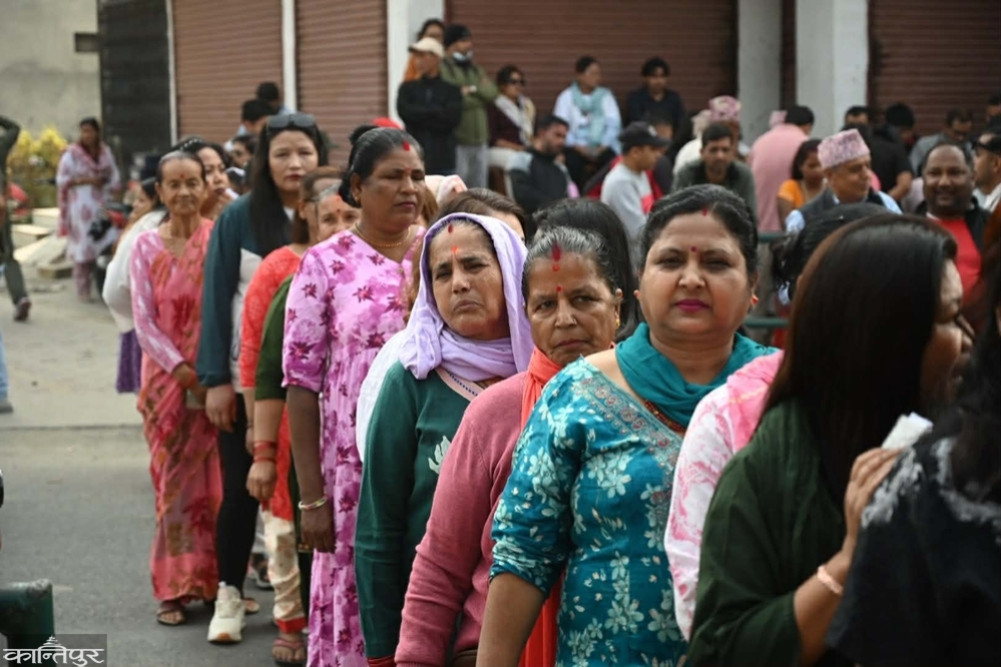
Nepal's democracy is now searching for answers - will the majority be the real beginning of change? Or will history once again remember it as the 'majority illusion'?
We use Google Cloud Translation Services. Google requires we provide the following disclaimer relating to use of this service:
This service may contain translations powered by Google. Google disclaims all warranties related to the translations, expressed or implied, including any warranties of accuracy, reliability, and any implied warranties of merchantability, fitness for a particular purpose, and noninfringement.
Majority: The basis of democracy
Nepal's latest election results have once again raised an old, but relevant question—is majority really hope or can it sometimes be an illusion?
The basic basis of democracy is the decision of the people. Citizens express their political will through elections. This process forms the government, sets policies, and determines the direction of the state.
Political philosopher Rousseau had placed the will of the people at the center of democracy for the collective good, warning that if public opinion is influenced by the emotions, anger, or propaganda of the moment, it can stray from the collective good. That is why, although a majority is necessary in democracy, quality is more important.
In the context of Nepal, decisions in elections are often made more based on emotional waves, party loyalty, and momentary dissatisfaction than on ideas and policies. Some voters also tend to vote without deeply understanding the qualifications, experience, or vision of the candidate. That is why sometimes the majority results in less of the long-term aspirations of the people and more of a momentary outburst of anger or hope. Therefore, in Nepal, a majority gives power, but political maturity is still needed to ensure stability and results.
Nepal's political experience
Nepal's modern political history is full of majorities' ups and downs. Looking at history, we can see that a majority gives power, but does not guarantee stability. The deeper reason for this is not only arithmetic politics, but also political culture, institutional maturity and leadership's approach. In Nepal, the reason for the collapse of governments many times is not only the power of the opposition, but also factionalism, individualism and short-term power struggles within the government. Therefore, a majority alone is not enough for stability - strong institutions, policy continuity and a shared commitment to the national interest are also essential.
Public dissatisfaction and new power
In recent years, dissatisfaction with the old parties in Nepali society has increased sharply. Corruption, unemployment, foreign migration, sluggish administration and political instability have created deep disappointment among the people. This dissatisfaction has made the emergence of new political alternatives possible. This time, new parties like the Rashtriya Swayamsevak Sangh (RSS) have received significant public support in the elections. This is not just the success of a party—it is also a clear indication of the mood of the people.
However, there is a ‘spicy’ reality here – the emergence of new parties in Nepal is often driven by a wave of hope, but the ability to sustain that wave becomes a test.
People disappointed with the old parties have voted for new faces as symbols of change. However, politics is not run by ideals and slogans alone – state governance capacity, depth of policy-making and institutional maturity are also required. The biggest challenge for the new forces is this – are they just the result of dissatisfaction, or are they really an alternative to a solution?
If the new forces are to succeed in ruling effectively for five years, then economic reform, administrative capacity, transparency and long-term policies are essential. Because people’s hopes do not last long with empty slogans. Ultimately, politics comes back to this truth – it is easy to raise slogans for change, but institutionalizing change is the most difficult.
Balance between hope and illusion
Nepal's democracy is now at a new juncture. The old parties must face many challenges to restore credibility. The new parties have raised hopes for change, but those hopes are not something that can be easily fulfilled as if they were waved with a magic wand and said, "Open up, Simsim." Efforts are essential, because in a two-thirds government, there is no excuse or excuse that "others did not allow it." However, this election also showed another harsh truth - many voters still have a strong tendency to vote on impulse, slogans, and momentary emotions without considering the candidate's ability, vision, or character. In some places, voters, without understanding who the candidate is, what he does, or what his past is like, cast their votes based solely on the party symbol, the enthusiasm of the crowd, or rumors on social media. In a democracy, the people's vote is supreme, but sometimes an unwise vote does not produce a prudent government. Voting is not only a right, but also a responsibility. Therefore, winning an election is not the final success. Whoever gets the vote should also remember – that vote is not just support, but a debt of trust from the people.
History gives a clear message – a majority is neither a complete hope nor a complete illusion. It is only an opportunity. If that opportunity can be converted into results, then a majority becomes a hope. Otherwise, it will once again turn into a political illusion.
Nepal's democracy is currently searching for an answer to this question – will the majority be the real beginning of change, or will history once again remember it as the 'illusion of the majority'?