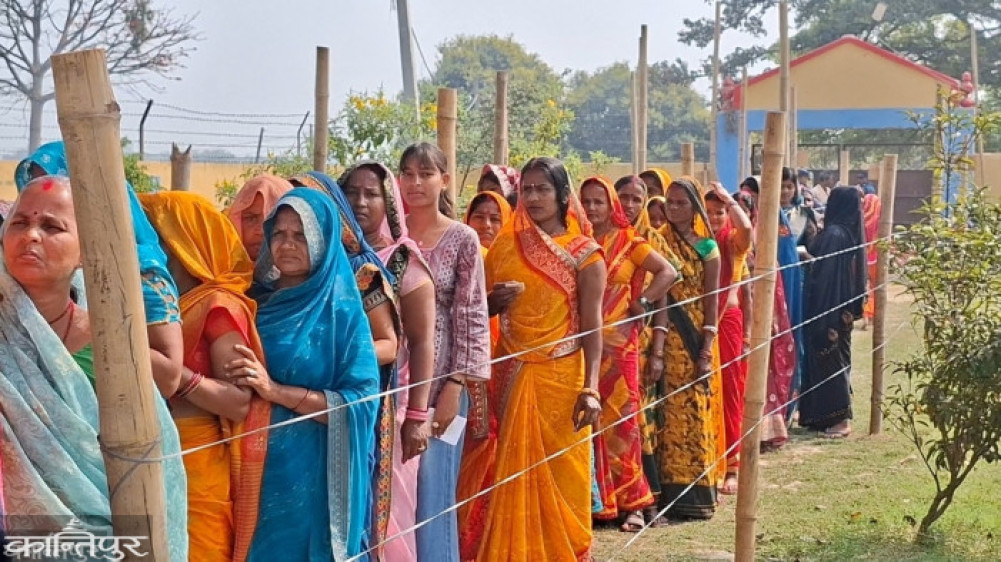
Although the Falgun 21 election was unexpected, it was the third periodic election since the 2072 constitution and the largest in terms of voter turnout. This was the largest number of new voters registered to vote for the first time in history.
We use Google Cloud Translation Services. Google requires we provide the following disclaimer relating to use of this service:
This service may contain translations powered by Google. Google disclaims all warranties related to the translations, expressed or implied, including any warranties of accuracy, reliability, and any implied warranties of merchantability, fitness for a particular purpose, and noninfringement.
The election to the House of Representatives held on Falgun 21 has attracted widespread national and international attention. Perhaps the most international media attention since the 2062 People's Movement, the overthrow of King Birendra's dynasty, and the Great Earthquake, the Falgun 21 election received continuous coverage from major media outlets around the world. Despite political instability, economic challenges, inflation, unemployment, and youth revolts due to youth discontent, it is no small achievement that the election was held peacefully, free, fair, and credible.
This time, 19,77,711 votes were cast out of a total of 18,93,678 eligible voters. Provincially, the highest voter turnout was 60.93 percent in Bagmati Province, 59.91 percent in Lumbini, about 59 percent in Gandaki, 58.62 percent in Koshi, 58.39 percent in Madhesh, 58.58 percent in Sudurpaschim, and the lowest 55.66 percent in Karnali.
According to the data released by the Election Commission, the voter turnout this time, which is about 58 percent, is not satisfactory in terms of the quality of the election. This figure is slightly lower than the 61.63 percent of the previous 2079 election and is one of the lowest since 2048. This has sparked a serious constitutional, political, and social debate, ‘Has the Nepali people become deeply disillusioned and disappointed with politics and the democratic process?’ This is the topic this article seeks to analyze.
Although the Falgun 21 election was unexpected, it is the third periodic election after the constitution promulgated in 2072 and the largest in terms of the number of voters. This was the largest number of new voters registered to vote for the first time in history. Since federalism has been implemented in the country for only ten years, each such periodic election is considered an important link in institutionalizing the federal democratic republic. The more clean and fearless the election, the stronger, more mature and consolidated democracy becomes.
It is a pleasant matter that the relatively balanced manifestos of the major parties have come out this time. From a general observation alone, it can be said that some parties have achieved positive achievements in this election. Although the expenditure at the state level has increased significantly this time, the election expenditure of the candidates or parties was seen to be less than in the previous elections. Digital materials were used more in the election campaign. In terms of security, this election was excellent. The best part is that the unnatural alliance between the parties was only in name this time.
Despite all this, there were signs on the voting day that the voters were confused somewhere between the emergence of new forces and the disillusionment with the old parties. And, for the first time in history, only 58 percent of the votes were cast. This is not a happy thing in itself in terms of the effectiveness and quality of the election.
Nepal's electoral history and voting 'trend'
If we look at Nepal's electoral history, although the voter turnout has always fluctuated, there was no such apathy as in the recent elections. The data of the main elections after the restoration of democracy, i.e. 2048, is available in the chart included in this article.
The highest voter turnout in Nepal's electoral history was recorded in the second Constituent Assembly election held on 4 Mangsir 2070. According to the Election Commission, 78.34 percent of the total 12.147 million voters cast their votes. This percentage is the highest ever in any parliamentary or Constituent Assembly election in Nepal.
The failure of the first Constituent Assembly shows that the people had blamed the political parties. At the public level, they thought that if they failed again, the country would face another crisis, and the people saw voting as an opportunity to save the constitution. The Carter Center and Enfrel, internationally renowned election observers, also declared this high turnout as evidence of the people's "trust and will in the constitutional process" and asserted international legitimacy.
8 reasons for the decline in voter turnout
The factual reasons behind the low turnout this time can be assessed as follows. First, this election was an unexpected and unplanned election. For this type of unexpected election, relatively few people who had left their jobs or businesses and migrated within the country or originally went to India returned to vote. And, the turnout was low.
Second, the frequent changes of government. Parties abandoning their principles and forming alliances for power and the failure to solve the basic problems of the people (such as inflation and unemployment) may have developed a feeling among voters that "it's the same no matter who wins." Due to this, voters did not want to go to the polling station on election day.
Third, the Election Commission has encouraged new voters to register, and compared to the way it encouraged them to register, it can be confirmed that the total number of voters is not as high as it is now due to the fact that the records of voters who have died or have left their homes and migrated abroad permanently have not been updated. It can be estimated that some names have been registered twice.
Fourth, it is said that about 40 to 50 million Nepali youth are outside the country. Due to the lack of a system of 'proxy voting' or 'online voting' for them, it is common for a large number of people not to vote. It is natural that this number will increase as the number of young people going abroad increases.
Fifth, the Election Commission has not invested enough and made enough efforts in voter education this time. And, compared to the support provided by development partners in voter education in the previous elections, it seems that the lack of support this time has not brought voters to the polling stations.
Sixth, for those living in big cities like Kathmandu, Pokhara and Biratnagar or similar cities but who are registered voters in villages, this unexpected election made it expensive to go to vote. Or, they may have been reluctant to go. And, even though the government made it easier by giving its employees more leave, people working in the private sector did not get that facility. That is why they were also unable to return to their villages to vote and few votes were cast.
Seventh, the Constitution of Nepal, 2072, provides a provision to ensure the right to vote for all Nepali citizens. On 7 Chaitra 2074, the Supreme Court had also ordered the government to grant the right to vote to citizens living abroad by making necessary legal and procedural arrangements. Although the government had held a series of debates on granting the right to vote to citizens living abroad, this decision was not implemented even in the 21 Falgun elections that were announced due to the lack of necessary legal and administrative preparations. And, unless this arrangement is made, the voting percentage is certain to continue to decline in the coming days.
Eighth, the fact that people living in the northern part of the Himalayan districts were unable to return to their villages to vote due to snowfall in the third week of Falgun also reduced the turnout to some extent.
The question of validity: Theoretical and legal aspects
The question of what percentage of votes is considered valid for an election is often asked. In a democracy, there is no specific minimum percentage of votes for the validity of an election. Even if only a normal percentage of votes are cast, the election is technically considered valid. However, for political and moral legitimacy, a turnout of more than 50 percent is considered satisfactory. Along with this, when talking about the quality of an election, there is also a practice of looking at the percentage of votes in the previous elections of that country as a baseline.
In international practice, if the percentage of votes is very low, it is considered a 'silent protest'. This indicates that the elected representatives do not have full support from the people. The election held by the king in 2062 can be taken as an example of this. The 58 percent turnout in the 21 Falgun 2082 election is not a situation that should be viewed as a cause for concern. However, the continuous decline in the turnout is a serious issue.
Situation of other countries in the global scenario
Nepal is not alone in the question of turnout. Let us look at the average turnout of various countries in the world. In Denmark, which is always considered excellent in the Democracy Index, the turnout is usually between 80 percent and 85 percent. Since it is considered a mature democracy and the political awareness among the people is high, the people participate in the elections with enthusiasm.
Looking at the example of our neighboring country India, it is also clear that the average turnout in recent elections has been above 67 percent. 'Digital India' and widespread voter awareness seem to have increased this. In the 2024 US presidential election, 65.3 percent voted. Minnesota had the highest turnout of 76 percent and Hawaii only 50 percent. Switzerland, which has the lowest turnout, only 40-45 percent voted. Perhaps voters may have developed 'voting fatigue' because referendums or elections are always held on small issues in Switzerland.
Australia is an interesting country when it comes to elections and voter participation. Since there is a system of 'compulsory voting' there, the voter turnout is above 90 percent. Similarly, in countries with conflict or political instability (Algeria, Tunisia and Haiti), this percentage is limited to 20-30.
Ways to improve in the coming days
The current vote percentage is only a warning to us. This warning should wake up our parties and state machinery. It is imperative to do the following to increase participation in the upcoming elections:
Voting rights for Nepalis living abroad: As per the order of the Supreme Court, arrangements should be made for Nepalis living abroad to vote online or through postal methods. This is not only the intention of the youth movement of last Bhadra, but also the demand of millions of diaspora. Nepal should also make an action plan that can start this only with the proportional vote of the upcoming provincial assembly in 2084. This can be expected from the next government.
Inter-district voting system: Currently, only employees or security personnel involved in the election are allowed to vote in proportional representation, and there is no provision for millions of other voters who are within the country for profession, business, and study and cannot go to their polling stations to vote inter-district. In such a situation, there is no need for major preparation or expenditure to start 'anywhere voting' (voting from wherever you are) in the upcoming elections.
Compulsory voting debate: Like in some countries, a debate can be held on imposing a general fine or tightening government facilities for those who do not vote.
Right to reject or no vote: Taking the situation of silent rebellion by boycotting the election at some polling stations in the Falgun 21 election as normal is not good for the people. For this, the state machinery can move forward by understanding the reason for the rebellion with them. However, if the right to vote 'no' is given if the candidate is not liked, voter participation will definitely increase. And, pressure will be put on the parties to field good candidates. Which will increase the overall number of votes.
Political reform: The most important issue is that parties should work to improve the living standards of the people. Until the people believe that 'their vote changes their lives', their enthusiasm will not return.
Effective voter and mandatory civic education: It is not enough to place a voter volunteer in a municipality after the election is announced or to sing an awareness song on some radio or TV. For this, the importance of civic education in the overall development of voting and strengthening democracy should be kept in the form of curriculum related to democracy or elections in schools and colleges. If this is done, voter participation in voting will increase.
Party activity in elections: Political parties claim from time to time that millions of members are affiliated with their party. And, if party members are active in voter education, rather than just taking voters to the center in training programs held in political parties, voter participation in elections can increase sustainably.
स्थानीय सरकारको संलग्नता : हालको हाम्रो निर्वाचन प्रक्रियामा स्थानीय सरकारको संलग्नता वा सहभागिता कहीँ कतै देखिँदैन । आगामी दिनमा पालिकाहरूमा एउटा निर्वाचनसम्बन्धी कार्य, नयाँ मतदाताको नामावली दर्ता, मृतक वा बसाइँ सरेकाहरूको डेटा अद्यावधिक र मतदाता शिक्षालाई पालिकाहरूबाट दिइने हर क्षमता अभिवृद्धिका कार्यक्रमहरूमा समावेश गर्नुपर्छ । यसो गर्दै जाने हो भने दीर्घकालमा ७७ जिल्लामा रहेका निर्वाचन आयोगका जिल्ला कार्यालयको औचित्य पनि समाप्त हुन्छ । यसले लागत प्रभावकारिता मात्रै नगराई निर्वाचनमा सहभागिता पनि बढाउँछ । र, संघीयताको मूल मर्म पनि त्यही नै हो ।
निष्कर्ष
निर्वाचन केवल ‘टिक अन बक्स’ गर्नु वा प्रक्रिया पूरा गर्नु मात्रै होइन । निर्वाचन खासमा लोकतन्त्रको एक महान् चाड र उत्सव हो । मतदानका दिन बिस्तारै ओह्रालो लाग्दै गरेको मतदाताहरूको उपस्थितिले हाम्रो लोकतन्त्र कतै ‘थकित’ हुँदै गएको त होइन भन्ने विषयमाथि गम्भीर संकेत गर्छ । मतदाताहरूको उपस्थिति घट्नु भनेको जनताको दलहरूप्रतिको अविश्वासको एउटा सूक्ष्म सूचक पनि हो । राज्य संयन्त्र वा निर्वाचन आयोग वा राजनीतिक दलहरूले समयमै सुधारका कदम चाल्न सकेनन् भने यसले व्यवस्थामाथि नै प्रश्न उठाउन सक्छ । तसर्थ, राज्य र राजनीतिक दलहरूले यसलाई गम्भीर चेतावनीका रूपमा लिनु आवश्यक छ । र, अब हाम्रो लोकतन्त्र थकित भएको छैन भनेर सबैलाई सन्देश दिन ढिलो गर्नु हुन्न ।