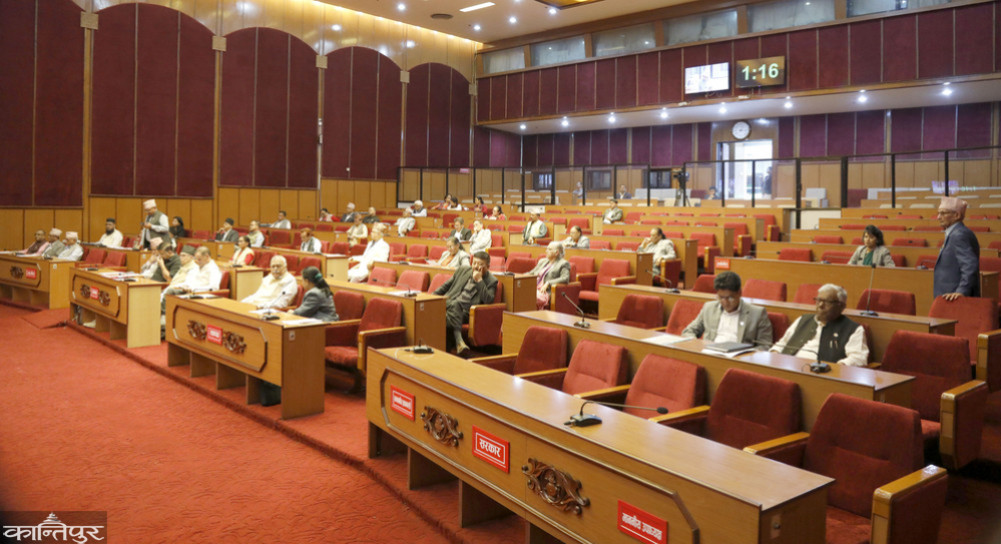
Dialogue, coordination, and cooperation on important political issues, including a roadmap for constitutional reform, are indispensable between the new forces approved by the general election and the traditional forces that retain dominance in the National Assembly.
We use Google Cloud Translation Services. Google requires we provide the following disclaimer relating to use of this service:
This service may contain translations powered by Google. Google disclaims all warranties related to the translations, expressed or implied, including any warranties of accuracy, reliability, and any implied warranties of merchantability, fitness for a particular purpose, and noninfringement.
The National Independent Party has achieved an extraordinary victory in the general election, defeating the traditional mainstream political forces UML, Congress and NCP.
Even in the absence of a strong opposition in the House of Representatives, the presence of the ruling party in the entire National Assembly is zero. Such a unique situation has probably never been created anywhere in the world in a bicameral legislature.
The RSVP can be represented in the National Assembly only through the elections for the 19 seats that will be vacant from Falgun 2084. Therefore, for the time being, dialogue, coordination and cooperation on important political issues, including a roadmap for constitutional reform, are indispensable between the new forces approved by the general election and the traditional forces that have maintained their dominance in the National Assembly. The House of Representatives is much more powerful than the National Assembly in the process of making laws and passing the budget.
Even if the National Assembly rejects ordinary bills and budgets originating in the House of Representatives, the House of Representatives can re-pass and implement them. In such a situation, the President's authority is limited to the extent of being able to return them for reconsideration once. The Head of State does not have the privilege to block a bill sent a second time. But in the context of constitutional amendment, two-thirds of both houses are required.
In the heat of the House of Representatives election, the other house of the federal parliament, the National Assembly, has been overshadowed. Coincidentally, the term of the 18 members elected on 11th Magh for the members of the National Assembly is supposed to start on 21st Falgun, but the oath-taking is only being held on Monday (25th Falgun) due to a long public holiday.
Out of the 19 members who left the assembly after completing their 6-year term on 20th Falgun, the election was held on 11th Falgun itself. In the National Assembly, which is a permanent house, the term of one-third of the members expires every two years. Thus, in accordance with the legal provision that a new election must be held at least 35 days before the vacancy occurs, the new 18 members were elected.
The remaining one seat will be nominated by the President on the recommendation of the Council of Ministers. The National Assembly is a permanent house of the federal parliament, with 56 members representing different ‘clusters’ at the rate of eight from seven provinces and three nominated by the President, including at least one woman. This does not allow the people's representative institution to go to zero even when the House of Representatives is dissolved for periodic elections.
The election of members of the House of Representatives on 21 Falgun is not a regular periodic election but a product of the extraordinary situation that arose in the country due to the 'Gen-G' uprising on 23 and 24 Bhadra. Although the Supreme Court has the jurisdiction to resolve constitutional and legal disputes arising from issues such as the electoral government formed outside the House of Representatives, the dissolution of the House of Representatives on its recommendation, and the announcement of the date for new elections, the National Assembly should have had a serious discussion on the political crisis, public aspirations, and all issues of public concern arising from this. In the meantime, the National Assembly session held for a short time has missed that historic opportunity.
An opportunity reduced to formality
The National Assembly could have started an important discussion from the beginning on the political confusion after the Gen-G uprising, the uncertainty seen in the initial days about the announced general elections, and the pressing questions raised from various angles on good governance and constitutional reform. In such difficult times, if the National Assembly could have worked in a way that established that the absence of the House of Representatives is not the absence of a parliament, it would not only have confirmed the legitimacy of the upper house, but would have made a tangible contribution to the strengthening of the democratic system.
In an article published in the Kantipur National Daily on December 1, I have also discussed that the National Assembly had a unique opportunity to prepare a roadmap for constitutional reforms to be carried out in the near future, not only on the issues of ensuring elections, peace and security, good governance and public concern.
In neighboring Bangladesh, a referendum held on February 12, 2026, along with the parliamentary elections, has passed a roadmap for constitutional reform. After the student movement ousted the then Prime Minister Sheikh Hasina-led government 16 months ago, the interim government led by Nobel laureate Mohammad Yunus in Bangladesh has provided a way out for the country through elections. Bangladesh, which has suffered from two decades of elected dictatorship, has received public approval for the roadmap for constitutional amendments prepared before the elections to prevent a recurrence of autocracy.
It has been a decade since the constitution issued by the Constituent Assembly was implemented in Nepal. There have been calls for constitutional amendment on many issues such as reform of the electoral system, restructuring of the Constitutional Council, reduction of the number of constitutional officers and people's representatives who are not up to the task. There are issues mentioned in the constitution itself regarding certain provisions that need to be reviewed in a decade, including the appropriateness of various constitutional commissions. A roadmap for constitutional amendment could have been prepared before the elections to the House of Representatives by holding serious discussions on all such issues in the National Assembly.
It would have been wise for the parties to go to the people with their own perspectives and stances even on issues where there is no general consensus. But unfortunately, the 19th session of the National Assembly, which was held for a short period in the absence of the House of Representatives, did not proceed in that direction. There was no constitutional or legal obstacle to holding such discussions through a special resolution by the Assembly itself or forming a special committee to study the overall problems seen in the implementation of the constitution. But due to lack of political will, the Assembly did not take any such special initiative.
The resolutions, urgent public importance or attention-calling motions mentioned in the rules of the House are a parliamentary tool available to every MP not only to make the House effective, but also to guide the entire country in times of crisis and to convey hope. Like Hanuman in the mythological story Ramayana, whether it is because he did not know his power or because of lack of willpower, the entire House has been seen to be averse to the historical responsibility it has received. During the 1977 Emergency and the dissolution of the Lok Sabha in neighboring India, the Rajya Sabha did not enter into regular legislative matters.
Instead, it had made a significant contribution to constitutional reform by discussing important issues such as the state of emergency, civil rights, and freedom of the press. The National Assembly also had a historic opportunity to make a new political resolution along with a roadmap for constitutional reform through meaningful and open discussions with the youth of the Gen-G and Gen-Alpha age groups. Such an initiative would have made it easier to find a way out of the political deadlock from the Parliament after the general election, even if the balance of power in the House of Representatives was different from that of the National Assembly, and the Upper House would have been morally stronger.
In the absence of the House of Representatives, the National Assembly alone could not complete any legislative cycle. Clause-wise discussions on ordinary bills and ordinary meetings of committees do not confirm the legitimacy of the National Assembly in times of political crisis and transition. Therefore, the bills submitted and passed in the session are not the work of the Assembly in the long term but are mere formalities.
It is natural that the common people are not concerned about the session of the Assembly, which is limited to its six-year term with a convoluted farewell speech. The responsibility of making the House attractive and effective in all circumstances lies with the leadership of the Assembly, the concerned political parties, the leaders of the three, the chief whip, the chairman, members and the secretariat. Everyone concerned should take responsibility for the situation where the session ends without entering into the main subject during a national crisis.
Lack of commitment
To what extent are the leaders of the political parties and the three towards the essence, dignity and legitimacy of the National Assembly, they did not even consider it necessary to issue a manifesto for the National Assembly member elections on 11 Magh. The National Assembly, which is a symbol of federalism, represents the provinces and local levels.
Members of provincial assemblies, mayors/deputy mayors of municipalities, and chairpersons/deputy chairpersons of rural municipalities are members of the electoral college that elects the National Assembly. Such behavior displayed by candidates seeking to be elected to the prestigious post of the National Assembly for a period of 6 years and the parties nominating such candidates has raised questions about the need and justification for the upper house in a federal system that is still in the process of being institutionalized.
The parties fielding candidates in the National Assembly election campaign did not even consider the need for any consultation with the people's representatives at the provincial and local levels about the political, economic-social crisis that has arisen in the country, the challenges that have emerged in the implementation of the constitution, and the initiatives that they should take to resolve it. In a party system, it is natural for people's representatives elected at the provincial and local levels to have party affiliations.
But if they are not allowed to exercise any discretion in secret voting or not, it is alleged that this is not a democratic election but a farce. A compelling situation has arisen where the candidates who have not even made public their formal views and perspectives on key issues of public concern and national interest, if they are given the responsibility of a member of the sovereign parliament, have to consider the selection made by the elected members of the electoral college as ‘prudent’.
Since even civil society did not raise any questions on such a serious issue, the parties and their candidates had started campaigning without a manifesto in the House of Representatives elections. Political parties including the Rashtriya Swayamsevak Sangh (RSS), Nepali Congress, and UML, which claimed to be the largest party in the election and to have a single majority, had not made their formal documents public within the time limit set by the Election Commission. Even though the parties made their manifestos public in the form of pledges, resolutions, and commitments very late, there was no public discussion on their substantive issues.
Ethical questions
In a bicameral legislature, the upper house is called the assembly of the mature. The Senate of the United States, the House of Lords of the United Kingdom, and the Rajya Sabha of neighboring India are examples of this.
Our National Assembly is different and original in terms of its electoral system and jurisdiction. However, since the promulgation of the constitution by the people-elected Constituent Assembly, none of the five elections for members of the National Assembly have generally sent representatives who confirm its legitimacy. Based on the experience of the Constituent Assembly and the transitional system before it, it has been strictly prohibited for a person who loses in the election for a member of the House of Representatives to be a minister for the duration of that term of the House.
The constitutional arrangement in which the Prime Minister with the majority in the House of Representatives and the members of the Council of Ministers are members of the Federal Parliament, leaves the door open for an expert person from outside the Parliament to become a minister for six months. In order to prevent such a special arrangement from being misused, the Constitution itself has also made a restrictive provision that a person who becomes a minister from outside the Parliament cannot be appointed a minister again during that term of the House of Representatives unless he becomes a member of the Parliament within six months.
Such a restrictive provision cannot be considered as giving a moral exemption to a person who loses in the general election to enter the National Assembly with the aspiration of becoming a minister during that term of the House of Representatives. However, the major political parties have misused the National Assembly as a place to manage leaders who have been defeated at the local level and those who have not been able to win the House of Representatives elections. It is necessary to find a guarantee now that this will not happen again in the elections for one-third of the National Assembly seats in the next two years.
Finally,
There are theoretical and practical disputes all over the world about the need and justification of the Upper House. The justification of the Second House is questioned due to the duplication of legislative work between the two houses, resources, manpower and time. Second houses around the world continue to face the difficulties of insulting public opinion when rejecting the decisions of the directly elected House of Representatives, and constantly questioning their justification when accepting them as they are.
In the case of Nepal, more practical questions have been raised about the justification of the Upper House than theoretical ones. No serious review could be conducted before this National Assembly election regarding the effectiveness of the House and the criticisms made about the background, qualifications and public statements of the representatives sent by the parties. केवल सिट संख्याको दाउपेजमा रुमलिएका दलहरूलाई प्रतिनिधिसभा निर्वाचनको माहोलमा सायद राष्ट्रिय सभाको प्रभावकारिताबारे सोच्ने फुर्सद पनि उपलब्ध भएन ।
जुनसुकै दलका तर्फबाट उम्मेदवार भए पनि जननिर्वाचित निर्वाचक मण्डलबाट चुनिएका कारण राष्ट्रिय सभाका सदस्यहरू सबैका साझा हुन् । किन र केका लागि माथिल्लो सदनको सदस्य हुने भन्ने सार्वजनिक प्रतिबद्धताबिना नै चुनिएको भए पनि नवनिर्वाचित सदस्यहरूलाई विगतको गल्ती दोहोर्याउने छुट छैन । निर्वाचित भइसकेपछि उहाँहरूले संविधान र नागरिकप्रति उत्तरदायी हुने नयाँ संकल्प गर्नु आवश्यक छ । सभाका सदस्यहरूले आफ्नो भूमिका प्रभावकारी बनाउन सक्दा मात्रै माथिल्लो सदनको गरिमा बढ्छ ।
आज पनि धेरैले माथिल्लो सदनबाट प्रतिनिधिसभामा हुने सक्ने आवेग र उत्तेजनालाई सन्तुलनमा ल्याउने परिपक्व भूमिकाको अपेक्षा गरेका छन् । तर प्रतिनिधिसभा निर्वाचनमा अभिव्यक्त जनमत र परिवर्तनको चाहनालाई संस्थागत गर्न सघाउनु राष्ट्रिय सभाको कर्तव्य हो । उसले प्रतिनिधिसभाका निर्णयलाई अस्वीकार गर्दा जनमतको अपमान हुने, जस्ताको तस्तै स्वीकार गर्दा आफ्नो औचित्यमा प्रश्न उठ्ने दुई धारको तरबारबीच अब राष्ट्रिय सभाले आफ्नो औचित्य पुनर्पुष्टि गर्न सक्नुपर्छ ।