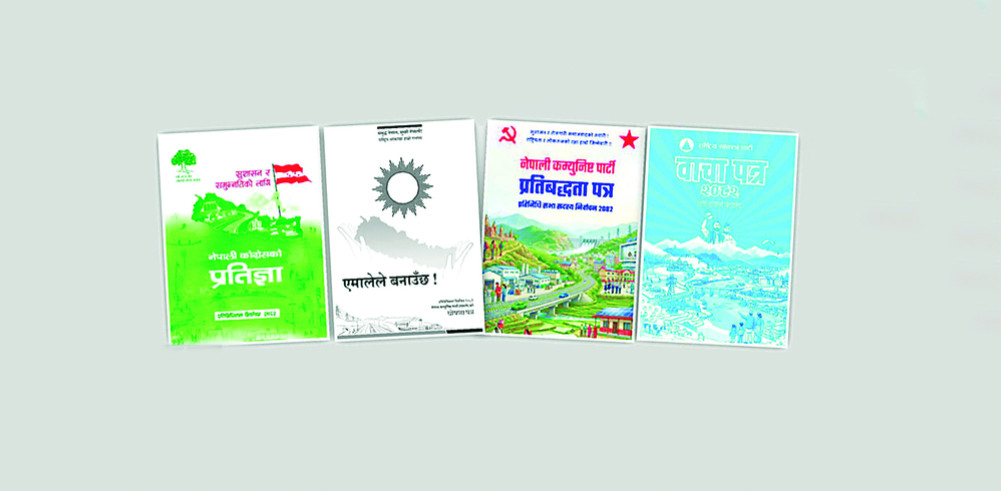
All the parties have made their election manifestos public. Have we read the manifestos of the parties? How much has been written about the issues of the poor, Dalits, marginalized, women, landless farmers, and workers? What efforts have the parties made in the past to implement the issues written? Let us review and read the manifestos of the parties.
We use Google Cloud Translation Services. Google requires we provide the following disclaimer relating to use of this service:
This service may contain translations powered by Google. Google disclaims all warranties related to the translations, expressed or implied, including any warranties of accuracy, reliability, and any implied warranties of merchantability, fitness for a particular purpose, and noninfringement.
From tea shops to social media, from home courtyards to squares and squares, there is talk of elections. In a democracy, elections are not just a process of choosing representatives, but also an opportunity for political discussion. And, it is also a generational transfer of leadership. It is an opportunity to get to know the party, leaders, and people, to get to know each other, to think, discuss, debate, and reflect on social development, and to listen to the commitments of representatives. And, in fact, it is an opportunity to choose a good ruler.
Looking at the recent political movements, the behavior of political parties, the statements of some candidates and the style of their supporters, it indicates that we are not moving towards positive thoughts, discussions and debates. This has also raised doubts that we are not moving in the right direction. It has raised some serious questions in the democratic system and practice. Therefore, there is a fear that we will fail to choose good rulers.
Democracy did not come about, it is the result of past sacrifices and struggles. But, how much has changed in the lives of citizens? How much good governance and transparency have come to the government and leadership? How accountable have they become? How effective is service delivery? What is the status of the implementation of the policies made? These are all questions that citizens are raising. In general, there are still deep problems in all these areas. And, there are many questions. We have heard many times that corruption has ruined the country. Is it because we have not been able to choose good rulers for all this to happen?
The Nepali people have many problems. Although some laws have been made, the implementation is weak. Integrity and responsibility in the leadership implementing policies are weak. In election speeches, citizens are at the center, but in practice, it is the opposite. Power and position become strong and they are ready to do anything to maintain them. This is a scenario that has been repeated for years and is causing suffering to the people. Now this must change.
It would be easy to say that the only reason for this irony is the leaders, but it is not enough. In a democracy, citizens should be strong. However, here the citizens are seen as helpless and weak. Their own rights have been taken away. The representatives they elected and sent are not honest with the people. The people are not able to raise questions.
Because we did not ask questions, because we did not answer questions when they arose, and because we isolated those who raised questions, the problem became institutionalized. The culture of questioning weakened. The tendency to consider criticism as hostility increased. As a result, power became unbalanced and citizens were gradually made innocent. The courage of those who asked questions decreased and the accountability of those who had to answer decreased.
The time is of social media and fan followers. A new trend has started where those with many fan followers are seen as strong and powerful. Those who ask questions are being criticized. The tendency to consider criticism as hostility is increasing. In fact, the courage of those who question the system, policy, and leadership is weakening. The accountability of those who have to answer is decreasing.
It remains to be seen what the results of the elections that are going to be held unexpectedly (due to movements) instead of regularly, will be. Nevertheless, this time's elections have been called a competition between the new and the old. The old did not work, so the new is necessary - this argument has attracted many. However, the question arises - is really new only age, face, and party name? Or should thinking, style, and culture also be new? Let's hope - along with the names and faces of the new, the thinking, style, and behavior should also be new. Let us feel the newness through change and work.
It is not that all the new ones are automatically clean and capable. It is worrying that old customs are seen in some new faces. Protests, abuses, personal attacks, provocations on social media and emotional slogans alone will not do anything. If the style is old, how will the result be different if only the character changes? How will he move the country forward on the path of prosperity? That is why the people are looking for a good ruler, a good representative and a good guardian.
The most worrying aspect in politics is the tendency to worship personality. The culture of seeing a leader not only as a leader but as a god is not a democratic culture. The current situation is such that a certain leader is kept above the circle of questions and if someone dares to question him, he is completely suppressed. Where there is suppression of questions, accountability certainly dies there and heroism begins. That is a threat to democracy.
Those who say that the system has deteriorated because they did not question the leader cannot ask legitimate questions about their favorite leader today. They cannot tolerate anyone raising questions. They call criticism a conspiracy, and the voice of disagreement treason. Such a culture does not create good governance, but blind devotion. There are some groups who enjoy person worship.
In a democracy, a leader should be a representative of the people. He should have a passion for serving the people. He should be ready to answer every question raised from the ground. Questions make him mature for leadership. And, one thing that should not be forgotten is that every person has the right to ask questions to his representative. Not only that, they also have the right to choose their representative.
Voting in elections is a decision of conscience and secret balloting is the soul of democracy. This is not just a right, it is the responsibility of the citizen towards the country. Because each and every vote of the people plays a decisive role in choosing a good representative.
By now, everyone has made their election manifestos public. Have we read the manifestos of the parties? How much has been written about the issues of the poor, Dalits, marginalized, women, landless farmers, and workers? What efforts had the parties made in the past to implement the issues written? Let us review them. Let us also study and review the pledges brought by the new parties. Let us also study how much the people's issues were covered there and what kind of commitment they have made to implement their issues. The selection of representatives should not be based on the influence of social media. It is a decision made based on facts, conscience, and fair evaluation.
What we want is good conditions, not bad conditions. What we want is good governance, not misgovernance. What we want is development, not perversion. What we want is leadership, not leadership. The country we want is not built by speech, but by culture. It is not built by abuse, but by ideas. It is not built by words, but by actions. It is not built by blind support, but by the responsibility of conscious citizens. The responsibility of strengthening democracy does not only belong to the party or leader, but also to us, the citizens.
Perhaps the biggest decision in this election is not only choosing a candidate, but also deciding what kind of citizen we will become.