Some people feel that going to the polls with a prime minister already selected is incompatible with the parliamentary system. In this system, MPs are elected from different constituencies. Based on that, it is determined which party wins and whether or not it gets a majority in parliament.
We use Google Cloud Translation Services. Google requires we provide the following disclaimer relating to use of this service:
This service may contain translations powered by Google. Google disclaims all warranties related to the translations, expressed or implied, including any warranties of accuracy, reliability, and any implied warranties of merchantability, fitness for a particular purpose, and noninfringement.
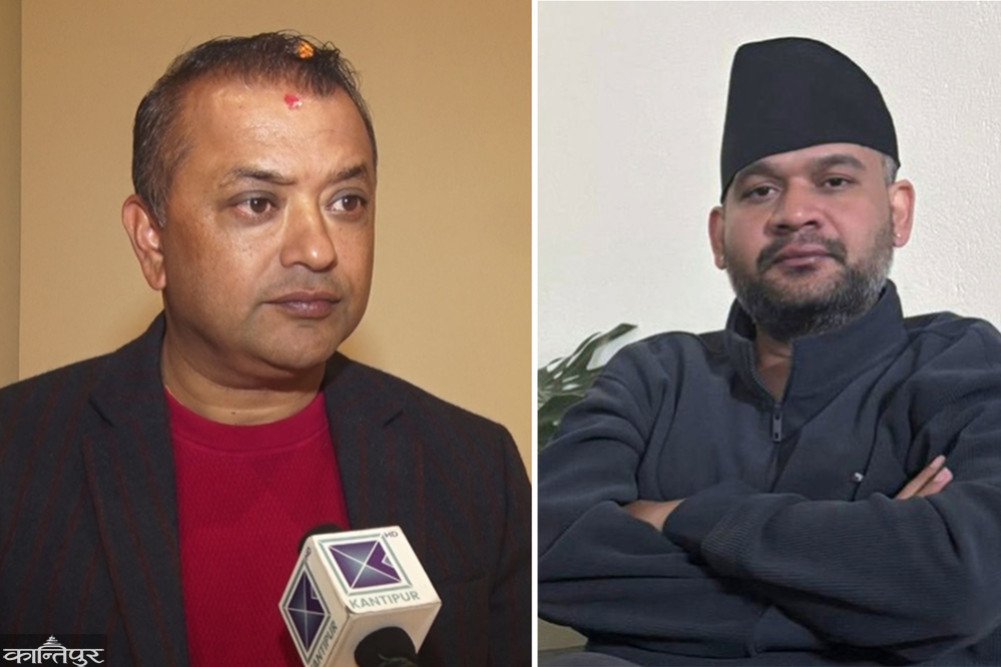
There is only a week left until the voting day. Right now, two people are in the spotlight - Nepali Congress President Gagan Kumar Thapa and senior leader of the Rastriya Swatantra Party Balendra Shah. Both are proposed as the future Prime Minister by their respective parties. This was not the case in previous elections.
In 2048, the then General Secretary of UML, Madan Kumar Bhandari, seemed like a minor rival to Congress President and Prime Minister of the interim government, Krishna Prasad Bhattarai. He had not become a public figure outside the party circle. Bhattarai lost the election, the Congress won the majority, but he could not become the Prime Minister. Bhandari won the election, but his party could not win the majority. There were competing parties in the 2064 Constituent Assembly election, but Pushpa Kamal Dahal, the then Chairman of the CPN (Maoist), was not a rival to Prachanda. His party did not have a majority in the Constituent Assembly, but Dahal became the Prime Minister with an overwhelming majority. This time, there is a tough competition between both parties and leaders, and the election is also becoming exciting. The day is approaching to see who will win.
Some people think that going to the election with a prime minister in advance is incompatible with the parliamentary system. In this system, MPs are elected from different constituencies. Based on that, it is clear which party won, whether it got a majority in parliament or not. After the election, each party elects a leader of its parliamentary party, and the leader of the parliamentary party with the majority becomes the Prime Minister. This practice is based on the trust and collective responsibility of the elected MPs from the party. The position of the Prime Minister in the government is only that of the leading minister like other colleagues. The cabinet with joint responsibility was considered a feature of the parliamentary system. But this practice is outdated, it is being replaced by the prime ministerial system. The belief has developed that the Prime Minister, as the chief executive, is also the leader of the country. Yes, in the parliamentary system, he is still elected from a specific constituency, but as the leader, he conducts the entire election. The defeat and victory of that party are seen as a graph of the voters' trust in him. If that graph goes up, he remains in the leadership, if it goes down, he leaves the leadership. The practice that has begun in this election of presenting a leader as the future Prime Minister is welcome. It needs to be institutionalized.
In a democracy, the leader is the one who leads the election, the party is the identity and the open platform for public mobilization. In today's digital information technology, the use of the party in election campaigning has also become secondary. The leader can directly contact the people in a matter of seconds and convey his message. During elections, the leader should be able to convert the feelings of the people into votes, this is also the key to the recognition of leadership ability. Therefore, those who cannot get that public approval in the elections should leave the leadership after the elections, take a break from politics. The political maneuver of making leaders and prime ministers who cannot command public opinion during elections but are smart in mathematics within the parliament should end with this election. This is the introduction of leadership that is responsible to the voters that I am trying to emphasize.
The current election atmosphere is focused on two circles: Gagan and Balen. There may be shortcomings of individuals, and they do exist. However, overall, the leading personalities of this election are Gagan and Balen. There is no need to introduce these names among the voters. Gagan Thapa has been established as a rebel leader since his student life. He had to rebel even for a regular convention in the Congress. Despite receiving popular support within the party ranks, he had to wrest the post of president from Sher Bahadur Deuba. His rebellion has filled the Nepali Congress with electoral enthusiasm. New hope has been instilled in the voters. The rhythm of the Congress and the voters has begun to match.
Gagan Thapa is not someone who rose to power in politics all at once, nor was he plucked from the streets as the Prime Minister. He has had an uninterrupted political journey of three decades since his student days. There is no need to run on empty assumptions to know what his leadership will be like. In a short period of time, whether it is as the Minister of Health or in the Parliament and the party, a glimpse of his ability has been projected. His political thinking, understanding and involvement can be seen and known as an open book. He can be considered a leader who can understand the essence of the federal republic of Nepal and can be trusted accordingly. He has the ability to communicate and debate with dignity, not only in the media, but also with his opponents. His ability to work with his colleagues and team has been confirmed by the recently concluded special general convention of the Congress. In fact, Gagan Thapa is the most energetic and capable leader that the Nepali Congress can give after the 2062/63 movement. There is no other person who represents the essence of that movement.
Another character, Balendra Shah, has been in the news since the last election of Kathmandu Metropolitan City. He is also known as the hero behind the Gen-G rebellion. Some of his political sarcasm can be known, but the basis for knowing his political identity is not clear. His political thinking and leadership ability have to be assessed from the peak of power at once. He does not communicate and debate, but gives orders and arrogant responses. This is not my negative opinion towards him, it is something that everyone can see. Yes, no one is born with politics, nor is anyone a rebel or a revolutionary. The situation shapes his politics. Our politics has long been focused on the movement and struggle against authoritarianism. Our political values, party and leader's identity were also formed on that basis. Even now, we continue to inquire about who the leader is and what he is like on that basis. Involvement with a political party makes a person's political values and inclination towards the system public. In the case of Balendra, we do not have this facility.
When Balendra was born, the multi-party system had just been restored in the country. During the autocratic era of Gyanendra, he was going to school carrying a backpack. As he entered his youth, he introduced himself as a rebel rap singer. Political stunts and satire began to shape his personality in an entertaining way. On the strength of that, his political journey began, which was only visible after he assumed the post of mayor of the metropolis, enjoying constitutional freedom and rights. He was able to directly enjoy the opportunities provided by democracy. It is a matter of joy that after the country entered open multi-party politics from the movement of 2046, Balendra has emerged as a representative leader of the first generation. It is the decision of the voters to accept or not to accept a leader. Democracy gives everyone, new and old, the opportunity to reach out to the people and be tested, and does not prohibit anyone. Balen will now play the role of preserving this feature of democracy and advancing others. In the same process, his political identity will be formed.
The Rashtriya Swayamsevak Sangh (RSS) has turned Balendra's craze among the youth into an electoral weapon. Now, others are scolding him, he is being promoted as if he had become the Prime Minister. This is not unusual in the run-up to the elections. But Balendra's political risks are also equal. First, to continue his political journey, he must win the election in Jhapa-5. If he loses, his political journey may come to a complete end. Second, he is not a product of party culture. He is riding on the RSP's boat in the run-up to the elections. He has received party entry, the Prime Minister's offer and the facilities of a senior leader all at once. But how much that boat will become his own remains to be tested. In Nepal's party politics, the practice of internal consensus among leaders is not dynamic, it tends to break up quickly.
The challenges and risks are also immense. First, under his leadership, the Nepali Congress should be able to achieve election results as the first party. In the last election, the Congress came first in the direct election, this time there is no alliance. The party was behind the UML in the popular vote it received. Yesterday, Sher Bahadur Deuba was the main culprit, but now Gagan has to take responsibility for it. Second, the Deuba faction has not yet been able to be positive about Gagan's leadership. This may affect the votes of the Congress in some constituencies. But the good thing is that this time, even if there are no rebel candidates in the Congress, the ones that are are negligible. However, the challenge of securing support and votes for the party is now in front of Gagan. If the targeted results are not achieved, there is a possibility that his leadership and political future will also be at risk.
The election is currently being colored by new and old commentary. In particular, there is an attempt to belittle the Congress and the Communist parties as old and useless, and to divide the voters by calling Balen, Ravi, Hark, and Kulman representatives of the new power. The parties that are called new today will be old tomorrow. The commentary that being new will not work as old is not correct. Our constitution and politics are based on the party system. Its alternative cannot be a so-called new miracle person. Therefore, what is needed is the development of competitive and responsible leadership based on the party system. So far, our leaders have neither been competitive nor responsible to the voters. This election is looking for old or new, competitive and responsible leadership.
What is worth considering here is that the political parties of Britain and the United States are the oldest. They have a history of more than two hundred years. It is important to understand how even those who have not completed 40 years come to leadership and become Prime Minister and President in such old parties. There is a leadership competition there, leadership is selected based on policy leadership and ability. If they can lead the party to the expected victory, they take over the leadership of the government; if they cannot, they easily leave, taking moral responsibility. There is no tradition of former Prime Ministers like ours running in a frenzy and making political maneuvers. Our main problem is that those who should take a break are stubbornly insisting that they are the only leader and there can be no other. This election should be able to break that and establish a new style and culture of leadership.
It is very difficult to predict what the outcome of this election will be. Along with the smoke of the Gen-G rebellion, the electoral scenario is also hazy. However, the outcome of this election is certain to be very different from the previous ones. Looking at the election atmosphere, the Congress and the Rashtriya Swayamsevak Sangh (RSS) are seen as the frontrunners. Both Gagan and Balen have also become the chief campaigners of their respective parties. But the UML cannot be underestimated either. KP Sharma Oli's leadership is criticized and in a state of decline in the eyes of the people, but the party's organized base cannot be considered weak. There is mainly a triangular competition between these three parties in the election. In some constituencies of Madhesh, the Janata Samajwadi Party and the Janmat Party cannot be ignored. For the rest, it will be difficult for some to maintain their old status, while the new ones face the challenge of 'entry' in parliament.
Finally, like in the past, the possibility of any one party getting an absolute majority in the House of Representatives this time too is very low. This is something inherent in the electoral system. There is talk of changing it by amending the constitution, but that is not so easy. There is no room for immediate change in the structure of the executive either, the constitution itself must be amended. Therefore, a coalition is inevitable to form a government even after this election. But in our context, the experience of the coalition is very bitter. Whatever the case, it could be a good practice to have the party that wins the most seats in the House of Representatives lead the government and the second-largest party play the role of the main opposition party. The party's manifesto, mandate, and leadership can be linked to both the government and the parliament.