Currently, Nepal only has a formal national security policy; a clear national defense policy and national security strategy have not yet been formulated, nor has there been any concrete government initiative in this direction.
We use Google Cloud Translation Services. Google requires we provide the following disclaimer relating to use of this service:
This service may contain translations powered by Google. Google disclaims all warranties related to the translations, expressed or implied, including any warranties of accuracy, reliability, and any implied warranties of merchantability, fitness for a particular purpose, and noninfringement.
Nepal's security environment in the three and a half decades since the end of the Panchayat system can be broadly understood in four phases: democratic transition (2046–2051), armed conflict and peace agreement (2052–2063), transition and reconstruction (2063–2082), and the 'Gen-G' rebellion and subsequent phase (after 2082).
In the first phase, the transformation from a panchayat security structure to a multi-party system began. In the second, the then insurgent Maoist armed conflict caused deep damage to development, security structures, and social harmony. Its wounds have not healed even today. After the 2062/63 movement and peace agreement, the end of the monarchy, republic, federalism, the 2072 earthquake, and the 2072–73 blockade further transformed the security challenge in a multifaceted way.
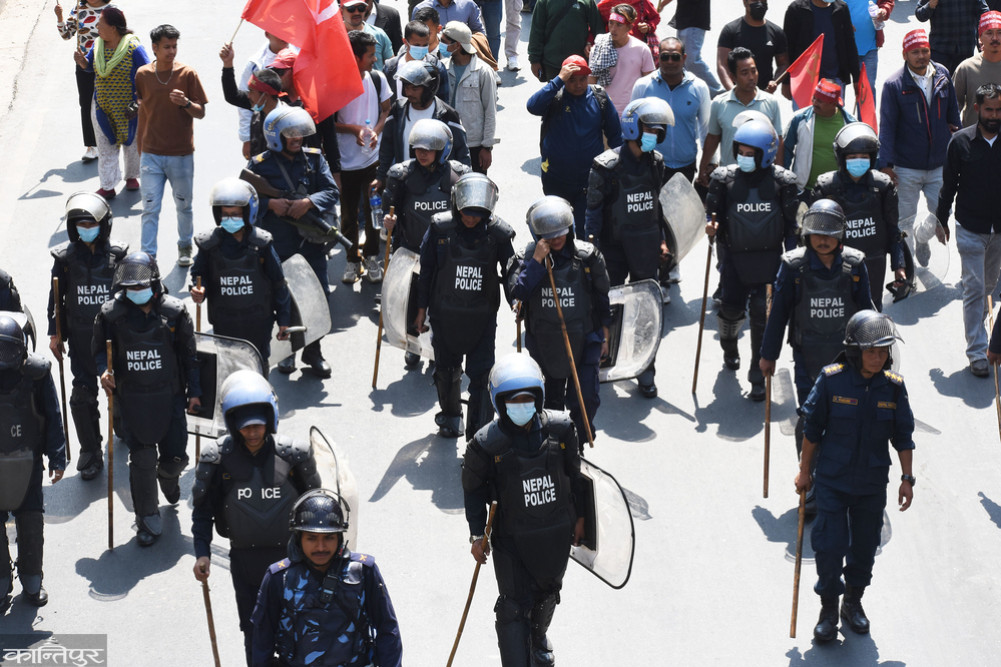
In the fourth phase, the ‘Gen-G’ protests of 23–24 Bhadra 2082 clearly showed that the nature of the national security challenge was transforming into a ‘hybrid’ threat and gray-zone activities. During this period, street protests, digital activism, the influence of social media, institutional distrust, and general dissatisfaction with the current state of good governance and employment were the focus, and well-planned destruction was inflicted not only on the political system, but also on the country’s historical heritage and physical infrastructure. National monuments that exercise sovereign power were reduced to ashes. The President's House, Parliament, Supreme Court, Singha Durbar, centers of authority and security mechanisms were destroyed.
The Home Administration is the main house of Nepal's internal peace and security management. Therefore, the Ministry of Home Affairs and its subordinate mechanisms are also considered as the internal managers of national security. The policy, coordination and supervision of the three important security organs, Nepal Police, Armed Police Force and National Investigation Department, are carried out through the Ministry of Home Affairs. In theory, it should set a long-term security vision and ensure the capacity development and professional environment of the security agencies. This is what should be done.
However, in practice, the professionalism of the security mechanism seems to have weakened due to political interference and administrative pressure. To some extent, the incident of misuse of the information allowance, which has been taken arbitrarily by the Home Minister and Home Secretary since 2046 for peace and security management and crime prevention and control, also reveals how exploitation is being institutionalized under the cover of the Home Administration. This situation has ended after the media exposed the issue of misuse of information allowance.
The tendency to take administrators who do not have sufficient security knowledge and experience to the Ministry of Home Affairs and its subordinate departments and district administrations has increased the challenge to peace and security. Employees who developed their careers from the Home/Defense administration and understood security administration were never given priority. Even if administrators with knowledge came from time to time, they were inspired by political interests and influence, so the work could not be done by prioritizing the national interest. If a position is established and responsibilities are assigned based on the subject in which the knowledge is excellent, effective mobilization and coordination of the security agencies is also possible.
The basis of national security is the security of citizens, justice and a life of equal opportunities. Not only the army and police, but the patriotism, trust and dedication of the citizens are the main strength. National security policy, defense policy and security strategy are three pillars that create a single strong foundation. Modern security is not only military modernization, but should be strengthened with good governance, economy, social unity, information technology, health and effective diplomacy.
The current global security scenario is moving towards 'gray-zone' conflicts and the polarization of power nations in South Asia has also affected Nepal. We also need to formulate policies/rules, strategies, and tactics by assessing today's polarized global situation. Currently, Nepal only formally has a national security policy. A clear national defense policy and national security strategy have not been formulated yet, nor has there been any concrete government initiative in this direction. Whereas, only the national security policy, national defense policy, and national security strategy, together, form a strong foundation for national security.
To some extent, the incident of misuse of the tip allowance, which has been taken arbitrarily by the Home Minister and Home Secretary since 2046 for peace and security management and crime prevention and control, also reveals how exploitation is being institutionalized under the guise of home administration. Only this can strengthen the country's internal security. The national security policy is the supreme security vision of the state, which covers issues such as sovereignty, geographical integrity, political stability, economic security, social harmony, and cyber security. The national defense policy is its military-defense pillar, which determines the structure to protect the nation from external military threats, border defense, military mobilization, and the direction of defense diplomacy. The national security strategy is a practical action plan to implement both these policies, which determines concrete steps according to available resources, geopolitical realities, and internal circumstances.
The role of the Investigation Department, the crisis and the need for reform
Intelligence is the art of collecting information and the science of analyzing it. Without accurate information and timely analysis, no security mechanism can be effective. According to Sanju, ‘If you know yourself and your enemy well, you do not need to be afraid of a hundred wars’. This statement is equally relevant in today’s era of unconventional security threats and gray zone activities.
After 2046, it seems that due to political interference in the National Investigation Department, it is being used for politically focused internal espionage. Until 2047, the external counter-espionage mechanism was effectively active in the Investigation Headquarters. A powerful mechanism for looking after external affairs was active. However, on the recommendation of Home Minister Yog Prasad Upadhyay of the multi-party government formed after 2046, the then interim cabinet led by Krishna Prasad Bhattarai abolished this mechanism. It can be viewed from many angles, and it is necessary to strengthen and revive that mechanism.
The National Investigation Department was established in 2008, which is Nepal's first formal intelligence agency. Article 268 of the Constitution 2072 has given it constitutional recognition. After 2017, during the Panchayat period, this institution became more powerful and closely linked to political control. In 2018, King Mahendra had envisioned a counter-espionage mechanism, although it could not be effectively implemented. The Janakpur bomb blast incident that took place on 9 Magh of the same year exposed the weakness in the intelligence capacity.
Before 2046, there were two agencies for external and internal espionage, the National Public Relations Headquarters 'A' and 'B'. 'B' looked after external intelligence activities. But after the political change of 2046, with the shift from a panchayat security structure to a multi-party system, the attention of political parties shifted to political competition rather than the needs of intelligence agencies. As a result, the Counterintelligence Unit 'K', formed on 13 Asoj 2046, was dismissed by the Council of Ministers on 27 Chaitra 2047 by the Home Minister of the interim government, Upadhyay, calling it irrelevant. This further weakened the external and counterintelligence capabilities. In the following periods, questions have also been raised about its relevance.
With the country's entry into a democratic system, it was necessary to restructure it with legal accountability, a professional intelligence culture, and modern analytical capabilities. But in practice, this institution often became an instrument of political control. This structural instability and leadership changes led to serious failures in the early stages of the Maoist armed insurgency. There was no in-depth analysis of the growing discontent in rural areas, distrust of the state, the expansion of Maoist organizations, and ideological influence. Although information was collected, it failed to be converted into a strategic warning.
However, even at the height of the conflict, some notable work seems to have been done effectively. High-level Maoist leaders were arrested inside India and operations like ‘Operation Mustang’ were successful. But the institutional structure had repeatedly become a subject of political manipulation. In 2051, Girija Prasad Koirala tried to bring it under the Prime Minister’s Office. After the republic, in 2065, a task force led by senior advocate Yubaraj Sangraula suggested that it be brought back under the Prime Minister’s Office and developed as a strategic intelligence agency.
It faced many difficulties in information collection and analysis during the Madhesh movement (2072–2073). A 1-year-old child and SSP Laxman Neupane, along with nine others, were killed in clashes between pro-Tharuhat protesters and police in Kailali. As the local-level human resource intelligence mechanism remained weak, effective coordination between various security agencies was not possible. Frequent transfers between the Prime Minister’s Office and the Ministry of Home Affairs blurred the clear chain of command. The Indian blockade and the Madhesh movement created not only internal security challenges but also external security challenges.
In Falgun 2075, the department was again brought under the Prime Minister's Office. This raised hopes of ensuring central oversight and coordination, but in practice it led to further politicization. The frequent changes in the Home Ministry-Prime Minister's Office negatively affected institutional stability, long-term planning, human resource management, and intelligence capacity development.
Overall, political interference, lack of legal autonomy, frequent transfers, weak analytical capacity, and lack of inter-agency coordination reduced the effectiveness of the intelligence apparatus. Learning from this, it is now imperative to modernize the institution with a legal framework free from political influence, a stable structure, modern cyber-intelligence capabilities, a strong analysis center, separate offices for internal and external intelligence, and a counter-espionage mechanism.
The work of intelligence agencies for national security and national interest should be borderless. But neither the state has understood its full importance, nor has trust in the institution. If the Ministry of Home Affairs does not fulfill its role in coordination and leadership, the state will likely fail again in the internal security and political crisis that will occur tomorrow.
Nepal Police: Struggle of conflict, politics and morale
Today, the Nepal Police is the organization that is most targeted by political and criminal gangs in Nepal. The police are forced to work in the field 24 hours a day amid limited resources, low wages, increasing legal violations and psychological pressure. Due to declining morale, declining public trust and increasing political interference, the police organization has become like a dilapidated house today. The main reason for bringing the police, which is the backbone of the country's internal security, to this state is the nexus between politics and crime, extreme political interference in transfers and promotions and some opportunistic police leadership. Who made any deal with political forces to reach their posts.
Armed Police Force: Objectives, controversies and clear policies
The Armed Police Force of Nepal was established on 9 Magh 2057. It was established with the objective of strengthening border and internal security after the Maoist armed rebellion intensified. The main responsibility of this force, which was created in a paramilitary format by transferring manpower from the Nepal Army and Nepal Police, is to maintain peace and order, control armed rebellion and terrorism, manage riots, monitor borders, provide revenue and customs security, and assist in disaster relief. In the 25 years since its establishment, the APF has become an integral part of overall national security, not limited to internal security.
The tendency to add posts based on political access, ignore organizational and management surveys, and ignore procedures has increased interference within the organization. The incidents of 23/24 Bhadra also showed that to protect the sensitive structures of the state, the security mechanism must be coordinated, clear, and capable, otherwise the nation will pay the price. The armed forces need to be redeployed as a strategic paramilitary force, not as a daily operational force like the police.
Its focus should be on border security, counter-terrorism, crowd and riot control, disaster relief, and strategic responsibilities assigned by the state. स्पष्ट कानुनी कार्यक्षेत्र, नेपाल प्रहरीसँग साझा अपरेसन मापदण्ड, सीमा निगरानी प्रविधिमा लगानी, विपद् विशेषज्ञता विकास, पारदर्शी पुरस्कार–दण्ड प्रणाली र सुदृढ चेन अफ कमान्डमार्फत मात्र एपीएफलाई व्यावसायिक, प्रविधिमैत्री र प्रभावकारी राष्ट्रिय सुरक्षा कवचका रूपमा स्थापित गर्न सकिन्छ ।
नेपालको राष्ट्रिय सुरक्षा सुदृढ गर्न आन्तरिक सुरक्षा भूमिका निर्णायक छ । गृह मन्त्रालयअन्तर्गतका निकायहरू प्रहरी, सशस्त्र र अनुसन्धान विभागलाई व्यावसायिक, पारदर्शी, समन्वित र राजनीतिक हस्तक्षेपमुक्त बनाउनु आजको प्राथमिक आवश्यकता हो । मुलुक संघीय शासन प्रणालीमा गइसकेकाले गृह प्रशासनअन्तर्गतका सुरक्षा संयन्त्रको आधुनिकीकरण, स्पष्ट कानुन र परिचालन नीति अपरिहार्य छ । आन्तरिक सुरक्षा बलियो नभई बाह्य सुरक्षा सम्भव हुँदैन । आन्तरिक सुरक्षा नागरिकको विश्वास, सहभागिता र विधिसम्मत राज्य प्रणालीमा आधारित हुन्छ ।(अधिकारी सुरक्षाविज्ञ हुन् )