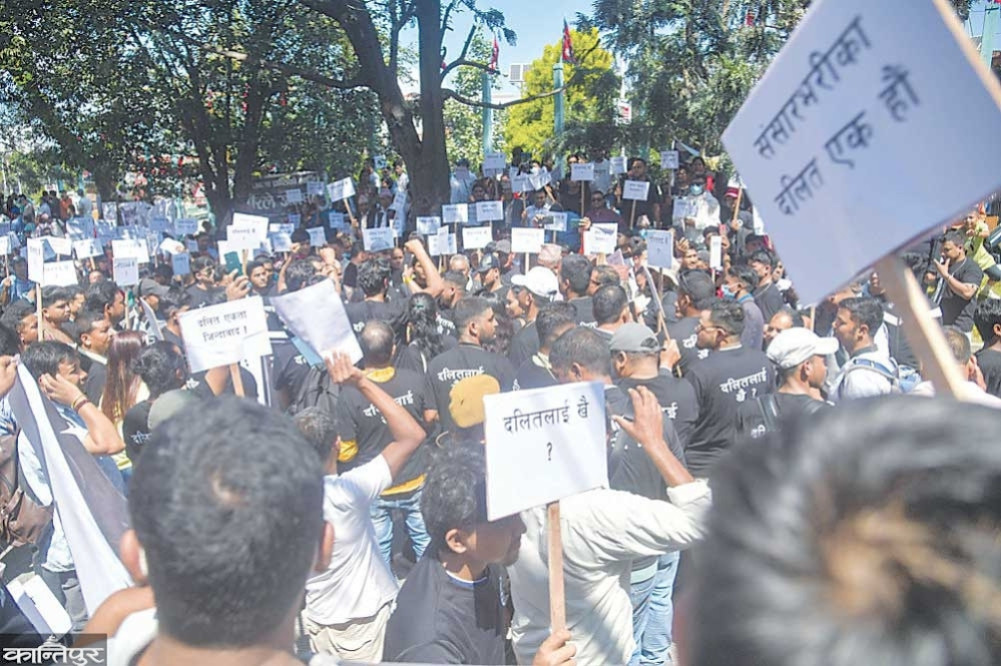
Parties must become serious about protecting Dalits from the effects of disasters, pandemics, and climate change, and giving them top priority in the journey of development and prosperity with social justice.
We use Google Cloud Translation Services. Google requires we provide the following disclaimer relating to use of this service:
This service may contain translations powered by Google. Google disclaims all warranties related to the translations, expressed or implied, including any warranties of accuracy, reliability, and any implied warranties of merchantability, fitness for a particular purpose, and noninfringement.
Although the principle of proportional inclusion has been provided for in the Preamble, Articles 40 and 42 of the Constitution, there has been no proportional representation of the Dalit community in the state machinery. It is necessary to end the current trend of superficial inclusion in a few posts and ensure representation of the Dalit community in key and executive posts, civil service, security agencies, constitutional and diplomatic posts at the federal, provincial and local levels in a way that has an impact on policy making.
Analyzing the practice so far, it seems that the mixed electoral system has fueled instability on the one hand, while on the other hand, the elite class has captured the proportional seats brought for the deprived classes. The mixed electoral system seems to be in the interest of a limited elite class rather than the general public.
Therefore, it seems that the option should be to abolish this electoral system and arrange for a fully proportional electoral system or to reserve constituencies for women and Dalits who find it difficult to contest elections directly in the direct electoral system.
Regarding the implementation of the constitution,
It is regrettable that even after ten years of its promulgation, the constitution has not been implemented and the Dalit community has not been able to benefit. Therefore, it is imperative to formulate an integrated Dalit Development Act that covers all these issues to effectively implement the pro-Dalit provisions in the preamble, fundamental rights, and directive principles of the constitution.
It is necessary for the parties to be serious about the issue of ‘the right of proportional inclusion of Dalits in all state bodies, provision of free education including scholarships for Dalit students from primary to higher education and technical education, provision of skills and resources for the use, protection and development of traditional professions, knowledge, skills and technology while providing health and social security, and effective implementation of the provision of the right to land and housing for landless and homeless Dalits’ in Article 40.
Ending caste discrimination and untouchability
It is a shame that untouchability has not been eradicated even after it has been abolished by the Constitution and the law. For the effective implementation of the right against untouchability and discrimination in Article 24 of the Constitution, a national strategy should be prepared to end caste discrimination and untouchability and adequate resources should be allocated and implemented effectively. Since the new name of the amended Untouchability Act and the provision of lesser punishment in it have caused problems in implementation, its name should be kept as it is and a punishment of at least 5 years should be provided so that the perpetrator can be sent to pre-trial detention.
To end untouchability in practice, it is necessary to transform the casteist and discriminatory mindset of the people. Political parties should make these issues the main agenda of the party and launch a nationwide campaign to end untouchability, and adopt an inclusive policy in accordance with the constitution, making all the mechanisms of the parties proportionally inclusive, providing training to law enforcement agencies and government employees against discrimination, making the Dalit desk launched in the Nepal Police effective, and implementing the constitution and declaring the municipalities free from untouchability in practice by providing additional budget. Everyone must be committed to adopting a zero tolerance policy against untouchability.
Issues of economic-social transformation
Policies and programs should be formulated to end poverty, deprivation and unemployment in the Dalit community due to historical discrimination and exploitation. The right of the Dalit community to use, protect and develop its traditional profession, knowledge, skills and technology, as mentioned in Article 40 (4) of the constitution, is linked to the upliftment and development of the Dalit community. Since this right can contribute to the national economy by making the Dalit community self-reliant and self-employed, the issue of making special legal and structural arrangements to protect and develop traditional professions, knowledge, skills and technology and formulating a policy accordingly should be included in the manifesto.
Providing access to land and natural resources for the economic empowerment of the Dalit community, providing semi-governmental Dalit development banks and cooperatives to provide them with access to the financial sector and connect them to entrepreneurship, providing reservation in private sector employment, and allocating a budget proportional to the population ratio for the overall development of the Dalit community, which is most trapped in the vicious cycle of poverty, should be included in the manifesto.
Increasing the effectiveness of the National Dalit Commission
The National Dalit Commission should have quasi-judicial powers including taking statements, investigating and prosecuting cases. Provision should be made for the establishment of sufficient resources and manpower to create an environment for the commission to work autonomously, and establishment of provincial offices in all seven provinces and branch offices in districts with dense population of Dalit community and high incidence of untouchability. In addition, the recommendations and directives made by the National Dalit Commission for the upliftment, development and protection of human rights of the Dalit community should be effectively implemented.
As per the order of the Supreme Court for Dalit rights, a national strategy should be prepared for the upliftment, development and empowerment of the Dalit community and implemented with adequate resources.
The parties should pay attention to the planned implementation of the International Convention on the Elimination of All Forms of Racial Discrimination (CERD) and the International Convention on the Elimination of All Forms of Discrimination against Women (ICED) and other commitments and recommendations of the UPR, which Nepal has signed as a member of the United Nations.
The constitution should be amended to correct the shortcomings seen during the implementation of the constitution over the past 10 years and to address the issues raised by various communities. The parties should express their commitment to including the Dalit community in the post-election constitutional amendment process, including proportional representation of the Dalit community and compensation for past discrimination, including apology and reparation, through constitutional amendments.
Issues of marginalized Dalits
Even within the Dalit community, Dalit women, children, disabled Dalits, Madhesi Dalits, Badi and Gandharva communities, gender and sexual minority communities, and Dalit youth are left behind. They have been suffering from unemployment, landlessness, and statelessness and are further deprived in education, health, politics, and economic conditions. Therefore, political parties should come up with concrete action plans for the most disadvantaged sections of society and ensure their identity, access, and representation, and decide on programs that will include them in the mainstream of development.
The dramatic changes in information technology have brought serious challenges along with opportunities. Since discrimination and violence on digital platforms have adversely affected Nepali society and unequal access and use of digital devices have generally increased inequality, a policy to end violence, discrimination, and inequality on all such platforms should be included in the party manifesto.
Parties must be serious about protecting Dalits from the effects of disasters, epidemics, and climate change, and giving Dalits first priority in the journey of development and prosperity with social justice. Effective implementation of the pro-Dalit provisions in the constitution and laws should be made immediately. In addition, for bringing about a change in the living standards of the Dalit community and for the long-term liberation of Dalits, it is necessary to abolish the caste and caste system that has trapped Nepali society in the quagmire of extreme division and discrimination.
Parties should clearly include these issues in all their documents, including election manifestos, and express a commitment to train cadres and work concretely to abolish the caste and caste system.