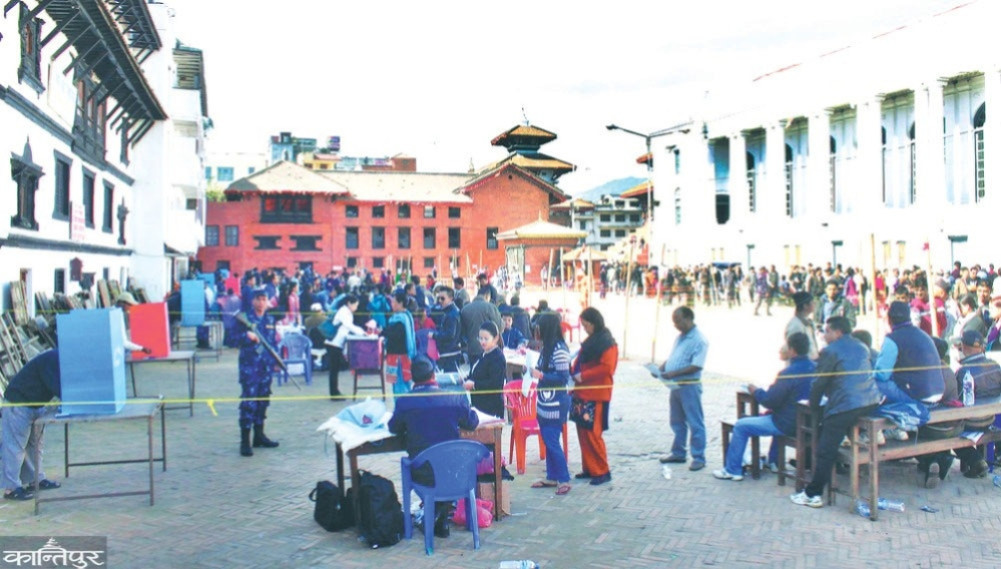
If only the expenditure can be made economical, the desire to run for candidacy will increase among Dalits, women, Madhesis and other weak and marginalized sections who have been excluded for centuries. As a result, the voices that the current situation is becoming incoherent will also be addressed.
We use Google Cloud Translation Services. Google requires we provide the following disclaimer relating to use of this service:
This service may contain translations powered by Google. Google disclaims all warranties related to the translations, expressed or implied, including any warranties of accuracy, reliability, and any implied warranties of merchantability, fitness for a particular purpose, and noninfringement.
The general election has been postponed by almost two years as a result of the Gen-G movement. Sixty-eight parties are competing for the election on 21 Falgun.
Some of them have participated in the elections alone, some have formed alliances. Parties have submitted 110 proportional and 165 direct candidates to the House of Representatives. With the completion of the candidacy registration process, the election code of conduct has also been implemented. What exactly is the code of conduct? What happens if we follow it? Will following it help the Election Commission to conduct elections or will it benefit the parties, candidates, voters and the entire democratic governance system of the country? And, if so, how? With this in mind, how have parties, leaders, candidates and voters used it in the past? How did it help shape the narrative before Bhadra 23? This article has been prepared with similar experiences.
In order to make elections transparent, clean and free from fraud, the Election Commission prepares and implements certain methods and standards with the aim of disciplining stakeholders at all levels and levels participating in the elections. That is called the election code of conduct. In addition to citizens/voters, government agencies and supporting organizations conducting and supervising the election, it is more targeted towards competing political parties and candidates. It contains prerequisites such as what to do, what to do and what not to do during the period of participation in the election process, campaigning, and the formation of the House of Representatives after the results are received. Among these, the method of collecting and mobilizing funds is the most important. Its main purpose is to ensure that no external factors can influence the election or voters, that they can express and give their votes to their preferred candidates in a safe and secure manner, and that only the elected representatives are truly representatives of the people. The role of national/international observers who observe and evaluate whether this process is legal or not is equally important. Based on the evaluation of the observers, the election is considered to be procedurally and clean, recognized or not, or has weakened or lost legitimacy.
Some people take the code of conduct lightly. One aspect of this is its poor implementation in the past. The Election Commission issues a document but does not carry out a detailed evaluation of the implementation of the actions prohibited by that document, and since it does not form the basis for encouragement and disincentives, the public has the impression that it is nothing more than a kind of ritual. Some people have questioned why Nepal has introduced a ritual concept like 'tying a cat during Shraddha' when such arrangements have been made in other democracies before elections.
Nepali democracy has taught us through practice not to take the code of conduct superficially as it did in the past. Let us look at the practices of Nepali democracy after 2048, focusing on one of the main aspects of the code of conduct, namely frugality. In the 2048 general election, many candidates did not have to spend money to win. One of the reasons for this was that there were few people with money, and even those who did not dare to buy tickets for the sake of money. Because the parties used to base their candidates on principles and contributions to the organization as the main basis. Since they had to reach the villages on foot, there was no crowd. Only a few workers and friends would accompany the candidates and help organize door-to-door visits, meetings, and public meetings. The election atmosphere in the villages remained peaceful. In the election competition between those who did not have money, who lived on the small help of their own friends, but were committed to the party's policies and organization, only one of them would win. During the election campaign, guests who came to the door-to-door were served local drinks such as water, tea, milk, and curd-mohi according to the number of people. Similarly, they were welcomed with food and shelter. Locals would gather at the places where they ate and stayed. That too became a part of the campaign. Abuses, false propaganda, etc. against competitors were not heard. Since telephone facilities were available only in telecommunication offices and especially government offices, physical meetings and issue-based discussions took place between candidates and voters. Workers of competing parties or voters who liked the candidate would also attend and ask their thoughts and questions. Although the houses seemed divided on a somewhat theoretical and ideological basis, in reality, the elections at that time were a festival of houses and towns that loved the candidate. Occasional incidents of beatings, use of weapons and violence were heard, but the participants were considered wrong and there was widespread sympathy in society for the victim. At that time, the victim usually won.
As the method of wall writing and placing election symbols in houses increased and goods such as caps, T-shirts, jackets, and handkerchiefs were distributed, an environment of investment in politics gradually emerged and increased. With the advent of roads and communication, all types of vehicles, and access to hotels and restaurants for the general public, campaigning and mobilization in recent elections have become extremely expensive. As a result, the practice of buying and selling candidates for money has become widespread, without limiting them to criteria such as being principled and morally upright, having made long-term contributions to society/organizations, and having earned public trust. It has become a practice to become a candidate only if one can collect and mobilize money. There are two sides to this, one is that the economic system introduced in the name of economic liberalization has given a section of society access to money that they never thought possible in history in the name of profit or commission. And another is that due to the internal migration of a small group in the name of modernization and urbanization, the value of land of those who were able to acquire and accumulate land on the basis of access has suddenly skyrocketed, and they have become newly wealthy overnight. For those who have land that can be easily sold at a good price when they want, property that was considered immovable yesterday suddenly became movable, so that they can sell as much as they want whenever they want. When the group that can buy a ticket for a candidacy in an election suddenly increased, the comment that ‘eventually, money is needed to run a party and contest elections’ suddenly seems to have made its place in politics. This series, which gradually started by giving tickets to a few ‘money-holders’, has created a situation where tickets are only given to those who have the money to contest elections today, or who have the ability to collect the necessary donations. The ability to collect donations is also seen as an investment based on the possibility of reaching a good position tomorrow, so that in the future, the interest and interest on that investment can be recovered ‘double by day, quadruple by night’. There are also terrible aspects that appear to have been spent but are not recorded. It is said that the party has been supported so much, but there is no money in the party account, it is not visible and the treasurer is not aware of it . It is said that it has been borrowed from relatives, but they do not seem to have the ability to collect that much money . The account is presented as falling within the Election Commission's criteria for spending so much, but even looking at the external expenses seen in the constituency, it cannot be assumed that the arrangements were made with that much money . In the last phase, the election has become a commentary that 'a country run by middlemen', and now it has even started saying that it is an investment by the 'deep state' There are dozens of such examples, which not only indicate that the investment in politics and the skyrocketing expenditure on elections are beyond the expectations of the general public, but also make it clear that the state has become a mute spectator.
The question arises, how to view this? It may be a reference to everyone remaining silent that politics has now gone into the hands of the rich and wealthy. But the situation will not be limited to that, as 23 and 24 Bhadau have already shown. One of the main factors behind the uprising and violence that erupted on the streets at that time is the deteriorating politics of the country. The tendency to practice money and access as two sides of the same coin has worked in making parties and leaders opaque and undemocratic in every respect. It can be said that the greed of going to political office and repeating it again and again has grown in Nepalis because of the chain of gaining access to resources after winning once and exploiting and reusing those resources to further increase the capital by winning the next election. The overnight party registration and bargaining, resignation, party entry and candidacy registration of ministers participating in the 'citizen government', who are not affiliated with any party and have a single mandate to conduct elections with a commitment not to contest elections, raises the question of whether this kind of attraction to politics is really only for the service of society and the nation ? Or, is there no profession to serve society outside politics ? Is there no such possibility ? Values such as patience, morality, commitment, sense of responsibility and accountability are nothing in politics ? Only the technical use of rights such as party registration, elections, competition, and voting are politics and democracy ? The understanding that this is so and the further spread of opportunism in this way is not a good sign for civilized politics . The continuation of such a culture and character seems to prove the latest Gen-G movement to be futile . The result is that the federal democratic system established with countless dreams and sacrifices will be betrayed and the other party will get a chance .
It seems that we should learn something from the past experience. Some of those who once won elections by influencing leaders or people because of their money/access have now had the experience of being displaced because they created a mindset/environment for those who had more money and money than them. At least now those people are saying that – ‘It is wrong to enter politics by influencing them on the basis of money like that.’ Even if they won alone due to the influence of money, when other parties fielded even more money-rich people, the number of those who lost the election and said ‘No more bass, no more flute’ is gradually increasing. This time, those who said that they did not get tickets even after engaging in the ‘lobby’ of getting tickets without paying money or without it have come to the fore. The situation seems to have reached such a point that, like in the past when the house/toll was divided on theoretical and ideological grounds, now the major part of the candidate's money has to be invested in persuading or buying and mobilizing the people of the party/group for which he has received the ticket, rather than attracting the opposition's votes. It seems that the experience of these and other characters who are tired of the past or are about to learn from the lessons and move on will be the only way to radically reform the electoral process. If only the expenditure can be made economical, the desire of the candidates from Dalits, women, Madhesis and other weak and marginalized sections who have been excluded for centuries will increase. As a result, the voice that it is not as inclusive as it is now will also be addressed. The mood between the voters and the candidate of 'winning by spending money' will also be transformed into a relationship of principled and true representatives. It will help the new entrants who are not willing to leave politics due to the greed of draining financial resources based on their positions, and will help them get rid of the current cycle of politics. In addition, money politics must be curbed to reduce the noise and violent activities caused by the misuse of alcohol, petrol and recharges that are easily bought from wealthy candidates. For this, the importance of the election code of conduct has increased from yesterday. Since someone or the other has to implement it until the society itself is aware, there is no alternative to all-party cooperation and coordination in its strict implementation.
Ravi was released from prison during the Gen-G movement. Balendra Shah's role was seen in forming a non-partisan government. Now he has joined the Rashtriya Swayamsevak Sangh (RSS) as the prime ministerial candidate. यही बेला महान्यायाधिवक्ताको कार्यालयले रवि लामिछाने जोडिएको सहकारी ठगी सम्बन्धमा सम्पत्ति शुद्धीकरण र संगठित अपराधको मुद्दा फिर्ताको पहल लियो । अधिकांश मन्त्रीहरू राजीनामा दिएर रास्वपाकै उम्मेदवार बन्न गए । यस्ता विषयले यो सरकार नै रास्वपाको मात्रै रहेछ कि भन्ने सन्देह गराएको छ । रास्वपा नेता बालेन्द्र नेकपा (एमाले) अध्यक्ष केपी ओलीको प्रतिस्पर्धी बनेपछि जिल्ला तहका प्रहरी प्रमुखहरूको हेरफेरलाई लिएर उनले गरेको सार्वजनिक असन्तुष्टिले पनि त्यतै इंगित गर्छ । यसले सरकारलाई आफ्नो तटस्थता र निष्पक्षता पुष्टि गर्दै जाने चुनौती थपिएको छ ।
यसबीचमा उम्मेदवारी घोषणा वा दर्ताका क्रममा बाजागाजाको प्रयोग, दुईपक्षीय झडप, एक–अर्काविरुद्ध नाराबाजी अनि निकृष्ट गालीगलौज र अमूक व्यक्ति प्रधानमन्त्री हुने अवस्था नबने ‘आत्मदाह गर्ने’, अर्को उम्मेदवारले चुनाव जिते ‘आत्महत्या गर्ने’ जस्ता भड्काव र हिंसा–प्रेरित अभिव्यक्ति सार्वजनिक भएका छन् । मनोवैज्ञानिक आतंक मच्चाउने यस्ता क्रियाकलापसहित सूचना प्रविधिको प्रयोग र दुरुपयोग निर्वाचन व्यवस्थापन र अनुगमनको थप र गम्भीर चुनौती छ । अहिलेकै अवस्थामा आचारसंहिताविरुद्धका प्रशस्त कामकारबाही भएका छन्, जसमा निर्वाचन आयोगले सचेत गराउने त परै जाओस्, जे भइरहेको छ, गलत हो भनेर आफ्नो धारणासमेत सार्वजनिक गरेको छैन । मतपत्र च्यातेका, शतप्रतिशत मत परेका, आतंकको भरमा निर्वाचन जितेकाहरूलाई पनि मान्यता दिएको विगतसामु नयाँ परिस्थितिमा कसरी काम गर्ने भन्ने अर्को पाटो छ । स्थापितहरूलाई नयाँहरूले चुनौती दिइरहेको, प्रमुख दलका मुख्य नेतहरूकै बीचमा तीव्र प्रतिस्पर्धा चलिरहेको र इतिहासमै पहिलो पटक भावी प्रधानमन्त्रीको उम्मेदवार नै घोषणा गरेर दलहरू मैदानमा उत्रिरहेको अवस्थामा साम, दाम, दण्ड, भेद जस्ता सबैखाले हतकण्डाको प्रयोग हुन सक्ने भएकाले हिजोको सुरक्षा संवेदनशीलता र सुनिश्चितताको रणनीतिका सट्टा नवीन समस्यासँग मिल्दोजुल्दो र त्यसको सम्बोधन हुने गरी सोच र संरचनागत संशोधन जरुरी छ । यी सबैका कामकारबाही देखिरहेको र साक्षी बनेका खास पर्यवेक्षक त नागरिक हौं । नागरिक चेतना, चनाखोपन, सक्रियता र खबरदारी सख्त जरुरी छ ।