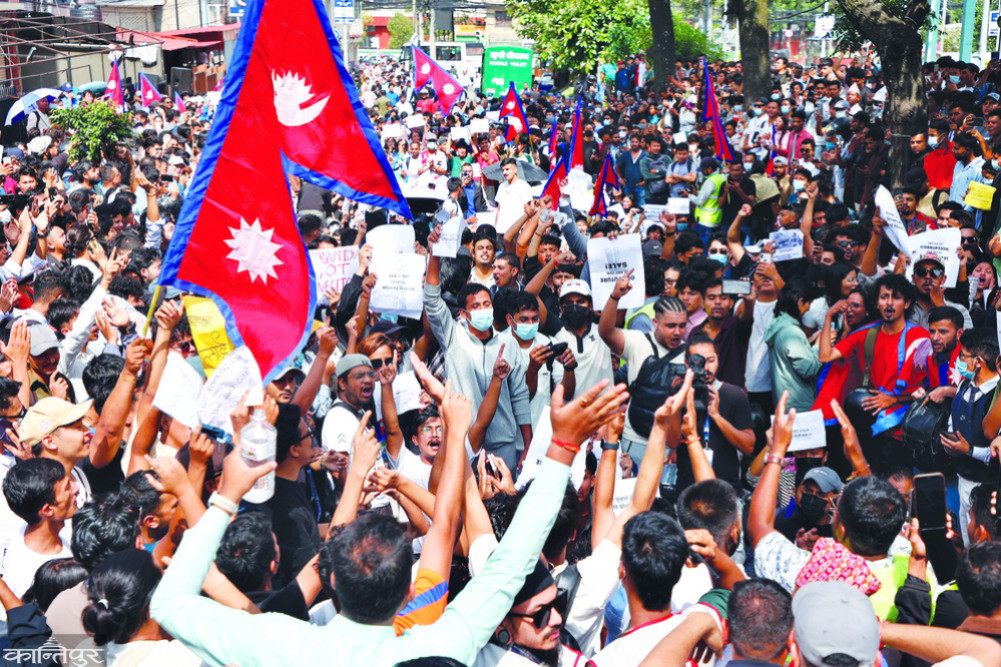
This generation will not forgive those who make street protests their personal careers and enjoy the luxury of power by basking in the blood of martyrs.
We use Google Cloud Translation Services. Google requires we provide the following disclaimer relating to use of this service:
This service may contain translations powered by Google. Google disclaims all warranties related to the translations, expressed or implied, including any warranties of accuracy, reliability, and any implied warranties of merchantability, fitness for a particular purpose, and noninfringement.
In the history of Nepali politics, the Bhadra 23/24 movement was not just an ordinary date on the calendar or a street crowd. It was a volcano that erupted to break the walls of the decades-old frustration, the cage of misrule, and the political syndicate. That uprising was a historic campaign to break the vicious cycle of Nepali politics, to bring the incompetent-corrupt leadership to justice, and to truly hand over the reins of power to a new generation.
However, the scene we see today when we look back at that golden opportunity to make history is very painful, ironic and heartbreaking.
Looking through the eyes of a conscious citizen and a harbinger of change, today we are faced with a serious question: where did we go wrong? This question is not just political, it is moral and existential. The greatest beauty and power of this movement was its spontaneity.
That ocean of people who took to the streets without the whip of any party or the order of any leader was an amazing phenomenon in itself. However, over time, that same power proved to be our biggest weakness. Before the passion and heat of the movement could subside, the way in which the movement divided into various factions, sub-groups and interest groups became the starting point of our strategic defeat.
Of course, it is not unusual for a movement not led by a single organized structure to have a diversity of views and to stand in different positions. In a democracy, differences of opinion are acceptable. We were unable to institutionalize the hope that the unprecedented unity seen on issues of common interest in the initial phase had aroused. When the time came to take the lead and give the movement a outlet, the battle of personal ambitions began rather than ideological clarity. Instead of collectively bargaining on a common agenda, by blowing our own trumpets, the very essence of the movement was attacked. We forgot that no matter how large the crowd is, if there is no compass to guide it in the right direction, that crowd will only turn into chaos.
The most surprising and tragic aspect came to the surface when the character who considered himself the self-proclaimed messiah of Gen-G chose the path with no alternative. Yesterday, our friends did not hesitate to take up the post of central member and line up in the race for election tickets at the doorsteps of the same parties against which blood-curdling slogans were raised on the streets.
Those who set out to change the system and indulge in ‘bargaining’ for posts before the situation could change is a cruel joke on the spirit of the movement. This trend has raised a serious question in society – was the purpose of the rebellion just to add some new and bright faces to the crowd of old and wrinkled faces? Was the fight we fought just to exchange chairs? When the so-called revolutionaries become the followers of the status quo, then the crisis of trust deepens.
The way the so-called alternative and new parties distributed opportunities in the name of Gen-G was seen to be even more discriminatory, unjust and plagued by feudal thinking. Here, the definition of Gen-G itself was narrowed. Looking at the behavior of the new parties, it seems that in their eyes, Gen-G reservation or opportunity is a safe quota only for the elite class.
Is an expensive degree from a foreign university and strong ancestral wealth the ultimate qualification for politics, leadership, and country building in Nepal? For equal access, equality, and an end to corruption, the children of the common people who came from remote villages, grew up in dirt, and were beaten by the police in street protests have been sidelined.
The way the squeamish, English-speaking, and well-connected have been embraced has raised serious questions about the intentions of the new parties. This trend has not only violated social justice, it has also tried to make politics a private affair for the wealthy class. Should the children of the poor, workers, and farmers always burn tires on the streets? And should only the degree-holding elites come to destroy the power structure? What kind of new politics is this?
Seeing today's selfish greed and greed for position, one feels deep remorse for those great martyrs, who, having dreamed of change, died forever. We, who have survived, are forced to ask ourselves when we look at our own faces in the mirror today, did our comrades sacrifice their precious lives for this?
The real warriors who shed blood on the streets, were mutilated and imprisoned are still stranded on the streets today. Let alone applying ointment to their wounds, no one even recognizes them. However, those who rose to power by taking credit for the movement by making the blood of those martyrs and the sweat of the injured a ladder, did not even bother to look back once. In some cases, when we think about it in solitude, we feel that we have lived in vain, that we have gone to the streets in vain. This is not just the frustration of one person, but the collective despair of thousands of youth. Did the stove of the real warriors of the streets burn or not while submitting their names to the Central Committee? This realization did not occur to any new leader.
This is not just a grievance or complaint, but a warning. We have not forgotten those faces who have occupied any seat or position of any party by chanting the name of Gen-ji or trading in sentiments. This generation will not forgive those who make the street movement their personal career and enjoy the luxury of power by resting on the blood of martyrs.
Time is powerful and history is cruel. The Gen-ji movement may seem a little sluggish or directionless now, but it is not dead. It is still alive like a fire in the ashes. Those who have chosen the path of opportunism today and sold the movement for class upliftment, remember – tomorrow’s history will ask them to account one by one. The fight we have fought is incomplete, but it is not over. Our path now will be – an organized and ideological journey with ruthless review.