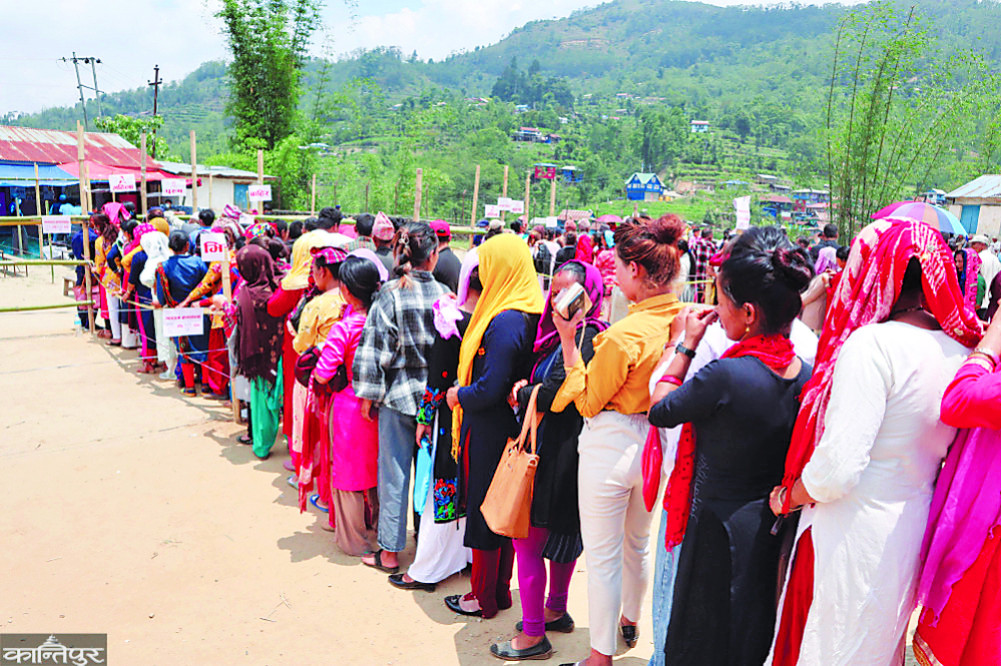
Despite the many political games and accolades taking place in Kathmandu, the general public is still not convinced about the election.
We use Google Cloud Translation Services. Google requires we provide the following disclaimer relating to use of this service:
This service may contain translations powered by Google. Google disclaims all warranties related to the translations, expressed or implied, including any warranties of accuracy, reliability, and any implied warranties of merchantability, fitness for a particular purpose, and noninfringement.
The election bell has rung. Parties have started focusing on tasks such as unification, homecoming, coalition formation, leader import and management. The idea that this or that party is indifferent towards the election is slowly disappearing.
In the past, independent political figures have started accepting the existence of parties. The constitution has allowed some to run as independent candidates, but this constitution has considered the power of multi-partyism as its main capital. The obstacles that may appear from various angles are being removed. As the sun moves from Dakshinayan to Uttarayan, the election begins to be clearly visible from top to bottom.
While various political games and celebrations are taking place in Kathmandu, the common people are still not convinced about the election. That is not to say that the doubts associated with the election are unfounded, but what kind of election will be held, what kind of House of Representatives will be formed by the election, what changes will there be in the manner of MPs and parliament? Kathmandu's election strategists have been presenting their own tentative list of numbers in their meetings.
They are determining the possible status of the parties based on assumptions and prejudices. The people who are still in a hurry are still unable to determine where they will fall. When politics crosses the Kathmandu Valley and reaches the outside world after the hustle and bustle of the National Assembly elections, a new question is encountered. Naturally, if the elections are held, the urgency of finding answers that is being revealed in this way can overwhelm the possible arithmetic of many assessments. The
question has begun to be heard. Even if it has not reached the air-conditioned rooms of Kathmandu. Elections are no longer just a constitutional process, they have become the name of a deep political rift – ‘our elections’ and ‘their elections’. This deep chasm, this terrible division is the biggest irony of Nepali democracy. The simple meaning of
elections is collective decision-making, a common future and a strong expression of the will of the people. But what is going to happen? ‘The hunter will come, he will lay the trap, he will throw the bait’. Each recent election has been manifested as the language of the chair and a symbol of the compulsion of the common citizen. ‘Our elections’ are elections that are endowed with power, resources, media and institutional protection.
‘Their elections’ are elections for the downtrodden, the marginalized, the discriminated and deprived, the poor, the unorganized voters and the uncomfortable questions. It is wrong to interpret the fact that periodic elections are being held or that there is a strong possibility of holding elections within the stipulated time frame after the current turmoil as democracy gaining continuity. Regular elections alone are not a sign of democratic maturity in general. If democracy is limited to voting only, then it becomes a mechanism of consent rather than participation.
Democracy is often understood as the sum of elections. But voting is only a process, not a value. When elections become an end in themselves and democratic consciousness becomes a means, then democracy shrinks into its own sack. This is the situation where citizens become reduced to voters and potential power considers itself free from moral responsibility, and the world is shocked that it has come with periodic mandates.
When ‘defeat’ is rejected in democracy and competitors are considered enemies, then it should be considered that a dark cloud has descended on democracy. When questions that arise during elections are avoided and suppressed, and competition tramples on conscience, the situation that arises in this way also turns elections into an exercise in dominance. And, instead of throwing out the wrong, elections become a ritual of legitimizing another wrong.
What do we consider a politics of value-based integrity? Principle-based, where decisions are made based on justice and injustice, not profit and loss. Rather than power, the attempt to be close to society is considered an effort, that is, power is considered a means, not a goal. Where the courage to accept inconvenient questions is expressed. The people are treated on the same level before and after the elections. Rather than the desire to lead a fanatical, superstitious, and fanatical crowd, the long-term interests of society are taken into account.
There is a readiness to admit mistakes and make immediate corrections. There is a determination to make institutions more effective than individuals. In the current climate, the politics of value-based integrity does not guarantee victory, but it can also make ‘defeat’ honorable and glorious. I remember what Anup Sahni (now deceased), a seven-year-old Janayoddha, said when I met him in Simraungarh a few years ago – ‘The politics that changes color in every election is a strategy, the politics that saves color in every situation is a value-loyalty.’
The politics of loyalty has either become a symbol of an impossible ‘ideal’ or a compulsion. What is needed is to transform power and restructure culture. It is not the removal of one group from power and the ascension of another. It is not necessary to sing the same rhythm together. It is not the intention to find fault with those who indulge in party activities while sitting in the cabinet but pretending to be neutral.
‘Their election’ is not about changing groups or characters, but the end of exploitation, deceit and corruption. It is a serious resolution against discrimination. Corruption does not operate only in a gross political manner, it operates by both the victim and the perpetrator assimilating the logic of the system. This can only be possible by changing the mindset of the common citizen.
In the context of the widespread moral vacuum in the electoral system, this election has become a golden opportunity for populist ideologies. Elections are an essential element for nationalist, racist or fundamentalist fraudsters. Two lines from the Hindi translation of ‘Macbeth’ with the help of Raghubir come to mind – ‘Kinthu yah vichitra ki/ Andhakkar ke anuchar chhalte hai humse/ Sach ke tukde dekar/ Phir hum kahin ke nahin rahate/ Hota hai sarvanash.’ Like Macbeth, today’s manifest messiahs are extremely ambitious and do not hesitate to engage in political swindling to gain power.
Where the hunger to win elections becomes higher than the constitution, democracy becomes sick. Elections are not just a means of changing power, but also a process of making power accountable. Competition without citizen awareness causes the silent death of democracy. We had a constitution, a parliament and a supposedly stable government, why was there a general feeling of emptiness and emptiness? Why was the atmosphere suffocating with suffocation? And, what difficulties can we be sure of getting rid of through the upcoming elections?
If some of the current ministers, even while sitting in the civilian government, loudly declare that they are without a party, and those who make them the pawns of their party hierarchy shamelessly smile, where did the spectacle of electoral politics come from? The tricks shown by the magicians hungry for power and authority remain the same.
In other words, even though the change of seasons has led to the journey of Uttarayana, the wheels of electoral politics are still turning in Dakshinayana. The real test of democracy is not in the election results, but in the election process. Defeat is also necessary in democracy, because from defeat, the competing party or leader learns humility. But here, everyone has to win at any cost. Just as opium seeds are raw materials for heroin addicts, elections are experimental raw materials for them.
Who will bring grassroots people into the mainstream about elections, domination, and resistance? How can political players be connected to these concerns? The masters of electoral politics turn it into mutual competition to make them forget the common pain of identity. How can Laxman Tharu and Resham Chaudhary unite over Tikapur? When community representatives or agents of the movement become the masks of the dominant, then power is divided among themselves.
At present, it is not heard among the deprived in Kathmandu – who do we want to change? Rather, there is a chant – who will provide some relief in the coming time? Electoral participation without resistance consciousness is a repetition of exploitation. Suppressed communities like Madhesh, Dalit, Tharu are seen as vote banks, but they are nowhere in the scenario as political subjects.
In a community that is afraid, disintegration and division begin before unity. Representation becomes meaningful when it starts speaking the language of pain, not the language of the dominant ones. In a deprived society, disintegration, internal conflict, and disruption are not because they are weak, but rather the potential unity among them is considered the biggest threat and the act of disintegration begins even before it can pose a threat. The electoral coordination between Madhesi forces or the polarization of Madhesi society into ‘Hindu and Muslim’ is being done with a similar tendency.
For them, elections are no longer a celebration of democracy, they have become a binocular to watch the world. For those who understand, another fair to be cheated, for those who do not understand, a feast and a spectacle. Parties are not involved in elections because they are giving the people a better option, because they are impatient to climb the ladder of power through this.
Therefore, there is no ideological debate or personal divisions are given the cover of ideological debate. And, such dramas are also vigorously promoted as a natural expression of the true character of Nepali society. Together we hear – ticket, alliance and resource management and bargaining.
This is ‘our election’. Where the results are decided in advance, the voters are counted later. Faces are brought in and the issue is covered up. Where, not questions, but cheers are heard. Votes are drawn in the name of nationalism, stability, miraculous development and fear-mongering, and thus democracy is not won through elections, but the power of the dominant ones re-establishes itself. In ‘their election’, voters want to ask questions but no one is listening. In this election, unemployed youth vote but also prepare to go abroad.
They give advice and scolding to their family members from abroad on who to vote for, but they are never able to tell the country that they will return permanently. This election where Madhesi, Janajati, Dalit, Tharu and others are voters but not decision-makers. Neither do signs of change appear by voting nor does the fog of change clear without doing so. Therefore, this crisis is not about the election, but rather about the meaning and intent of the election. When an election is held for power, it becomes ours; when it is held for society, it becomes common to all. The question of democracy lies in this – whose election is this?