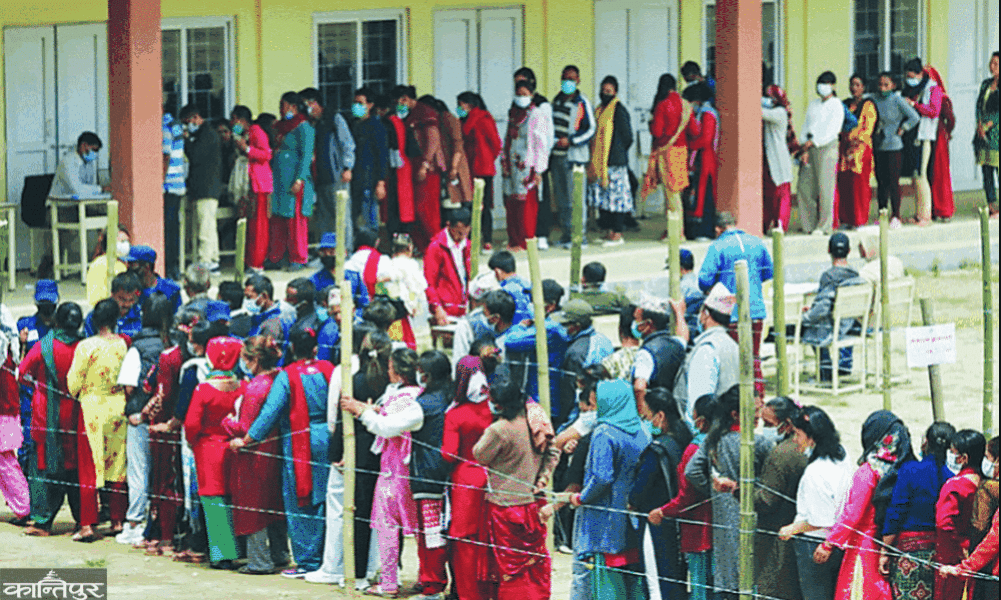
Elections that are held while barring a quarter of the country's citizens from voting cannot be considered legitimate. A democracy that fails to ensure realistic representation of the general public, regardless of where they live, is truly incomplete.
We use Google Cloud Translation Services. Google requires we provide the following disclaimer relating to use of this service:
This service may contain translations powered by Google. Google disclaims all warranties related to the translations, expressed or implied, including any warranties of accuracy, reliability, and any implied warranties of merchantability, fitness for a particular purpose, and noninfringement.
Nepal's democracy is based on federal, inclusive, and participatory republican principles. However, millions of Nepalis living abroad (migrant workers, students, businesspeople, and families) are denied the right to vote in national elections.
They have probably contributed the most to the nation compared to other groups, but whenever elections come around, their voices are silenced. Amidst these contradictions, the foundations of our democracy are weakening.
Immigration in Nepal is not a plot commentary. It is a reality. About half a million work permits have been issued in the last decade. This figure does not include Nepalis who have gone to India, students who have gone abroad for studies, and workers who have gone abroad informally. In fact, a quarter of adult Nepalis, who are entitled to adult voting rights, live outside Nepal. The remittances they bring into Nepal have been strengthening the Nepali economy even during the people's war, the COVID-19 pandemic, and the recent Gen-G movement. Our foreign exchange reserves fluctuate in proportion to their labor status. However, despite this, they are not allowed to vote in elections, which are the process of selecting national laws, policies, and leaders that affect the way of life of ordinary Nepalis.
The difficult life of Nepali migrants is proving this kind of exclusion even more challenging. To some extent, they have to endure hardship even before they board a plane abroad. They have to face problems such as fraudulent manpower-consultancy, high fees, cheating in contractual provisions and deprivation of legal protection. Some have even become victims of exploitation and sexual abuse in Nepal itself. Similarly, thousands of workers are returning to Nepal with life-threatening chronic diseases or in wooden boxes. Despite this, our foreign employment laws are outdated and incomplete, while the structures built to protect migrant workers do not seem to be a priority for the government. Without political representation, issues of workers' rights and interests are fading into the background in national policy-making. Therefore, the right to vote has become a matter of existence and dignity for migrant workers, rather than a constitutional vision.
In order to address the injustice faced by Nepali migrant workers, we filed a public interest litigation in the Supreme Court in 2017 to ensure their voting rights. Hearing this matter, the Supreme Court issued an order that was even more progressive than our demand. In that order issued in 2018, the Supreme Court declared that not only migrant workers but also all Nepalis living outside Nepal should be able to exercise their voting rights. The order explained that it would be unconstitutional to discriminate against citizens on the basis of their place of residence and deny them the right to vote. In addition, through that order, the Supreme Court directed the Nepali government to take necessary steps to ensure that voting can be done from outside the country by conducting pilot programs, registering voters abroad, establishing new legal arrangements, and diplomatic coordination. Through that order, a clear constitutional basis was set for granting voting rights to the Nepali diaspora living abroad for the first time in Nepal.
Even after the years since the order was issued, little progress has been made. It has been argued that the system for voting from outside the country is too complicated and expensive. However, more than 150 countries around the world have adopted this system. There are also some countries that lack resources compared to Nepal. For example, the Philippines has been making arrangements for voting from outside the country for the past two decades. Similarly, many countries including Mexico, Indonesia, Sri Lanka, and South Africa have naturally adopted this system. Even countries like Senegal and Tonga, which are considered to have weaker economies compared to Nepal, have ensured the voting rights of their citizens living abroad, considering their contribution to the national economy and stability. Therefore, the argument that making arrangements for voting from outside the country will be expensive for Nepal does not seem to be a product of technical weakness but rather a political reluctance.
After the Gen-G movement of 23 and 24 Bhadra, the political environment has changed to a great extent. For a democracy that is accountable, good governance and adequately represents all citizens, the immediate implementation of an out-of-country voting system seems to be a key and pressing demand of the younger generation, especially the youth of the Gen-G age group. Perhaps for the first time since the Supreme Court’s order in this regard, there has been clear and sustained political pressure to provide an out-of-country voting system.
Addressing this public sentiment, the new interim government led by Prime Minister Sushila Karki made a public commitment to provide voting facilities for the Nepali diaspora in the upcoming elections. This commitment has also been given legitimacy by the recently concluded agreement between Gen-G and the interim government. If implemented, this agreement will strengthen the legitimacy of the electoral system and restore public trust through the most meaningful expansion of adult suffrage in Nepal’s modern history.
What is sometimes overlooked is that the institutional foundation required for an out-of-country voting system is already in place in Nepal. For example, the Election Commission had included a provision for out-of-country voting in its strategic plan years ago. The commission has already studied the feasibility of systems such as embassy-linked voting, postal voting and electronic voting for its implementation. The commission has drafted guidelines for the provision of voter registration for citizens abroad and has assessed the technical and logistical requirements.
In addition, civil society, think tanks and international partners have been conducting extensive research, public training and advocacy on out-of-country voting, from which Nepal can obtain adequate methodology and suggestions in this regard. In essence, Nepal does not have to start from scratch. The foundation for this is already in place.
Data and evidence from studies have shown overwhelming support among Nepalis abroad. A recent study by the Labour Network and LapsoJ found that young migrants abroad are very eager to exercise their right to vote. They are unable to return to Nepal during the election, despite being registered as voters. Despite being among the most affected groups, they are unaware of the Supreme Court’s order on the system of voting from outside the country due to the inaction of the Nepalese government. However, Nepali migrants of all age groups seem to be interested in voting. Migrants in Qatar, Kuwait, Malaysia and other major labor destinations seem to have expressed a near unanimous desire to participate in the election, emphasizing the option of electronic voting. These results obtained during the study prove that the demands for migrant suffrage are realistic, deeply felt and coherent.
We are at a crucial time now. This is perhaps the first time in history that Nepalis have had the political will, institutional readiness and public demands aligned. Implementing a system of voting from outside the country is not just a technical improvement but a matter of integral democracy. Elections that are held by barring a quarter of the country’s citizens from voting cannot be considered legitimate. A democracy that cannot ensure realistic representation of the general public, regardless of where they live, is truly incomplete.
The system of ensuring the voting rights of Nepali citizens living outside the country does not only implement the Supreme Court order and the Constitution of Nepal, but also sends a strong message that Nepal treats every Nepali citizen equally. It will ensure political representation of the voices of migrant workers, make Nepali lawmakers more accountable on labor and immigration policies, and bring Nepal closer to international democratic standards. Above all, it will further strengthen the sacred relationship with Nepal for millions of Nepalis working in countries thousands of miles away from the country.
Second, ensuring the voting rights of migrants plays an important role in breaking the existing patron-client relationship between leaders and voters and creating a non-client-oriented voter class that is essential and relevant to the younger generation. In the past, the client-oriented relationship of leaders-workers-people has been found to have sidelined the fulfillment of demands for public goods, services, and accountability, favoring private interests or favoritism towards private individuals. Therefore, the role of the Nepali diaspora’s political remittances will be important in breaking down such leader-worker relationships and encouraging a social contract between citizens and their representatives.
Nepal cannot afford to waste this opportunity. The current interim government has an unprecedented opportunity to correct past injustices and reshape the country’s democratic future. The Nepali diaspora has been keeping Nepal moving even in dark times. Now, Nepal must include them in the national democratic system.
This is the time to make immigrant suffrage a reality. A democracy that excludes millions of its people cannot fully proclaim itself. Nepal must embrace inclusion this time. Nepal must choose justice this time. And, finally, this time, Nepal must welcome the voices of its anonymous citizens who are trying to return home.