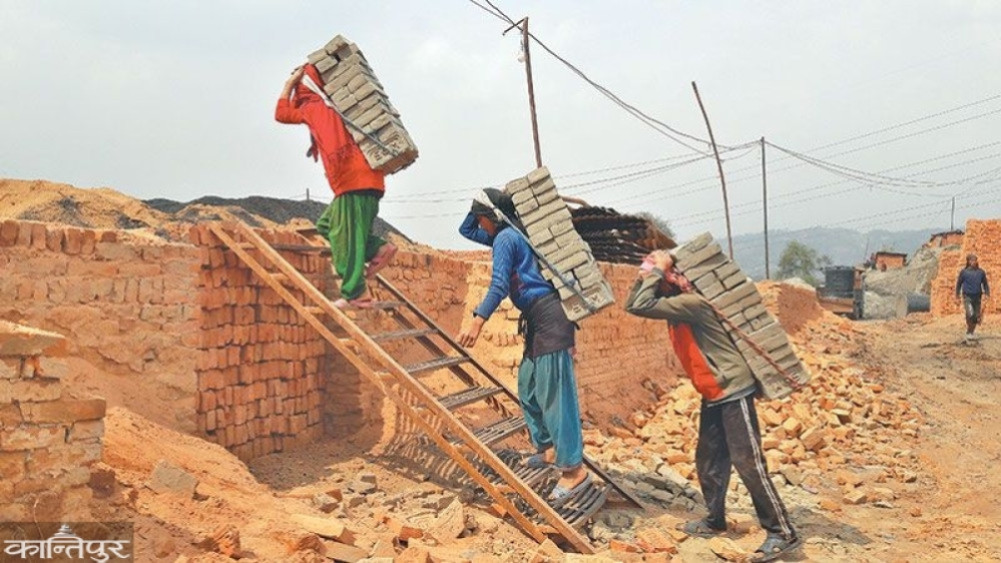
The state needs to play an influential role in intervention, facilitation, security, and domestic production in certain areas for the benefit of the common citizen.
We use Google Cloud Translation Services. Google requires we provide the following disclaimer relating to use of this service:
This service may contain translations powered by Google. Google disclaims all warranties related to the translations, expressed or implied, including any warranties of accuracy, reliability, and any implied warranties of merchantability, fitness for a particular purpose, and noninfringement.
UML General Secretary Shankar Pokharel and Congress General Secretary Gagan Thapa agreed that the only parties in the country should be the Congress and the UML. Sher Bahadur Deuba and Khadga Prasad Oli formed the government of the Congress and the UML, breaking the tradition of the first party to be in the government and the second party to be in the opposition in parliament, as per parliamentary tradition.
In fact, it can be understood that the formation of the coalition government of these two parties was oriented towards a two-party system from a multi-party system. As practiced in wealthy countries, they wanted to run a two-party system in Nepal. But the formation of a two-party system in Western countries was not as simple as expected.
In the background, the changes in the production system and class struggle played a major role. The two parties, especially the liberal left and the liberal right, were separated by a new progressive economic and political theory. It is necessary to understand how the parties that call themselves progressive, and even socialist and communist, were born liberal progressives.
Most of the parties in Nepal prefer to call themselves socialist, leftist, progressive, but when reading their manifestos, when they reach the government, it does not seem that they have been able to show even the minimum qualities of what kind of political and economic programs are required to be called progressive or what kind of statements are required and implemented.
The Congress and the UML have been parties that have been supporting the neoliberal market economy for a long time, and while forming the coalition government, they had decided on a minimum consensus program based on that market economy. Their coalition government, which had a two-thirds majority in the federal parliament, collapsed like a house of cards within a year and a half due to a small rebellion by the Gen-G generation.
In particular, the main reason for the collapse of this coalition can be attributed to their lack of principles and the renaissance against supporting the status quo. Even after the Gen-G rebellion, the leaders of these parties do not seem to have come to the conclusion that the main reason for the rebellion of 23-24 Bhadra is underdevelopment, unemployment, and unequal distribution of wealth and income. Even after the rebellion by the new generations, these parties do not seem to have changed their thinking about the economic system.
If we are to adopt the same kind of economic and social policy, we do not need two parties. However, what has happened since then is that more than twelve dozen parties have been registered with the Election Commission in a country with a population of three crores.
However, they do not seem to have presented a clear roadmap for the country's economic development. Despite the calls for socialism and democracy in the manifesto, they do not seem to have chosen the option of a market economy. But the country is going through a serious economic crisis, and to get out of this crisis, it is necessary to at least find an alternative to a progressive economy.
The historicity of the left-wing progressive economy
The progressive economy model was not formed in a day or night. In the late nineteenth century, the economies of the developed European and American continents had to face several depressions. As precarious work, low wages, curtailment of labor rights, mass unemployment, environmental destruction, public health issues, and political corruption at all levels of government became widespread, tumultuous uprisings and revolutions ensued.
Therefore, these changes were widely discussed and debated in intellectual circles there. They also came to the conclusion that if the state has a strong presence in the economy, the national economy becomes democratic, if employment increases, a state of public welfare is created, and national prosperity is achieved.
A progressive economy is about balancing the private sector and public activities and achieving national goals through economic growth on the basis of equality (Ruy Teixeira and John Halpin, March 2011, The Origins and Evolution of Progressive Economics Part Seven).
In contrast, the open market demands a weak or insignificant role for the state in the economy. The market economy seeks to reduce the social security provided by the state to the general public. It opposes the work of creating a strong plan for the social economy, that is, planning.
It discourages the work of establishing public ownership of the means of production or making structural changes so that everyone has access to ownership of the means of production. It proposes the production of social services and goods, security, regulation of private sector activities, and the contraction of public goods and services. This economic system of the late nineteenth century was also called the ‘laissez-faire economy’.
It was against this ‘laissez-faire economy’ that the German Social Democratic Party first put forward a 10-point progressive economic and social program in 1891. Such as eight-hour work, ban on employing children under 14 years of age, ban on night work, worker protection and minimum wages, guarantees of medical treatment for injuries, disabilities and illnesses, etc.
The issue of the second phase of progressive economic transformation arose in a larger scale in the third decade of the twentieth century. At a time when the world economy was in a state of stagnation due to the Great Depression of the First World War, Polish economist Michael Keleski and English economist John Minyard Keynes put forward broader ideas. The main issue they raised was state intervention in the economy.
They gave the mantra that during the economic recession, the state should increase aggregate demand by spending a deficit budget and imposing low taxes. During the recession, the market should not wait for itself to be purified.
The government needs to manage demand through fiscal policy (spending/taxes) and the central bank through interest rates. During the recession, the state should have a role in government spending, increasing employment, and controlling inflation by imposing taxes when there is excess production. If the balance between the state and the private sector is achieved, economic prosperity will not have to wait very long.
The third phase of progressive economic transformation can be considered the economies adopted by Latin American countries. The years from 2000 to 2020 are considered the ‘pink tide’, i.e. the time of progressive governments. Latin American governments tried to eliminate inequality through social spending during the first phase (2000-2010). For example, they increased the minimum wage and advanced the cash transfer program from the income received from mining and minerals (oil and mining).
That led to a drop in the Gini coefficient from 0.51 to 0.47 in countries like Venezuela and Bolivia. But in the second phase (from 2010 to 2024), especially after COVID-19, it is facing difficult times. In recent times, the government that calls itself progressive seems to be facing difficulties due to its inability to make structural changes for economic and social transformation. For example, high inflation, debt, and weak economic growth can be taken into account.
China has been putting forward the Common Prosperity Program for All since 2018. Its main purpose is to reduce inequality in wealth and income by increasing the minimum income of the class below the poverty line. To provide access to education, health, and social activities for all. Regulation of capital, especially capital that expands in an extraordinary way, including regulation of high tech, real estate businesses, etc.
To prioritize investment in the development of provinces to reduce regional inequality for balanced development. Progressive taxes, welfare programs, and structural changes when necessary. Developing and implementing economic growth plans with the common people at the center. These campaigns have been moved under that program (Michael Dunford, March 9, 2022, The Chinese Path to Common Prosperity, International Critical Thought, Routledge).
What kind of left-wing party implements a progressive economy?
What does it take to be a left-wing progressive party? How did the idea of joining the party come about? What ideas and beliefs inspired Homin to fight for progress? What is the goal of society, that is, what kind of society is the goal of building? What institutional practices will be developed to achieve the goal of building society after reaching government? Who and how will they prepare alternative programs to overcome the shortcomings of the past? These are common questions asked of parties that call themselves progressive, democratic, socialist, and communist parties.
A left-wing-progressive party needs an ideology. Ideology gives identity. As soon as the word communist party is said, it is understood as a party oriented towards socialism and communism. The theory brands the values and beliefs of the party. It gives a different identity among competing parties.
The theoretical ideology adopted by the party creates a base of support and well-wishers for the party. On that basis, the party system becomes strong. Second, only a party with an ideology prepares a programmatic framework and takes political decisions accordingly. It teaches us to identify the areas in which the state should intervene and the issues on which social responsibility should be borne, especially in the economy.
Third, only a party with an ideology adopts a strategy for gaining power by setting a social and political program. Fourth, a party with a theoretical ideology presents a commitment to the people for state transformation through an election manifesto and implements the commitment after being elected.
If the structure of the state's economic and political components needs to be changed for transformation, it will gird itself to change the structure without hesitation. But parties that are not guided by ideology continue to uphold the status quo and exploit the state for personal gain and do not fulfill any responsibilities during their tenure and do not implement commitments.
Nepali political parties have long lost their identity as per their names. There is no difference between them. Due to the lack of commitment to the principles and ideology as per the name, the existence of both the old parties of Nepal and the country is being threatened.
In the Nepali context, all parties have been promising social security in the words of their manifestos. They talk about income generation and redistribution of wealth for economic equality and social justice.
They promise radical reforms in the democratic system to serve the people. But they have established a practice of entrusting the market with all these tasks. Whether they call themselves liberals or leftists, these are the practices they have practiced for three decades with about two dozen business houses, one hundred to one hundred bureaucrats, and the ‘caucus’ at the leadership level of the ruling and opposition parties.
Whether they are forming new parties by breaking away from old parties or are forming new parties spontaneously, it is important for them to understand that a country like Nepal can no longer sustain a neoliberal market economy. As explained by neoliberal pundits, the explanation that neoliberal markets favor efficiency, innovation, transparency, and the rule of law has proven to be wrong.
The weak role of the state, privatization, and deregulation have left the country plagued by corruption, black marketing, and dishonesty. At least in the areas where the economy needs it, the role of the state has become indispensable. The state needs to intervene in certain areas for the benefit of the common citizen, provide concessions, security, and play an influential role in domestic production.
Economic agenda of the Left Progressive Party
1. Reconstruction of the Nepali agricultural sector: The agricultural sector is the primary sector of the economy. The current trend of land degradation is not boosting the Nepali economy. Access to arable land for farmers working in agriculture is still a mandatory condition. Therefore, if we are to be correct, land reform and management are still necessary in the agricultural sector.
2. Industrial strategy development: It is necessary to carry out a Nepali industrialization campaign by linking it with the agricultural sector. For that, new research and surveys, fact-based planning, and new institutional systems are necessary. The main objective of industrialization should be to increase employment and increase exports by increasing production. For that, first of all, it is necessary to establish and protect enterprises with comparative advantages. For that, coordination is needed, not competition, between the public and private sectors.
3. Social justice and equality for industrialization and productivity growth: It is necessary to end discrimination on the basis of caste, region, gender, religion, disability, etc.
4. Economic intervention and regulation: Although not mentioned in government statistics, economic inequality has become widespread in Nepal. For that, state intervention in the distribution of income and wealth is a mandatory condition. That means setting a minimum wage, labor rights including the right to form organized unions, management of progressive taxes, and provision of unemployment benefits like a social safety net.
5. Environmental protection: It is the duty of any progressive left-wing party to protect nature. Nature itself provides us with many resources. Protection of water, forests, and land is indispensable. It is essential to regulate investment in renewable energy, construction of roads or railways, or opening industries that can spread pollution.
6. Provision of education, health, and housing: A party that prefers to call itself left-wing progressive should, once it reaches government, at least guarantee proper provision of education, health, and housing in accordance with global standards. Privatizing these services and leaving them stranded in the market is an insult to the word left-wing or progressive.
7. Establishing and reviving democratic values: Promoting secularism and pluralism is a mandatory condition for any left-wing progressive party. Protecting human rights enshrined in the constitution, protecting everyone's participation in development decisions, protecting voting rights, reforming banks and financial institutions to provide financial reform and affordable and accessible credit to the common citizen, and protecting the interests of the country from corporate greed are essential conditions for progressivism.