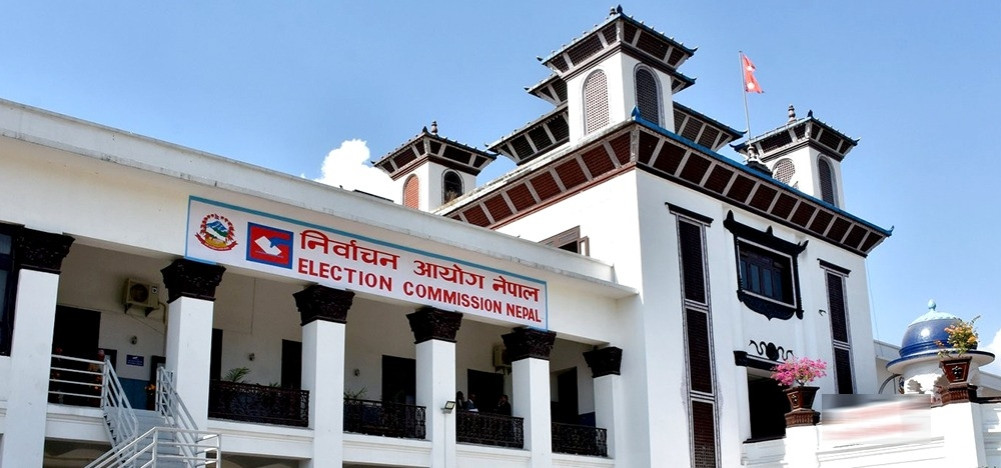
Look at the names of the parties registered with the Election Commission - Democratic, People's, Socialist, Revolutionary, Communist, Nationalist! The names are like this, as if all the parties have printed the same 'branded' name on the same card printer.
We use Google Cloud Translation Services. Google requires we provide the following disclaimer relating to use of this service:
This service may contain translations powered by Google. Google disclaims all warranties related to the translations, expressed or implied, including any warranties of accuracy, reliability, and any implied warranties of merchantability, fitness for a particular purpose, and noninfringement.
One hundred and twenty parties have been registered in the Election Commission's documents. At first glance, the large number of political parties listed may seem to have widened the scope of competition. The public will have many options to choose from. Of course, the more parties, the more people's voices are expected to be voiced.
It can be interpreted as an opportunity for each party to accept a healthy challenge to get to know the people and thereby enhance democratic participation. This can open alternative doors for leadership development. If more parties reach the people, it may help increase the critical awareness of the people.
The scope of political training can expand. It can be hoped that monitoring of the government's election management and vigilance against possible irregularities by competing parties will increase. This is not a two-party system, but a multi-party system - so the majority of parties is natural, it is argued from one angle. Doesn't the inability to support more parties mean that citizens do not believe in themselves?
But, do all the parties registered in this way participate in the electoral competition? Democracy and elections complement each other, if democracy is incomplete without elections, why do some of the listed parties deprive themselves? What are the reasons behind the attempts to register with the Election Commission or the experiment of participating in electoral competition? If democracy is a system of governance with accountability and transparency, then it is necessary to examine whether those who claim to be the representatives of the people have truly achieved this in practice.
Starting a party and contesting elections is a civil right. Some people believe that starting or competing parties will increase their social identity. According to them, it is desirable for the people to create an alternative to the old ones, to think about and prepare for it. Therefore, vigilant citizens should not remain neutral with the operation of the state, but should continue to guide the state in a positive direction with active participation.
For democracy to continue to be successful, continuous citizen vigilance is required, but an organized effort for that is to open a 'party'. The existence of a party did not come about without a reason. For some, this is a pinch of courage to make a hole in the sky.
Hindi poet Dushyant Kumar has a famous line, ‘How can a hole be made in the sky, a stone can be thrown out of a person’s body.’ Classes, parties or groups that do not usually get the opportunity to field candidates in the current electoral grammar, form parties even to attract attention. Some seem ready to round up the anger of those inspired by ideology, worried about the disintegration of ideology.
But, where does the matter end? It is important to understand that the leaders should be able to make their own decisions to form parties. However, since many elements in the Nepali power structure have encouraged the formation of parties in this way, the number of parties has also increased. Strong candidates help form pocket parties to use resources in the elections.
Some characters are bargaining in the election market by carrying the name and election symbol of the party, for some this is profitable farming. They keep the 'brand name' of an active party of a certain period in their pockets legally and eagerly await the election stock market. The increase in the number of parties in this way also does not bode well.
A party registered once does not remain permanent. Some prescribed process must have been completed for party registration. Despite this, there is not much debate about the political business cycle that runs after opening a party. The story of Ayaram-Gayaram is happening because of such multifaceted parties with a majority. If you do not get a ticket from the previous party, there is space to immediately change parties.
Rather than dividing the parties into groups based on whether they are good or bad, it is inevitable that new or small parties should also operate along with the big parties. Since the influence of the old and big parties is widespread, it is natural that a thousand eyes are on them. However, those who claim to be alternatives in the name of the new cannot be ignored. Being old does not make them stale, nor does being called new make them fresh. Currently, the state of good governance is weak and citizen dissatisfaction is high.
In this background, there is a public psychology that expresses its dissatisfaction through vote changes in elections, but will the people, instead of getting what they want in the name of the new, end up with a poisonous party? It is reasonable to be careful. How much are the old ones trying to be true or how much are those eager to be called new coming to terms with themselves? The fate of the present will decide that.
Look at the names of the parties registered with the Election Commission - names like democratic, people's, socialist, revolutionary, communist, nationalist are hanging around. Like a tree of Barmazhiya, they have the vision of confusing the country by spreading the illusion that they are the real 'brand'. The name itself is like this, as if all the parties have printed the same 'branded' name on the same card-printer. The people want a different style of work.
By keeping a dark name, neither is that party considered a shadow trader, nor is it considered a symbol of purity by shouting 'light'. From which background are most of the participants who want to start a new party coming? How many so-called professionals remain ‘loyal to their manifesto’? How much meaningful inclusion is there? Looking at the emergence of new parties, it seems that some leader did not like the old house, so he demolished its walls and hung a ‘new’ board in front. Looking at the party market, one hears the comment of the common man – there is a ‘black market’ of ideology in the country.
There is no ban on opening parties now, this is not the era of active monarchy where parties are banned. The people have sought transparency and accountability. Why hide the inner desire of party politics and electoral competition, even in a temporary electoral government, but maintaining a party for hire? Why keep the key to the party even after being imprisoned by the Supreme Court? How can the country rise when such a character comes to destroy the law? In this way, new parties look more like a ‘re-start button’ for political entrepreneurs than an alternative. To say
, the leaders of the new parties say, ‘We are against the old ones’. However, only their ‘against the old’ is new – their nature, style, and structure are all old. Having a large number of parties is not a problem in strengthening democracy, but a disorderly plurality is definitely a problem.
The gist of the chatter heard on public transport in Kathmandu is, ‘The party registration process is so easy that just as you buy a ticket and board a bus, similarly, you register a party by submitting a file. There is no ideology, no internal democracy, no clarity of members. The most difficult thing is choosing a party name because there are so many similar names that it is difficult to come up with a new one.
The party’s cadres are joining that party, the same praise, the same thirst for petty gains. The old parties are like fifty-year-old machines, worn out but not shutting down. The candidates recommended by districts are the same, the issues are the same, but the jargon in speeches is new.’ Such references expressed by the common people illustrate the restlessness that has grown among the people.
Elections are a celebration for the people, but they have become just a 'project' for the parties. Elections are an opportunity for the people to exercise their franchise, but the parties have taken it as a 'mega-tender' and in this way, voters have been made into just a 'target group', the people are no longer Janardan. Basically, 'manifesto fatigue' has begun in the country. Will inferior content come in the name of alternatives? A committed resolve is needed to spread an atmosphere of integrity, transparency, and purity among the party's workers. Real democracy is seen when the party walks ahead of the people, not behind the Janata Dal.
Society is waiting for a leadership line that will draw a new line, strengthen the civil power, and accept the sovereignty of the people rather than military blessings. One who can ask tough questions about the present and at the same time show a prudent picture of the near future.
We are waiting for parties that will continue the existing political achievements to strengthen the people and make sincere efforts for more. In democracy, a party is not a 'contractor', it cannot guarantee on behalf of anyone. A party is accepted as only an organized 'representative' of the people, and when this is forgotten, a political crisis begins. A party that has lost its dialogue with the people gets stuck somewhere like a car with a 'clutch' failure in elections.
Now, when the people are speaking, the process of unification and front-lining with various demands is starting, while the characters in the cover are trying to create a puppet power in the name of the people. After this drama has gone on for a long time, democracy has become a 'tragic drama'. The irony of the old party culture is that leadership is not born within the party, only 'lines' are born.
When party culture began to worship individuals, not ideas, then democracy was seen as just a 'microphone-decoration'. A party that considers leadership change a risk is actually putting itself at risk of inertia. When ideas in a party are weak, factions become strong, in such a situation, the 'gesture' of the party leader becomes decisive rather than voice.
Party culture deteriorates when the person who gets the position becomes the party and the person who gets the party is forgotten by the people. When criticism of the party leadership or even the party itself is considered hostility, the party is not reforming, but heading towards decay. Even within the old parties, the 'setting arrangement' of meetings has become a big politics rather than values and ideas.
The past has shown that factions are not a plurality of ideas, but a direct result of the lack of transparency in the decision-making process. The habit of a party remembering the people only in elections is the most expensive weakness of democracy. The people have thousands of questions, but the answers are disappearing in the parties that are open in the name of the people.