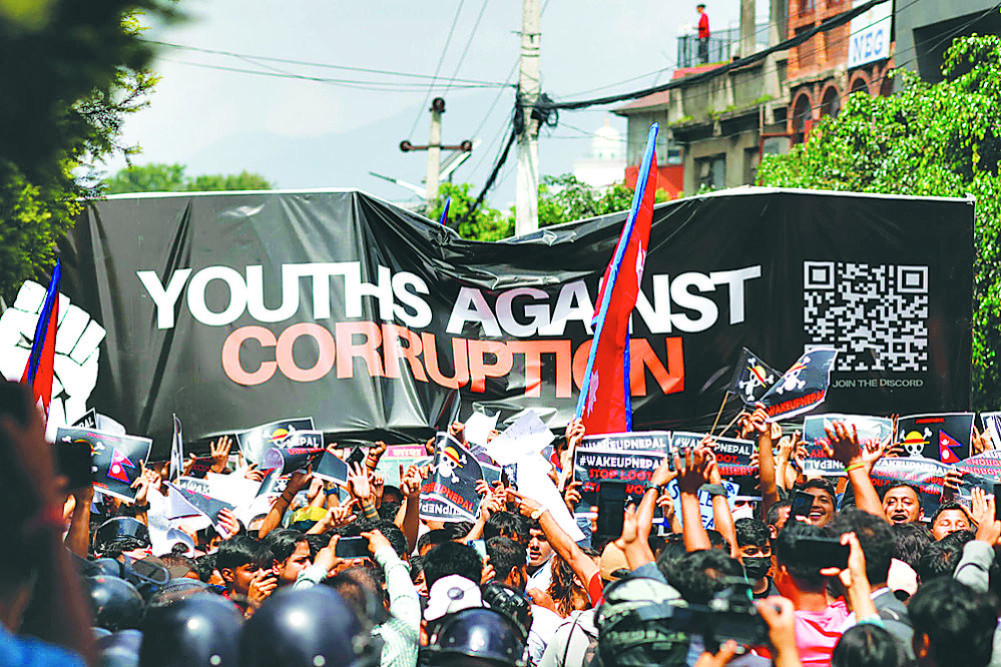
Is the incident of 23-24 Bhadra a 'revolution' or not? Should it be politically verified or will it be decided over time?
We use Google Cloud Translation Services. Google requires we provide the following disclaimer relating to use of this service:
This service may contain translations powered by Google. Google disclaims all warranties related to the translations, expressed or implied, including any warranties of accuracy, reliability, and any implied warranties of merchantability, fitness for a particular purpose, and noninfringement.
After the protests of 23 and 24 Bhadra, the term Gen-G has started to be used a lot in the language. Everyone belonging to this generation has been burdened with adjectives like rebellious, addicted to mobile phones, anarchic, immature, destructive, disloyal, and not following tradition. Such ‘labels’ are not just accusing any individual, but an entire generation.
The aforementioned comments are not just a laughing matter. They are powerful tools for constructing social meaning. Words do not just give identity, they also give meaning, value, blame, respect and accusation. This is why Gen-G has become a kind of social ‘label’ today. Where the multidimensional existence of the individual is being erased. And, like the comments of the humor, words like ‘ticket generation’, ‘immature crowd’, ‘directionless youth’ have started to define a large group.
American sociologist Howard Baker’s ‘labeling theory’ states that what makes a behavior ‘crime’ is not the action, what is crime or deviance is not created by the action, but by the process of how society interprets and labels it. This is why portraying the Gen-G generation as an immature, unstable crowd, anarchy is not a normal reaction. It is a social practice to maintain the generational balance of power.
Especially after the 23-24 Bhadra movement, the more unstable the country became, the greater the instability that society is creating. Which is oppressing an entire generation at once. Possible mistakes in the movement, lack of experience, mob behavior, violence, etc. can be a separate aspect of the analysis. However, the question is also that why was the debate instead focused on the entire identity of Gen-G? Why is Gen-G being interpreted as rowdy, immature, anarchic, destructive?
Fear has arisen at this time. This fear is not only about the immediate political situation, but also about the signs that a new class is being born in society. Which is being ignored. Self-esteem has been questioned. Thoughts have been 'labeled' as immaturity.
Is the incident of 23-24 Bhadra a 'revolution' or not? Should it be politically validated or will it be decided over time. However, one thing is clear – the energy that stood on the streets at that time was not just an explosion of anger, it was a huge wave of questions. Which was trying to revive the dialogue that we had forgotten for years.
The explosion of 23 Bhadau was a sign of political and social dissatisfaction that had been suppressed for years. The destruction of 24 Bhadau was an uncontrolled outpouring of emotions. Both cannot be weighed on the same scale. The instability of the country is a big problem, but a bigger problem is the commentary that is being created in a wrong way by imposing responsibility for it on one generation. If it continues to be suppressed like this, the sorrow that we have not seen but is forming in our hearts will one day come out. At that time, it will be difficult for society to answer.
The age group that Gen-G now represents is the same age group that has been the forerunner of great changes in history. The work of unifying Nepal was not born only from political strategy and military force. At its heart was the extraordinary decision-making power, the ability to take risks, and the unwavering stubbornness of a young man. When Prithvi Narayan Shah started unifying Nepal, he was only about 20-21 years old.
The age of youth is ridiculed today as raw and immature, but that rawness gives them an indomitable imagination. Which awakens the courage to change the status quo. The democratic revolution of 2007, the people's movement of 2046 and 2062/63, and the underground armed conflict were all born in the embrace of youth, the enthusiastic crowd, the energy of the streets, and the ideological heat. Yesterday, those who ate sticks on the streets were of the same age group as today's Gen-G. But at that time, this society respected them as 'patriots', but today's youth are being called 'rabble-rousers'.
Yes, Gen-G uses mobile phones a lot, asks a lot of questions, wants to rewrite traditions. But with a mobile in hand, they can compare the constitutions of the world in two minutes, analyze environmental 'data', and debate. They speak because speaking is not a crime, but being unconscious is a crime. They are the ones who are highlighting issues like student movements, gender rights, mental health, and ‘corporate exploitation’ today. This makes it clear that Gen-G is not a ‘threat’ but a continuation of history. But while walking on the road, listening to conversations on the bus, and listening to debates in coffee shops, I am horrified by the newly created narrative. Will a ‘generation’ be born as a new oppressed class?
If we are understanding the current events only as ‘political unrest’, then it is a continuation of the old vision born of discipline and oppression. But if we can see it as a sharp impulse of cultural-philosophical questions, this is also a historical moment where the seeds of a new consciousness are being born.
In this sense, the change that is happening now is not just a generational change, but a review of human values, a reconstruction of democratic dialogue, and a reinterpretation of power relations. There is instability, risk, and emotional upheaval in this. However, history has always said that it is within this instability that the stable foundations of the future are planted. But there is a serious condition here – if this consciousness does not receive sustainable leadership, responsibility and moral direction, its energy and potential can be transformed into chaos.
Are we a society that has the ability to guide rawness? If we fail in this, the future will not place the blame on the shoulders of the youth, but on our silence, neglect and blaming as a crime.
The invisible mental oppression of the current ‘explanation construction’ is eroding the confidence of this generation. Which has created the danger of breaking the backbone of the future by giving the generation that can lead the country a ‘label’ of blame. If society continues to call those who ask questions ‘guilty’, ‘noisy’, ‘aimless crowd’ in this way, the country will lose the possibility of courage and innovation.
It is clear that history has always taught us that like the movements of yesterday, today’s questions are not just political. Rather, they are connected to the deep structures of consciousness, justice and inequality. Therefore, let the path remain open, let the power to ask questions survive, let the self-respect of seeking answers be protected. Our responsibility is not to burn raw wood to ashes, but to nurture it and transform it into materials for building bridges of tomorrow.
Now is the time, either we can continue to destroy the future by blaming a single generation, or to create a culture of debate. This question is not just a matter of the youth or Gen-G. This is a test of our society, consciousness and social values. Which path will we choose? This question is our sociological test.