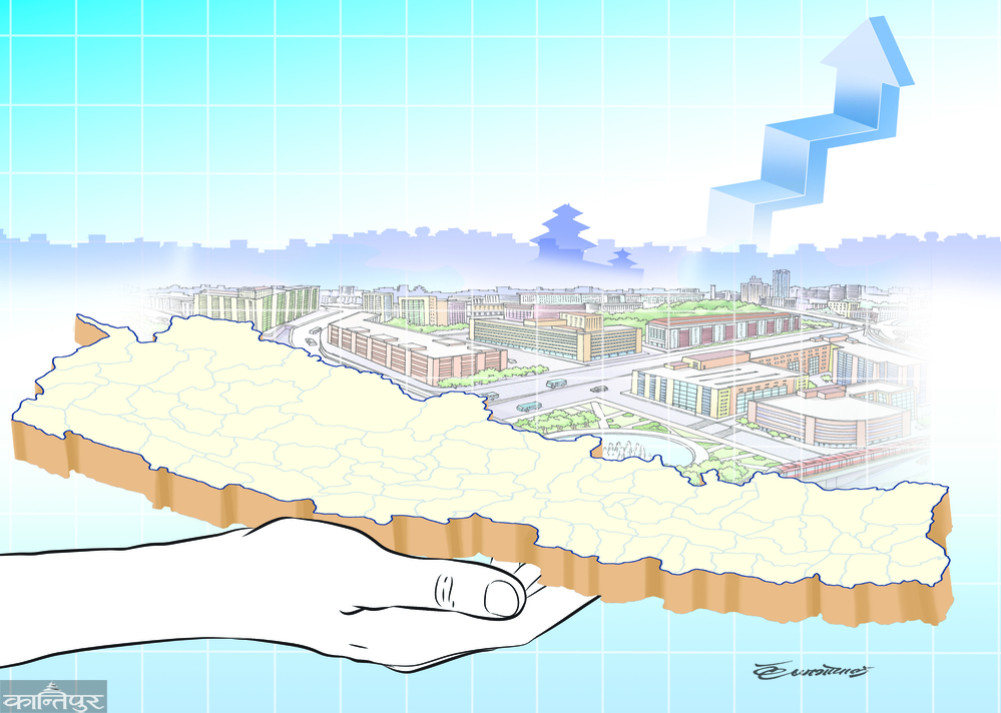
Nepal's graduation from the status of a least developed country is undoubtedly a proud achievement, which will enhance Nepal's international identity and confidence. However, to make this achievement sustainable, economic transformation, good governance, political stability, productive investment, and strengthening human capital are indispensable.
We use Google Cloud Translation Services. Google requires we provide the following disclaimer relating to use of this service:
This service may contain translations powered by Google. Google disclaims all warranties related to the translations, expressed or implied, including any warranties of accuracy, reliability, and any implied warranties of merchantability, fitness for a particular purpose, and noninfringement.
The resolution to upgrade Nepal from a least developed country was passed by the United Nations General Assembly on 23 November 2021. The resolution states that the upgrade to a developing country will take place from 24 November 2026, with a five-year preparatory period. This is a historic achievement for Nepal, but preparatory work such as concrete economic reforms and strengthening institutional capacity are important for this.
There are three main indicators set by the United Nations for upgrading – Gross National Income per capita, Human Assets Index, and Economic and Environmental Risk Index.
Of the three indicators mentioned, Nepal has made relatively satisfactory progress in the Human Assets Index. However, according to the United Nations’ 2024 data, the minimum per capita gross national income required for upgrading should be US$1,306, while the economic risk index should be less than US$1,300 and the maximum of 32. In 2021, it was 24.7 and increased to 29.7 in 2024, which is a sign of a worrying situation.
The common problems of the least developed countries, including Nepal, are low domestic product, low investment, high unemployment rate, trade deficit, high impact of the informal economy, low capital expenditure, weak infrastructure, weak disaster response and disaster risk reduction capacity, political instability, and corruption. All these problems are not partial but structurally deep in Nepal.
In the context of Nepal, the main challenges and issues for upgrading are the growth of production-based revenue, proper mobilization of natural and human resources, development of skilled human capital, employment creation, reduction of corruption, expansion of the tax base, construction of disaster-resilient infrastructure, and disaster risk reduction.
Important for upgrading are the contraction in economic and financial sector growth, persistently high trade deficit (trade deficit of Rs. 1,397 billion in FY 2081/82), which has created great pressure on the external balance. In addition, the low progress of capital expenditure (about 45 percent of the allocated budget in FY 2081/82) and low investment in the productive sector, as well as the relatively low salaries of workers going for foreign employment due to the failure to develop human capital as demanded in the world market, have prevented Nepal from achieving qualitative progress even during the preparatory period.
In recent years, the rate of natural disasters such as floods, landslides, and inundation has increased due to climate change and weather changes. Such incidents have necessitated the mobilization of large resources from the state treasury for disaster mitigation and reconstruction.
In addition, the Gen-G movement of Bhadra 23 and 24 has had a profound impact on Nepal's economic, social and geopolitical structure. The violence, vandalism and arson incidents during the movement have turned peaceful protests into an economic crisis.
Therefore, Nepal has not been able to achieve the expected progress in the economic and financial indicators considered essential for upgrading. Due to low investment in the production-oriented sector, declining foreign direct investment, an import-based economy and low competitiveness of industrial businesses, the economy has not been able to make the expected quantitative and qualitative leap. In addition, due to the lack of skilled human capital, it has not been possible to earn the expected benefits from foreign employment, and there is also a shortage of skilled workers as demanded in the domestic labor market. Investable funds are accumulating in banks and financial institutions, but interest rates have fallen to extremely low levels due to the lack of credit expansion. Similarly, investor confidence has declined due to the fluid political situation and continued instability, the direct impact of which has been seen in the stock market.
After upgrading to a developing country, Nepal needs to strengthen its priority economic diplomacy and focus its relations with political, economic and development partners on productive investment, technology transfer, employment opportunities and export promotion.
Nepal will also have to face various challenges after upgrading. There is a possibility of reduction in foreign aid and grants, concessional loans and market access facilities. Nepal's exit from the status of a least developed country is undoubtedly a proud achievement, it will increase Nepal's international identity and confidence. However, to make this achievement sustainable, economic transformation, good governance, political stability, productive investment and strengthening of human capital are indispensable.
In the context of the current economic structure, lack of investment, disasters and political instability, the possibility of immediate upgrading to provide the expected benefits is limited.
–Upreti is the Deputy Team Leader of Helvetas Nepal.