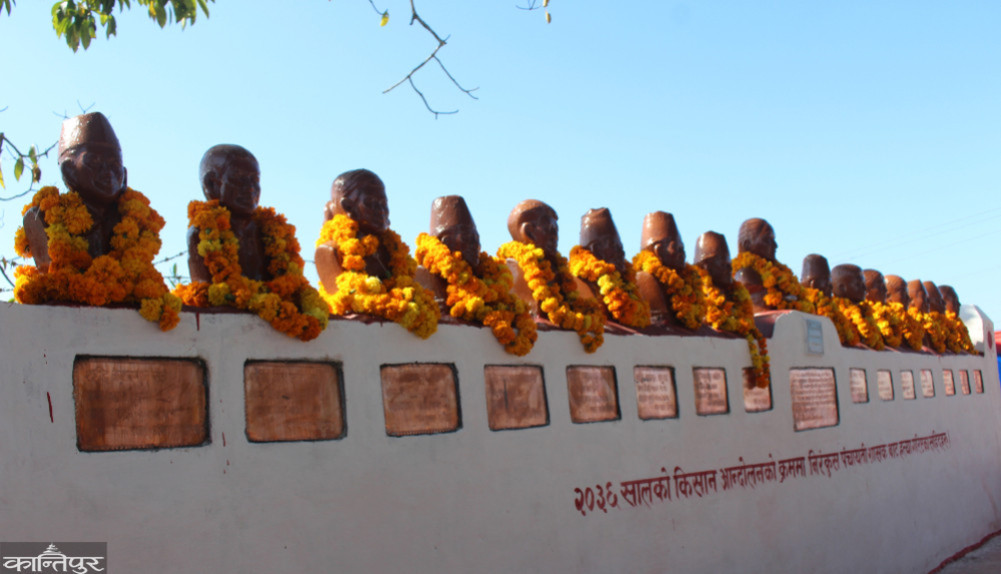
The victimized women fighters of Chhintang are over 70 years old, but they are still waiting for justice. While Arun is dying, the wounds of the female warriors of Chhintang continue to hurt.
We use Google Cloud Translation Services. Google requires we provide the following disclaimer relating to use of this service:
This service may contain translations powered by Google. Google disclaims all warranties related to the translations, expressed or implied, including any warranties of accuracy, reliability, and any implied warranties of merchantability, fitness for a particular purpose, and noninfringement.
There is a song – Khoku Chhintang Dukho Ki Arun Susada.... This touching song reminds us of that historic Chhintang tragedy of 2036. It was a big event that we were hearing/reading about. However, when I reached the scene myself, I felt that tragedy up close.
When I reached Chhintad village in Dhankuta's Sahidbhumi rural municipality in the last week of Baisakh, the scenes of that incident kept replaying in my mind. When I reached the village, the previous wave of people in the courtyard were still there – three women along with a man who had been imprisoned in the 2036 peasant movement.
That Chhintang massacre
In 2031, a teacher named Bam Dewan had reached Dhankuta. With his presence, the children of the village started receiving formal education through schools. A kind of awakening had begun to spread in the village. The locals and the youth had organized and started raising their voices for justice.
In 2036 BS, famine struck Khoku Chhintang village. However, the limited wealthy farmers of the village had been storing food grains for years. When the villagers were about to leave the village due to hunger, some people were storing food grains in their homes to last for years and to sell.
Similarly, some youth in the village requested that the food grains in the landlord's house be distributed to the people in famine, 'on the condition of paying later'. Some agreed, some did not.
The farmers who were in the grip of scarcity and famine had no choice. When the famine struck the village, the farmers who hid the grain were not ready to lend it to the farmers despite repeated requests, a group of youth and farmers united and went to the rich and started a campaign to break the grain. And, keeping enough grain to feed the creditor family for the whole year, the remaining grain was distributed to the locals on the condition of ‘paying later’.
That grain seizure incident took a violent turn. Locals Chinta Bahadur Poudel and Baksaman Rai filed a complaint with the then District Administration Office against the grain grabbers. Based on that complaint, arrests were started against local young farmers from Asad 2036.
Rape incident that was forgotten along with the Chhintang massacre
The village youth and male farmers were not the only victims in the Chhintang massacre. There is a long series of rape, violence, humiliation and mental torture that dozens of women suffered at that time. All of which is forgotten. According to locals, in that incident, pregnant Laxmi Rai and two-day-old Shrimaya Rai (Hankkhila Saili) were dragged to the edge of the field along with their child and raped and murdered.
Despite extreme oppression and torture, Jhapendra Rai, who survived, died in Magh due to lack of treatment. 31 youths related to the incident were arrested and sent to various jails with sentences of up to 18 years on charges of robbery. Advocates Subash Nembang and Shambhu Thapa represented them.
During the statement in the case in 2043 BS, Krishna Bahadur Rai said that he had given food and money voluntarily after being raped. The victim won the case and was released from prison after seven and a half years. Many of them have since died.
During the conversation with me, local people of Chhintang, including Rekha Rai, Narayandal Rai, Baksman Rai's son Ramprasad Rai, Mardabahur Rai, Pokhman Rai, Chitraman Rai, Malsuram Rai, Gokelman Rai, Gurdabahur Rai, Shukta Bahadur Rai, Meena Rai, Birimdhwaj Rai, Balunsari Rai, Sharada Rai, Buddhaman Rai, Krishna Rai, Gorkhamaya Rai, and others, narrated a list of torture and rape against women.
At that time, the wives of men who were killed and imprisoned were pressured by the police and other village elders to remarry in a planned manner. They say that the police and elders put mental pressure on them by saying, 'There is no way for a husband who is in prison to return home, get married again.'
When the husband was in prison for a long time and the family was disintegrating, some women remarried in the village. However, after years of being released from prison, the farmers did not show any anger even when they saw their wives marrying someone else.
What we learned from the conversation was that there was no provision for food, shelter, or security at home. In such a situation, since it was not decided whether they would return home, the husbands were happy that their children and wives got security when they remarried. Some of the women who remarried behave amicably with their ex-husbands and men with their ex-wives, and even continue to cooperate in fairs.
Those who did not fall under the eye of the republic
There was a lot of oppression against women who joined the fight alongside men. The police entered every village, beating and beating men and women wherever they found them. Rekha Rai is a warrior who joined the fight alongside men, who not only suffered deprivation and struggle, but also witnessed the torture and violence against women. She is an eyewitness to many incidents where girls and mothers were raped by the police. She has not yet forgotten that pain. Even women in childbirth and pregnant women were not safe.
According to Rekha, after many male farmers were arrested and sentenced to various prison terms, a group of more than 30 women went to surround the police station, some clashed with the police to save their husbands from arrest, shouting slogans. The police, in turn, began threatening the protesting women.
Despite the police's abuse, torture, and threats, there were three women who remained steadfast in the village - Rekha, Meena, and Sharda Rai. Even when their husbands were in jail, they would participate in political discussions and meetings in the village. Women who were active in political activities, saying, "Even if their husbands are imprisoned, they will not marry again," continued to be a target in the eyes of the police.
After the advent of multi-party politics in 2047 BS, the state provided compensation of Rs. 100,000 each to 16 families who had sacrificed for social justice in the Chhintang incident and Rs. 50,000 to 31 families who had spent their lives in prison. However, despite the police beatings, mental torture and violence, the women fighters who are struggling in the villages are still in the shadows. The raped women have not received compensation either. Even after the establishment of the republic, the women fighters of Chhintang have not received any relief from the state.
The women fighters of Chhintang are over 70 years old, but they are still waiting for justice. When Arun dries up, the wounds of the women warriors of Chhintang continue to hurt.