Thus, the interpretation of secularism can encompass the sentiments of the majority of Nepalese people who follow the Sanatan Dharma. On the one hand, the protection of Sanatan Dharma and culture, and on the other, the assurance of freedom and coexistence of all religions.
We use Google Cloud Translation Services. Google requires we provide the following disclaimer relating to use of this service:
This service may contain translations powered by Google. Google disclaims all warranties related to the translations, expressed or implied, including any warranties of accuracy, reliability, and any implied warranties of merchantability, fitness for a particular purpose, and noninfringement.
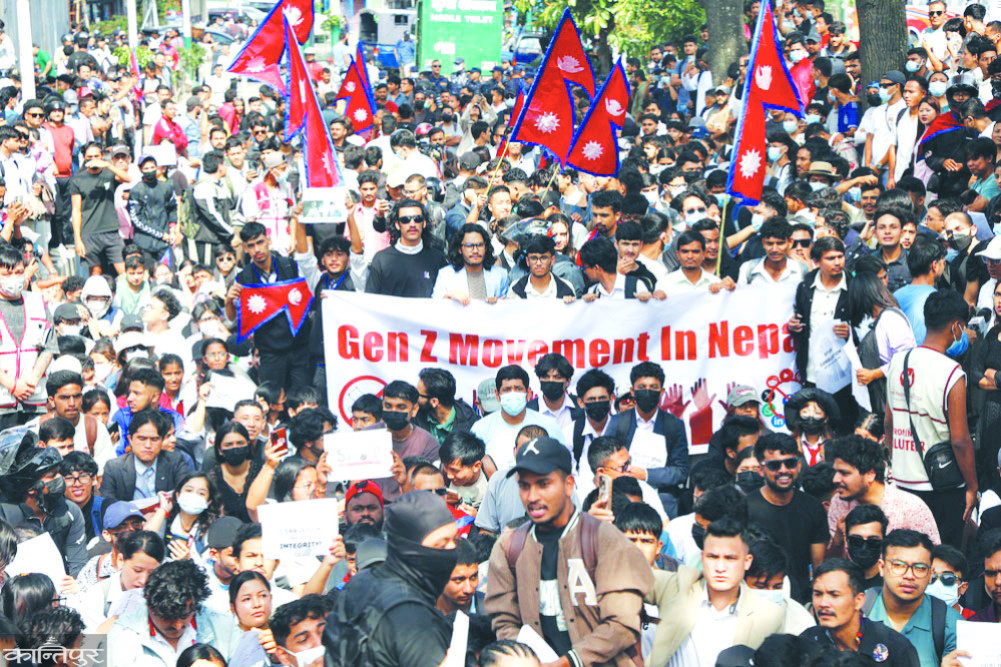
Following the Bhadau movement, there are debates from various angles regarding the agenda that Gen-G, which is poised to emerge in the upcoming elections, should cover. However, if we look at the statements and documents sent by various groups, it seems that the Gen-G generation is either silent on secularism or is trying to address the issue only in general terms, saying, "We are committed to the Constitution."
Although this issue is not the initial issue of the movement, a well-considered approach will be expected from the new generation to move forward with it in the upcoming elections. The fact that some sections of the progressive wing of society are dissatisfied with making religion the main agenda and are agitating from time to time, and the sporadic incidents of religious/communal conflict that have flared up in the Terai region, make this issue even more relevant. Therefore, it is inevitable that a deep and concrete view on secularism will emerge from the new generation.
The question of whether or not a state should have a religion may be a matter of academic debate. But if we look at world history and Nepal's own practice, it does not seem that the state has completely deviated from its traditions and culture. Even if we look at countries that have embraced secularism, the influence of a particular religion is found in their state-running practices. Historical sects in law and the concept of state-nation in political science also emphasize these things. From the perspective of Nepal, on the one hand, there is a view that secularism cannot be done to the right or left. On the other hand, some parties are demanding the declaration of a Vedic Sanatan Hindu Rashtra compatible with all religions. This has gradually been made a commentary on progressive and regressive among the intellectual class. It seems that Gen-G should express its clear opinion in favor of the middle path shown by the Constitution itself, without taking sides in this ideological conflict. This will further increase the general public's attachment to the Constitution and try to calm down the occasional dissatisfaction with religion. This will convey the message that the young people of the country have addressed their art, religion, culture and originality, as well as breaking away from the traditional debate and forging a new path.
Let's discuss the middle path shown by the Constitution. If we look at the provisions of Article 4 of the Constitution of Nepal, it is mentioned that Nepal is a secular state and in the explanatory section, it is provided that ‘for the purpose of this article, ‘secular’ means the protection of religious and cultural freedom, including the protection of religious and cultural freedom that has been practiced since ancient times.’ From this provision, it can be understood that the Constitution has adopted two principles. First, the state should adopt a non-interference policy in any religion while protecting religious freedom. Second, to protect religious and cultural freedom that has been practiced since ancient times, i.e. Hindus, Buddhists, Kirats, etc. These two principles seem to be contradictory to each other. However, this provision of the Constitution should be understood as an attempt to include the interests of 92.57 percent of the people, including Hindus, Buddhists, and Kirats, while maintaining religious freedom and tolerance.
Now the first question arises, can the state act in a way that addresses the interests of Sanatan Dharma based on the provisions of the current Constitution or not? The Supreme Court itself, in a case of Tulsi Shankhara in 2074, while explaining Article 4, had stated that where more than 80 percent of the population is Hindu, and where the culture and civilization have been linked to the Hindu religion and way of life since ancient times, the state cannot remain indifferent to protecting such religion and culture, and that secularism does not mean that ‘the state should not turn a blind eye to religious matters’. Similarly, in the judgment of Khagendra Subedi’s case in 2077, it had stated that Lord Pashupatinath has been considered the supreme national god of Nepal and the inspiring source of the advancement of Nepalis only since ancient times, and acknowledged that this is a matter of pride for all Nepalis. From a practical point of view, crores of rupees are allocated in the country’s ministerial red book for the construction of temples, monasteries, etc. every year. The presence of the head of state in special pujas held in many temples in Nepal is almost mandatory. From a theoretical and practical point of view, the state can work in favor of Sanatan Dharma. Even if a Vedic Hindu nation has not been declared, the state can expect that level of behavior through the existing constitution. But till date, this level of clarity has never been present in the political circle, nor has it been explained to the people.
Nepal is a country that occupies a special place from a spiritual perspective. It is also a land where various sadhus and saints practice penance. Whether it is Swargadwari Mahaprabhu in the west or Mahaguru Phalgunanda in the east. Nepali traditional spiritual practices have their own characteristics. There is a lot of room for the state to do in favor of traditional characteristics like yoga, meditation, astrology, tantra, Ayurveda, etc. If these traditional traditions were followed in the country's education, health, etc. and policies were formulated in accordance with them, it could have brought all parties together within the current constitution. In addition, such work would have been of great help for social harmony and the spiritual peace of the country. For this, the state should make a new beginning and formulate a special act to clearly outline the operation of Article 4 of the constitution for the protection of Sanatan Dharma and culture. For that, the initiative of Gen-G is necessary.
Now the second part. Religious freedom and coexistence. The inclusion and right to religious freedom that are a feature of our Constitution and the protection of the mentioned Sanatan Dharma are not contradictory statements but fundamental practices. The state can protect the culture of Sanatan Dharma without interfering in the observance of religion by its citizens. However, the question may arise, does such an interpretation not lead to secularism like in present-day India, where the state discriminates on the basis of religion. What we need to understand is that the situation in Nepal is different from that in India. The measure of religious tolerance here is incomparable. There has never been a religious riot like in India in the history of Nepal. The overall socio-political and social environment of Nepal is also different. Again, the interpretation given above emphasizes only the protection of the Sanatan traditions including Hindu, Buddhist, Kirat and others, rather than running a state based on any particular communalism. This practice cannot be said to ignore any religion.
Thus, the interpretation of secularism can encompass the feelings of the majority of the people of Nepal who believe in Sanatan Dharma. On the one hand, the protection of Sanatan Dharma and culture, and on the other hand, the assurance of freedom and coexistence of all religions. This is the interpretation in accordance with the constitution. It is necessary to establish this interpretation at the political level by giving it the form of a campaign. This work should start with Gen-G. It seems that a balanced national vision should be presented in the upcoming elections.