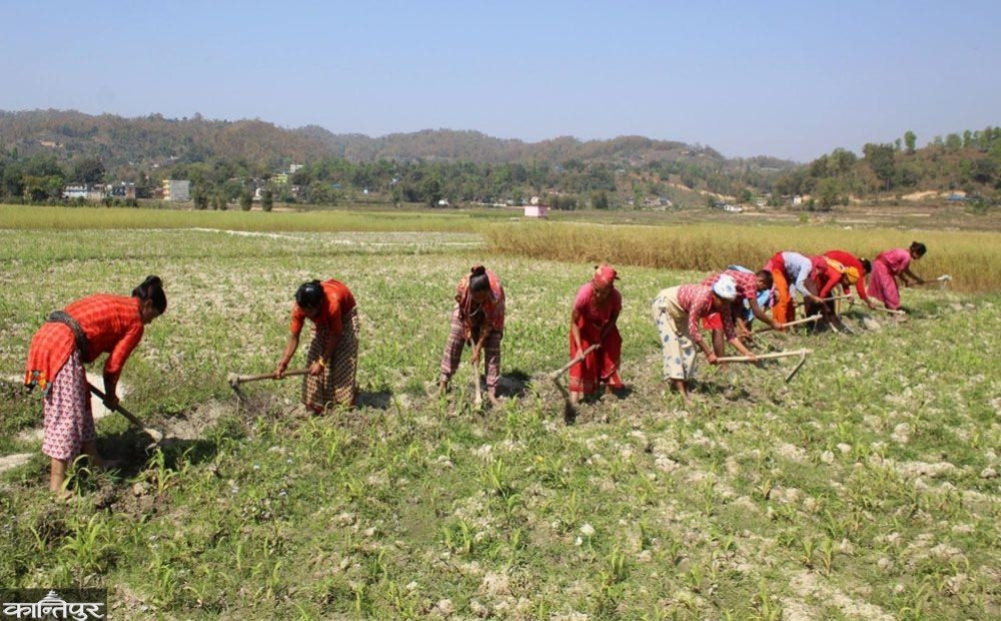
Women farmers are deprived of the right to own land. They work as agricultural laborers in the fields, but are sad and frustrated due to the lack of land ownership.
We use Google Cloud Translation Services. Google requires we provide the following disclaimer relating to use of this service:
This service may contain translations powered by Google. Google disclaims all warranties related to the translations, expressed or implied, including any warranties of accuracy, reliability, and any implied warranties of merchantability, fitness for a particular purpose, and noninfringement.
The changing weather has been causing a lot of trouble for farmers lately. They have been struggling to plant crops, but the rains are causing trouble when it comes to harvesting.
After the damage to the invested, labor-sweat-spilled farming and food crops, the farmers are worried about how to survive. This time's rain has also added to the farmers' suffering like in previous years.
Farmers' relationship with the soil is like nails and flesh. There is land, there are farmers. There are farmers and there is production. There is production and we humans are living. We farmers consider soil as life. Every day, we play with soil from dawn to dusk. Not only farmers, any of us cannot live without soil. Soil has sustained the world. Soil has given life to the whole world. And, it has also saved it. And the human-earth has survived.
In our agricultural country Nepal, 60 percent of the people depend on agricultural work. But, sometimes floods and droughts keep causing problems to farmers. That problem is such that farmers have to struggle to even make ends meet.
Nepalis, most of whom are involved in agriculture. However, they do not have enough land for production. Most farmers are forced to work and earn wages on other people's land. Some farmers, even if they rent other people's land, are forced to cultivate, raise their families, and pay for the use of land in the form of grain and fodder. There are many landless people among us who do farming. They cultivate on river banks, river-river-sweeping land, land near forests, open land and collect some grain and fodder. On the one hand, the cost of cultivation is high, and on the other hand, various seasonal disasters and wild animals also affect farmers, so it is not that easy to cultivate. That is why the practice of leaving land fallow has started increasing in recent times.
On the one hand, the impact of climate change is increasing, on the other hand, there is an added problem of unavailability of manpower for cultivation even in rural areas. Farmers are busy with traditional farming, while on the other hand, they are suffering from the impact of climate change. The government has not been able to provide local farmers with sufficient knowledge and resources for climate-adapted crops. As a result, farmers are forced to bear a lot of losses every year as they do not have enough information about the new environment and changing weather conditions. On the other hand, even if the Meteorological Department provides information, the farmers (who live in rural areas) do not receive that information, and even if they do receive it, the loss of crops increases due to lack of practice in believing it. The rains a few weeks ago also caused terrible damage to the rice crop that was just about to be harvested.
Here, it is not the farmers who are affected. It is the farmers who are the ones who are affected. Others do not care about crops. Apart from farmers, those who work in jobs, politics, and employees only have the knowledge to buy food from the market. It seems that they are not aware of the specific problems of farmers.
Most of the farmers in Nepal are poor. Even among the poor farmers, the most affected are women farmers. Women still contribute more to farming than men. Women have made an incomparable contribution in the roles of planting, cultivating, producing, safely storing and preparing food. And, the problems arising from this are also being faced by women farmers, they are more concerned. On the other hand, it is also a challenge to store the produced grains at home and preserve them for a long time.
Recently, the attack of diseases and pests on grain crops has also increased. Because most of the seeds used in farming today are hybrids. Nowadays, it is not possible to preserve grain crops for a long time like before. Of all these, women farmers are more concerned.
These same women farmers are also deprived of the right to land ownership. They do not own land. Most of the women of small farmers and landless farmer families do not even have access to land. They work hard in farming, do agricultural labor, but they are sad and suffer due to lack of land ownership.
As per the demand of our land rights movement, the government brought a policy of making joint land deeds. According to which, those who own land can establish joint ownership in the name of their husband and wife, but this campaign also could not move forward effectively. This policy should be followed and put into practice by everyone across the country. That alone would have helped women farmers gain ownership of land.
On the other hand, since landless families, who have been demanding land ownership for years, have not been able to get ownership of land, women farmers from those families are even more deprived of ownership. The state and the government are not listening to the demands of these classes.
There was another hope. That turned into disappointment after the Gen-G movement. Because there was a Land Commission, which was doing the work of land registration and land management for landless Dalits, landless squatters and unorganized settlement families. That commission was dissolved by the government formed after the Gen-G movement. After that, a very sad situation has been created for the landless and women farmers.
Landless families were not able to use even the rights given by the Constitution of Nepal. After the government abolished the commission, the work was stopped and all the landless families who were hoping to get land titles were disappointed.
Now there is a woman Prime Minister in the country. This is also a golden opportunity in Nepali history. In this situation, if the Prime Minister himself had given a mandate to establish a fully-fledged land commission and provide land rights to all, from women farmers to the landless, it would have served justice to the landless and farmers who have owned land for years.