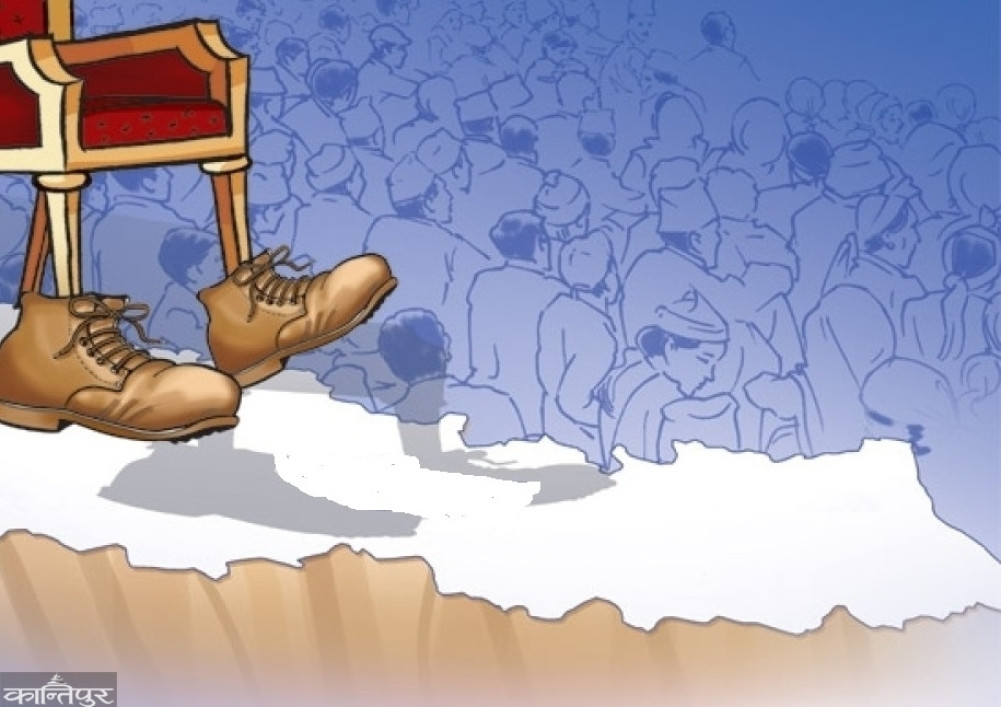
The need today is for provincial governments to correct the weaknesses seen during the federalism exercise and to build administratively and economically efficient, economical, and result-oriented provincial structures.
We use Google Cloud Translation Services. Google requires we provide the following disclaimer relating to use of this service:
This service may contain translations powered by Google. Google disclaims all warranties related to the translations, expressed or implied, including any warranties of accuracy, reliability, and any implied warranties of merchantability, fitness for a particular purpose, and noninfringement.
After the Gen-G uprisings of Bhadra 23 and 24, questions have once again been raised about the appropriateness of the federal system of governance adopted by the country. In particular, there is a growing demand to abolish the provincial structure and empower the local level even more.
On the other hand, public opinion is also being expressed in parallel, with doubts about whether it is urgent to find an alternative to federalism. Different views on this issue are being presented openly among various political and social representatives who have come to the surface after the movement.
The constitution was promulgated in 2072 BS to formalize the federal system of governance in Nepal, and it has been fully implemented since 2075 BS. Although the issue of federalism has been raised sporadically in the past, the main credit for establishing it goes to the Madhesh movement and other ethnic-regional movements that emerged after the interim constitution of 2063 BS. The then political parties were forced to suppress those movements and lead the country on the path of stability and accepted the issue of 'federalism'. Therefore, the fact that federalism is not a spontaneously accepted issue but a system established by the strength of the movement cannot be denied.
Against this background, the reasons for the increase in dissatisfaction with the 'provincial structure', which is considered the core spirit of federalism, have become a burning topic for study. Why is public opinion growing against the forcibly established provincial structure of federalism? With this question at the center, the debate on ‘Why are the provinces neglected?’ has now become the center of national politics.
The dubious role of the federal government
The Constitution of Nepal has clarified the division of state power and authority between the union, provinces, and local levels. The constitution has already defined everything from the common list of rights to the single list of rights. And, although the work report has made this more clear, in practice the federal government has not been able to take sufficient steps to strengthen the provinces.
The constitution has provided that provinces should not make laws that conflict with federal laws, but when the federal parliament did not make sincere efforts to make or amend the necessary laws, the provinces were left in a legal vacuum for a long time. The provinces were forced to make laws in their own way. For example, the federal civil service act has not yet been promulgated, but the provinces have already made their own civil and local service acts. As a result, there are inequalities and contradictions in the laws made by the provinces, and dozens of cases have reached the constitutional bench.
The commitment of the federal government in the field of fiscal federalism has not been satisfactory. While major taxes and large projects were under the control of the union, the provinces were unable to become financially self-sufficient and became dependent on federal grants. This raised questions about the intentions of the federal government.
Similarly, the chaos seen in employee adjustment also became a serious challenge. Employees who were forcibly sent showed behavior that opposed federalism. The effectiveness of federalism itself was weakened due to the failure to provide stability to the administrative mechanism considered the backbone of federalism implementation in a timely manner.
Weaknesses of the provincial government
In the initial phase of federalism implementation, the provincial governments appeared relatively agile and committed. When the small seven-member council of ministers started working, staff shortages and legal gaps were a major challenge. Over time, these problems were resolved to some extent, but the provincial government began to show a parallel trend to the union.
The practice of unnecessary ministry expansion, unnaturally sized councils of ministers, jumbo advisory groups, and administrative structures increased current expenses but did not bring tangible results in the livelihood of the people. Provincial parliamentarians engaged in the ‘manange trend’ of splitting parties or making various moves to gain positions and power. This further reduced public confidence. Corruption and uncontrolled service facilities further heightened the criticism.
When the government changed at the center, its shadow began to fall on the provinces as well. The practice of forming or changing governments at the behest of the federal leadership weakened the independence of the provinces. As a result, the provincial government, which is considered the soul of federalism, began to function by holding its own conscience hostage and could not be established as a trustworthy alternative among the people.
Ineffective role of the judiciary
There was an expectation that the judiciary could also contribute to making the provincial government strong and capable. Scholars have continuously raised the fact that constitutional and legal interpretations by the courts have a profound impact on federal practice. However, in practice, the judiciary could not play the expected role in ensuring the competence and independence of the provinces.
The courts failed to timely resolve cases registered for failure to facilitate or unnecessary interference by the federation in provincial-related work. There was also a lack of consistency and harmony in the decisions made. Whether it is the Sagarnath forest case filed by the Madhesh provincial government against the federal government or the employee adjustment dispute - it is a bitter reality that not only has there been no decision for 7 years, but the file itself has turned into ashes. There was a strong disagreement in the legal field in the interpretation and order of the court on the writ related to the formation of the Gandaki provincial government. When different orders were given even in the writs filed by the employees who were integrated from the federal government to the provinces, the provincial government and the employees working there were caught in a cycle of uncertainty.
This strengthened the accusation that centralized thinking dominates the judiciary. The judiciary's weakness in its role as the constitutional guardian to maintain the independence and stability of the provinces in the federal structure has become one of the main reasons for reducing trust in the federal practice.
Irresponsible mainstream media
The mainstream media could have played an important role in strengthening the practice of federalism. However, the media, knowingly or unknowingly, willingly or unwillingly, showed a tendency to follow the case for sale in the race for 'TRP' rather than giving adequate space to those knowledgeable about federalism.
The positive aspects like the investment made by the provincial government in the social sector, the improvement in the human development index, and efforts to promote tourism were not given due attention. Instead, the change of government, the change of ministers, the lifestyle or the vulgar lifestyle were exaggerated. In this way, the balance of propaganda was lost, creating a negative perception towards the provincial structure.
Incidents of corruption are not absent in the past. However, the media presented the news by showing that corruption increased unnaturally only after the establishment of the provincial government. Such biased information flow made the common people who were looking for good governance and administrative simplicity even more dissatisfied.
Social activists, influencers and interest groups
Nowadays, the main basis of information flow has become not only traditional media, but also social networks. Social activists and influencers active on these digital platforms are seen competing for 'followers' and 'views'. The positive works done by the provincial government could not become their content. Instead, the same mistake made by the provincial government was analyzed from multiple angles and presented in a sensational manner, adding fictional issues. This led to a flood of misinformation and the general public was caught in a situation where they could not distinguish between what was right and what was wrong.
The provincial level is the level that is difficult for the people to easily accept in the federal governance system. It will take some time to prove its necessity and inevitability. However, various interest groups used the time in between to exaggerate the shortcomings of the provinces and spread them among the people and tried to fulfill their own interests. In this way, misleading propaganda has played a major role in increasing the people's disregard for the provincial structure.
Finally,
Federalism is the backbone of the political, social and administrative system adopted by the Constitution of Nepal. It did not come only for administrative convenience, but was accepted as a means of addressing the diversity of Nepal and involving all parties in the governance structure. The need of the day is for the provincial governments to correct the weaknesses seen in the course of federalism and to build a provincial structure that is administratively and economically efficient, economical and result-oriented.
Only through improved and people-oriented federal practices can the provincial government be expected to become an important pillar in the journey to building a tolerant society and prosperous Nepal with the satisfaction of the people.