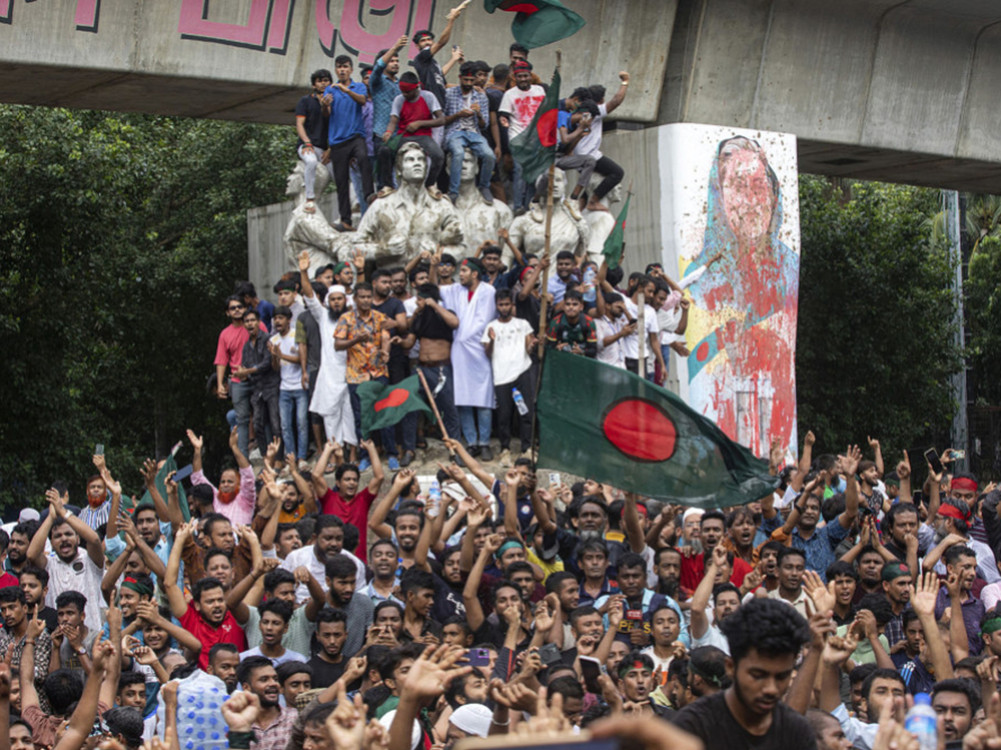
The goal of the movement is not just to change the government, but to bring about transparent reforms in political parties, bureaucracy, courts, security agencies, constitutional appointments, and the governance system.
We use Google Cloud Translation Services. Google requires we provide the following disclaimer relating to use of this service:
This service may contain translations powered by Google. Google disclaims all warranties related to the translations, expressed or implied, including any warranties of accuracy, reliability, and any implied warranties of merchantability, fitness for a particular purpose, and noninfringement.
Before the ‘Occupy Baluwatar Campaign’ began in 2012, the younger generation, like the younger generation today, was fed up with corruption and impunity. The main slogans of that peaceful protest, which lasted for 113 days, were ‘Let’s end impunity’ and ‘Let’s take action against the corrupt’. At that time, we did not like the fact that the old leaders had taken control of the major political parties.
While the ‘Occupy Baluwatar Campaign’ was going on, the exciting image of the ‘Arab Spring’ of 2010-01 kept coming to our minds. The thought kept coming to our minds that if we had led a vibrant movement like the ‘Arab Spring’ and dismissed the old leadership from politics, and educated youth had reached the leadership of all sectors including political parties, what a better country it could have become. Apart from holding the record for the longest movement in Nepal’s social movement, our peaceful movement did not gain much momentum. There were some achievements. The activists also got tired and the movement stopped. Structurally, that movement could not bring any change.
The movement we imagined was carried out by Gen-G and the change we could not even imagine came in two days. The Gen-G movement has exposed the structural corruption entrenched in Nepali politics, but it has also brought to our attention the natural questions and uncertainties of what the future holds and what path the country will take.
The Gen-G movement and the subsequent formation of an interim government are reminiscent of the movements of some Arab, African and neighboring countries. This article discusses the political journey of seven countries - Algeria, Iraq, Lebanon, Yemen, Egypt, Bangladesh and Sri Lanka - and the path they can show us.
Algeria: The end of the old leadership but the beginning of a new crisis
The popular movement (Diamond Movement) in Algeria in 2019 forced President Abdelaziz, who had been in power for 20 years, to resign. Due to the movement, he was prevented from running for a fifth term. The main demands of the movement were an end to corruption, unemployment and military control. But even after the change of regime, there was no real systemic reform. The Diamond Movement failed to create any alternative political force. With the support of the military, the new President Abdelmadjid Tebboune has been elected president twice, in 2019 and 2024.
The Diamond Movement initially raised hopes, but ultimately pushed the country into greater despair. Now, Gen Z feels that only the old faces have changed, not the system. This lesson is also important for us - individual leadership must change, but at the same time, institutional change must be strengthened. If institutional change does not occur, the leadership after the movement may become even worse.
Iraq: Chaos in post-dictatorship democracy
After the fall of Saddam Hussein, Iraq took to the path of democracy in 2003, but the decade that followed saw violence, sectarianism, and foreign intervention further destabilize the country. In 2019, a new generation resumed street protests demanding an end to corruption, guaranteed jobs, and political transparency. The government changed after the sacrifice of thousands of young people, but due to party divisions, foreign influence (especially Iran's influence), and unstable coalitions, systemic reform could not be achieved . The backbone of systemic reform in democracy is democratic political parties .
The example of Iraq shows that democracy is not just about the constitution and elections . If democratic political parties, a strong civil society, and a transparent governance mechanism are not built, whoever comes to power will automatically become corrupt . The lesson we need to learn from Iraq is that temporary government changes cannot bring about long-term governance reform, if institutions and values are not restructured . In the context of Nepal, this change does not seem to be meaningful if the character of the bureaucracy and the constitutional leadership cannot be improved by removing the soldiers of political parties .
Lebanon: The quagmire of corruption and the sectarian system
The widespread movement in Lebanon in 2019 raised the slogan, 'All the old leaders must go', similar to the slogan raised in our Gen-G movement now. The movement initially gained nationwide support, but within months, sectarian divisions weakened the movement. The economic crisis, bank failures, and unemployment further fueled public despair.
Lebanon has been unable to achieve reform due to the division of government seats based on religion. The lesson for Nepal from Lebanon is that the politics of division is an obstacle to reform. Political reform is only possible when citizens can rise above the mindset of ethnic, regional, and religious divisions. After the Gen-G movement, some elements in Nepal have been trying to incite religious riots. The political instability that religious riots cause is the most deadly.
Yemen: From protests to civil war
In 2011, President Ali Abdullah Saleh was forced to step down in Yemen during the ‘Arab Spring’. Initially, it was a peaceful movement of youth, but foreign intervention, military factionalism, and the rise of the Houthi rebellion pushed the country towards civil war. Today, Yemen is one of the countries facing the most serious humanitarian crises in the world.
The example of Yemen is very sensitive for Nepal – may no one turn any protests in the name of the Gen-G movement into violence again. In times of political transition, when there is no dialogue, consensus, and cooperation between the new and old forces, the result is not reform, but destruction.
Egypt: From democratic hope to military control
The Tahrir Square movement of 2011 ended the 30-year rule of Hosni Mubarak. Then, for the first time, free elections were held and Mohamed Morsi of the Muslim Brotherhood was elected president. But in 2013, the military seized power again and Egypt returned to its old dictatorship under the leadership of Abdel Fattah al-Sisi. To this day, Abdel Fattah is in power with the support of the army.
The trip to Egypt shows that if the security, court, constitutional appointments and administrative mechanisms remain the same even after the change of leadership, the movement cannot achieve anything. For Nepal, this directly means that even if the Gen-G movement temporarily changes power, reform will only begin when new and capable people are elected in the political, administrative, constitutional and security leadership.
Bangladesh: No reform, no elections in a year of revolution
The 'anti-quota movement' started by students in July-August 2024 turned into a nationwide political revolution. The movement that started with limited demands by students turned into a national movement with the general public's voice mixing with issues such as unemployment, corruption, social inequality and freedom of expression. Prime Minister Sheikh Hasina was forced to leave the country. With the broad support of the youth, an interim government was formed under the leadership of Nobel laureate Muhammad Yunus.
The interim government has not been able to bring enthusiasm to the country . The interim government does not have the capacity to fulfill the demands raised by the movement . The opposition party Bangladesh Nationalist Party, the army and civil society are pressuring the interim government to hand over its responsibilities to the elected government by holding early elections . Students who emerged from the movement have formed a new political party – the National Citizen Party. The interim government, on the other hand, has first brought the slogan of reforms and elections . The interim government has not been able to do the expected work as the Election Commission, judicial structure, bureaucracy, security mechanism are all of the same style and leadership. The election date has been set for February 2026, but many do not believe that the election will be held .
Sri Lanka: Change in leadership but the style of governance remains the same
In 2022, a mass movement broke out due to inflation, economic crisis, lack of foreign exchange reserves, widespread nepotism in politics and energy crisis . As a result, President Gotabaya Rajapaksa fled the country . In Sri Lanka, an interim government was not formed after the movement like in Nepal. Prime Minister Ranil Wickremesinghe was nominated as the President by the parliament as per the constitutional provisions and the President formed a new government to fulfill the demands of the movement. This government was considered a constitutional continuation.
Unlike in Nepal, neither an interim government was formed in Sri Lanka, nor were the protesters represented in the government. Presidential elections were held in 2024 and the National People's Party- NPP won the election with the broad support of the movement supporters. The new President Aruna Kumara Dassanayake won the election by addressing the demands of the movement institutionally. Although most of the issues are similar to Nepal's, the demand to curtail the powers of the Sri Lankan President or bring it under control through parliament is a worthy one for Nepal. Even after three years of the movement, the demands raised by the movement have not been addressed. There has been a change in leadership, but the style of governance has not improved.
Taking the above countries as examples, the following aspects should be taken into account to make Nepal's Gen-G movement successful:
1. Emphasis on institutional reform: The goal of the movement is not just government change, but transparent reform of political parties, bureaucracy, courts, security agencies, constitutional appointments, and the governance system.
2. Mutual unity, peaceful and continuous pressure among Gen-Gs: On the one hand, Gen-Gs should maintain strong mutual unity, while on the other hand, civil pressure and peaceful demonstrations should be continued.
3. Institutionalizing democracy within the party: Individualism and nepotism within political parties should be stopped. In Nepal, Gen-Gs should continue to create pressure for the development of a democratic system within political parties.
4. Common national agenda: A common agenda for governance reform should be created by rising above class, regional, or ethnic identity and focusing on economic development.
5. Building a culture of dialogue and collaboration – Movements give energy, show new possibilities, but only through dialogue and collaboration can good policies, positions, and methods be developed.
Finally, the Gen-G youth have started a new chapter in Nepal's political history. They have questioned the changes made so far, including political parties. If this movement does not bring about institutional reforms, internal democracy in political parties, and leadership that can participate in policymaking, this movement could become a cause of even greater dissatisfaction and political instability.
Nepal must now not only change leaders, but also take the path of institutional reforms. Let us hope and be careful that no one can use the Gen-G movement as a weapon of political instability.