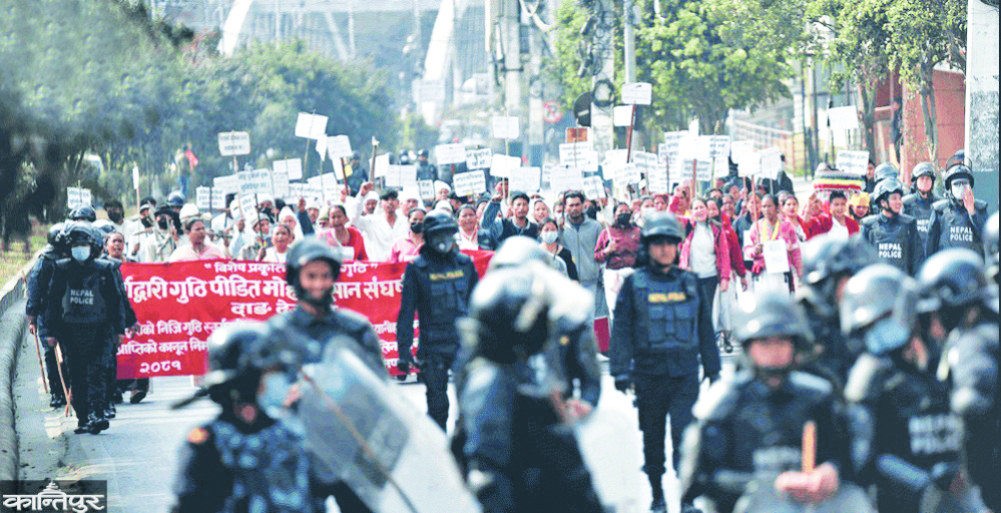
The landless have been dealt a great injustice by the government, which has abolished the 'Land Problem Resolution Commission' instead of resolving the problem of landlessness that has been going on for generations.
We use Google Cloud Translation Services. Google requires we provide the following disclaimer relating to use of this service:
This service may contain translations powered by Google. Google disclaims all warranties related to the translations, expressed or implied, including any warranties of accuracy, reliability, and any implied warranties of merchantability, fitness for a particular purpose, and noninfringement.
The lives of landless Dalits, landless squatters, and unorganized settlers across the country have once again been plunged into a pit of confusion and injustice. Their work to obtain land rights has once again stalled. This situation has arisen after the interim government abolished the 'Land Problem Resolution Commission'.
The government has done injustice to the landless by abolishing the commission instead of solving the problem of the landless that has been going on for generations.
This government, which carries the mandate of elections and good governance, has also struck the first blow against the people at the grassroots level, as in the past. By abolishing the commission that was responsible for agricultural land management, the government has hurt about 6 million people across the country. And, it has shattered the hopes of landless citizens for decades.
The state should ensure the right to housing and livelihood of citizens, but instead, abolishing the struggling body is a serious mistake. This means ignoring the constitutional system.
The state's attack on the dreams of the landless people
Less than a month after starting work, the interim government abolished the 'Land Problem Resolution Commission'. Instead of showing interest, concern and initiative to solve the problems of landless Dalits and landless squatters at the speedy rate, it is not a proper decision to uproot the root of this process. The civilian government formed through the movement, which was expected to bring change and justice, also took away the rights of the citizens. And, as in the past, it continued the party system.
Before abolishing the commission, the government needed to study its background. It was a completely wrong move to abolish the 'Land Problem Resolution Commission' by keeping other commissions, task forces and committees formed by the previous government intact. The path to solving the problem has been blocked after the commission itself was abolished, as it is necessary to provide speedy justice to the grassroots citizens who have been discriminated against and unjust for generations.
It is often accused of recruiting party workers to the Land Commission. However, other agencies and commissions are also being run by officials appointed on the recommendation of the same political party! Why is the only attack always on the commission that works on the landless? What is the political interest in this? Can't this be seen as a conspiracy to keep the landless landless forever?
There are experts in justice and law who have worked in the justice sector - under the leadership of the government. This government also decided to abolish the commission without paying attention to the spirit of the Constitution of Nepal-2072. According to Article 40 of the Constitution, Dalit Rights (5), there is a provision to provide land for housing and farming to landless Dalits by making laws.
For that, the Eighth Amendment to the Land Act-2021 had provided a legal basis to the commission. However, neither the spirit of the Constitution was respected, nor was the act implemented. The abolition of the Land Commission is not just an institutional abolition, but an attack on the fundamental rights of landless Dalits and the years of struggle. It is unjust to reduce to nothing the initiatives being taken by the state to resolve the land problem, the investment, resources, and manpower made by the federal and local governments. This decision has left millions of landless families in extreme despair.
Impact of the abolition of the commission
Currently, the management of landless and unorganized settlements was progressing in 750 local levels across the country. The last notice for data collection was published and the collection work was being done accordingly.
The Commission was working on receiving applications from 88,895 landless Dalit families, 168,441 landless squatters and 872,181 unorganized settlers and providing land ownership certificates to 1,129,517 families by managing and registering them.
Since the Land Commissions have been stuck in the cycle of formation and dissolution every time and have not been able to achieve results, provision was also made in the formation order of the Commission to resolve the situation so that it does not happen this time and that the problem does not remain in the future.
‘The term of office of the Commission and the District Committee shall be three years from the date of formation of the Commission, if the work is not completed within the specified period, the Government of Nepal may extend the term of the Commission by a maximum of two years.’
It is also stated that ‘the term of office of the District Committee shall be three years in the case of districts with more than five thousand applications, two years in the case of districts with more than one thousand and up to five thousand applications, and one year in the case of districts with up to one thousand applications.’ Regarding the dissolution, it is stated in the formation order that ‘the Government of Nepal will dissolve the Commission or the concerned District Committee after the work of providing land to landless Dalits, landless squatters and managing unorganized settlements is completed.’
The government’s decision to dissolve the Commission, ignoring all the provisions, has created a situation where all applications are left stranded. And, the efforts and investments made by the local government, which is most responsible for this process, have also come to a halt.
Uprooting is wrong
The truth is that there was some delay in the work of the Commission. The previous and dissolved Commissions could not give the expected results either. However, this Commission had been learning from the past and strengthening the rules and procedures. And, by conducting a deep review, it was possible to give results this time. The Commission could have been made stronger, simpler and more just, and it was necessary to make it. However, this government also did the same wrong thing that the past did.
This government should have instead discussed the issue of ‘How to further strengthen the Commission?’ by involving stakeholders, experts, civil society representatives, and leaders of the landless community. And, it should have given a clear procedure and time frame and given a mandate to reduce landlessness to zero. It is not justified to keep the landless in injustice forever, and to deprive them of their fundamental rights and social justice.
The one who is inferior, is the one who is the lowest
Every year, the government’s policy documents contain ambitious plans to distribute land ownership certificates to millions of landless people. However, no concrete readiness is ever shown towards its implementation. This year too, the government had planned to provide certificates to 500,000 landless families in its policies and programs. Such a big plan was announced in the budget, but how appropriate is it to ‘break’ the work by abolishing the Commission itself? What greater insult and injustice can be inflicted on the people at the grassroots level?
The way forward
The government has not issued new policies and programs. It has not brought a new budget either. This government's mandate is not that either. The government should withdraw its decision and let the commission work again. It would be appropriate to continue the ongoing work by adding experienced members and officials, experts who are lobbying for land, engaged in campaigns and movements, activists and rights activists to the commission. For this, the short-term order of the Supreme Court not to implement the decision to dissolve the Land Problem Resolution Commission has also given space. Please correct the weakness.
Solving the landless problem is also a question of the right to housing, the right to food security, identity, livelihood, self-respect, and social justice of the citizens. And, it is also the responsibility of the state.