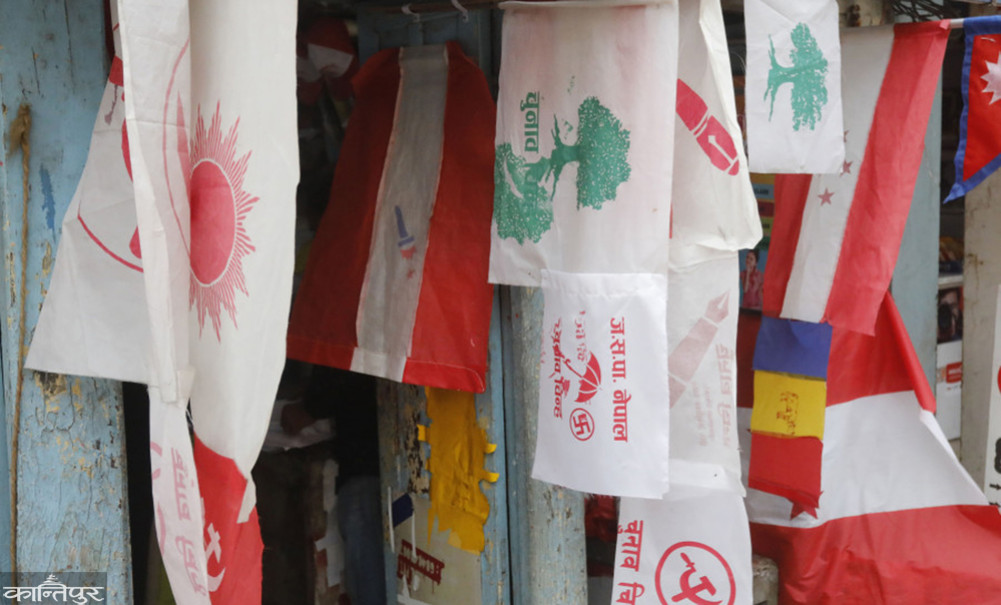
It is a basic electoral process for one party to point out the shortcomings of another party and present them to the public. However, trying to ban a party is authoritarian.
We use Google Cloud Translation Services. Google requires we provide the following disclaimer relating to use of this service:
This service may contain translations powered by Google. Google disclaims all warranties related to the translations, expressed or implied, including any warranties of accuracy, reliability, and any implied warranties of merchantability, fitness for a particular purpose, and noninfringement.
After the ‘Bhadaure Chatyang’, there has been a murmur from some quarters to ban the old parties. Is this just ‘Urentheulo Hatha’? Although it seems like a sense of contempt for the parties that have retired from power, it is basically a well-thought-out attempt to attack multi-partyism. And, this is a stubbornness that dreams of returning to the era of partylessness. If anyone thinks that opposing parties will benefit Nepal and Nepalis, then such a group must be reveling in the paradise of ignorance.
However, in the current foggy environment, there is a lot of bargaining power on the pretext of inciting anti-party sentiment and keeping it under control. Many commentaries are being written to keep the new generation under control. The attempt to establish independents as superheroes by sacrificing multi-party politics has not happened yet. By refining independents, various power centers have successfully used 'independent' candidacies in the recent elections in Kathmandu.
The current election law allows independent candidates to run at all three levels, but the country cannot be run by a grand alliance of independents. This role can only be played by political parties. Elsewhere, some of those who won as independents are also frustrated. Other tricksters of the permanent ruling trio are no less interesting. ‘The parties have ruined the country, if we follow the parties, Nepal is doomed to decline’ – this commentary has been spread in such a way that one can hear similar comments while commuting in public transport or in tea shops.
The ambition to rule did not arise in former judges. The hatred shown towards the parties by retired army officers in the secret meetings of Kathmandu is no less shocking. Some retired government officials have also played a significant role in creating a defensive mindset against the ruling parties. To some extent, this influential group has also been successful in its objective. It is not at all understandable that ‘some aristocratic officers will be ruled by the parties’. The promoters of the status quo always have the anti-party sentiment hanging in their mouths, and they have the illusion that they are protecting the country.
The interests of many elements are evident behind the ban on parties. Some see their rise in the end of old parties and leaders. Some try to push the election on the scheduled date by creating an atmosphere against the parties. Some want the government of so-called independents to remain instead of the parties that are ruining the country. Among these, there is a group that dreams of someone else being the waiting Prime Minister instead of Sushila Karki. Some are fighters who are creating a puppet government behind the scenes. Some are probably motivated by the abolition of the current constitution. Some are playing a game of spreading discontent towards parties by giving the slogan of a directly elected executive. Party ban should be a commentary on the exercise of using the state as a mere asset.
An undeniable fact is that no matter what the party is, no matter what it looks like in its name and leadership, if the people's indomitable aspirations are not reflected in it, the people are not able to feel their representation. No matter how much a certain party writes in its constitution to strengthen the people, if they do not feel that they are participating in it in practice, the people will not believe it. No matter how large the number of cadres who believe that 'a party is an easy platform for contracts, transfers/promotions and bribes' is, when that party starts being attacked, they keep quiet and wait for others to adapt. Despite the experiment and trial period of opening parties for almost a century, many difficulties have been encountered in building a free, egalitarian and just society. In order to fulfill this desire, the Nepali people have been experimenting with various experiments. The process of opening parties is ongoing with the belief that they will walk a different path than the past and a better path than the present. Until the reality of the past is understood and the present and future cannot be built, it is clear that even newly formed parties are just 'new caps in old bottles'. As long as this continues, parties will not take firm steps again.
Dissatisfaction with parties is at the grassroots level. However, this does not mean partylessness. This is not the imperfection of the party, but the result of the existing vacuum in the structure and structure of those in government and the party's governance. This is the rejection of the trend of 'lifelong leadership' by the common people. The argument is heard that the process of the party's feet leaving the ground should be stopped by the same character remaining as the party leader for a long time, but this is in the long-term interest of the party.
The possibility of making parties reputable or acceptable has been decreasing due to those who have ascended with money, access and influence, overshadowing the old and committed cadres within the party. Even if the understanding of the parties that engage in politics by luring them wins an election immediately, it cannot provide permanent assurance or attraction at the grassroots level. This has been the style of the parties that have participated in elections in the past. The image of the parties has been tarnished.
Democracy without multi-party system is lifeless. Parties have gained legitimacy to govern according to the consent of the representatives elected by the majority of the people by competing in the constitutional process. The presence and activism of the parties give citizens a choice. The party's job is to convey the aspirations of the people to the government, put pressure on the government to maintain a public-interest-oriented working system, and decide on various strategies to shape public opinion. The alternative to one party is another party. One party is giving moral competition to another party to remain strong, true, and meaningful. If a party starts becoming authoritarian through elections, the responsibility of reining it in lies with other competing parties. However, the way in which partyism was practiced confined its definition within a narrow range.
Parties, whether in power or opposition, when they start considering the distribution of state power as a natural right, see the state only as a source of exploitation. When a party reaches the point of forming a well-known syndicate, the scope of the party in a democracy becomes different from what was imagined. Multi-partyism is something that everyone says, but only a few adopt its essence. Due to such parties, multi-partyism in Nepal was limited to slogans. The parties that fought for a multi-party system were seen as losers. Yes, at present, the slogan of party-banning in a seasonal manner neither lasts long, nor does it have any weight. While saying this, this constitution cannot bear the burden of not reducing the distance between the people and the party.
Most parties have a tendency to worship individuals. There is an understanding that the party is sustained by the magnetic halo of a single person. There is a custom to consider a certain leader as the destiny of the party. If the party leader steps down from the throne, the party will split, and the pressure to ‘declare a successor or the party leader should voluntarily retire after a period’ is termed as a conspiracy. In such a situation, even if those party leaders say ‘I am a democrat’, they cannot get the privilege of being the true guardian of democracy from anywhere. A party is not a profit-making company in a democracy, where the leadership is evaluated on the basis of how many seats it has won, its role is considered higher. What values were promoted? On that basis, the relevance of the party leader will be explained. In what sense are new parties different from old parties? On that basis, their justification is established. Internal democracy within parties refers to the practice of democratic principles and processes in their organizational structure and functioning. This includes decision-making processes, leadership selection, policy formulation, and ensuring the accountability of party leaders to their members. New parties cannot be an alternative to old parties when their behavior and character remain the same.
If old parties do not improve, new forces will displace them from the mandate. The people have the right to decide who they want to represent them. There is a constant clamor to change party leaders, but why change? Similarly, the slogan ‘Remove old parties, bring in new ones’ has been widely spread, but what will the new ones do? There are many critics of the need for parties and the tragedies created by old parties. However, party formation is not a selfish game played in a dark room. This is a collective determination to bring the inconsistent side to light and establish the insufficient issue of change at the center of power.
Parties and elections are often inseparable. Political parties accept the electoral challenge. If the Sushila Karki-led government wants its honorable exit, the rules that emerged through the Election Commission should be made equal for all parties in practice.
Be careful, this is not a Panchayat election, but a process of playing various tricks to make those who like it participate and banning those who don't. Similarly, one party highlighting the shortcomings of another party and putting them before the public is a basic electoral process. However, trying to ban a party is authoritarian. Right now, those who have just come out of the cave are selling the dream of paradise on earth. Old parties do not collapse by 'fu'. However, if old parties are not corrected, time will move forward on its own.