It is preferable for state administrators to proceed with a thorough reflection on history, adherence to moral values and the changing dimensions of a changing world order.
We use Google Cloud Translation Services. Google requires we provide the following disclaimer relating to use of this service:
This service may contain translations powered by Google. Google disclaims all warranties related to the translations, expressed or implied, including any warranties of accuracy, reliability, and any implied warranties of merchantability, fitness for a particular purpose, and noninfringement.
Nepal is in a complicated phase of history. I have been hearing this statement for a long time. However, looking at the current situation in Nepal, it seems that global geopolitical tensions will have a major impact on Nepal if it is not able to get out of the current transition as soon as possible. The Gen-G movement, which started with minimal demands for transparency and good governance, has raised many questions about the future political, administrative and economic management of the country.
Also, the movement has forced us to think deeply about the basic question of how we got to today's situation and what will be the road map of Nepal tomorrow.
Even after the epochal change of 2007, major political changes took place in the last five decades. In spite of this, where have we failed in the basic aspects of development and good governance that the people want? Why couldn't we follow the minimum standards of ethics, morality, transparency and quality, the basic conditions of democratic system? In discussing all these matters we must go to the source of our learning.
Eastern philosophy practiced teaching people to spontaneously become ideal citizens. Prior to the present stage of formal institutional development, the basis of survival of our society was traditional values. Beliefs such as not eating for free, not doing injustice, living in good manners, donating a certain portion of income to the needy and social welfare were the basic and ideal sources of social management. In today's so-called developed countries, where Vedic Sanatan beliefs are not followed, after the industrial revolution, institutions that promote good governance were developed at a rapid pace. Institutional development, which economists Darren Yasemoglu, Simon Johnson and James Robinson have consistently advocated, is important in this context.
Nepal, which was not colonized in any period of history, was basically running on the basis of traditional values and beliefs even during the Cold War. The basis of society's operation was the ongoing ritual. An example of this is the practice of Pancha-Bhaladami to resolve various disputes.
In the last few decades, Nepal is going through the erosion of traditional social norms and the lack of sophisticated modern institutions. The institutions that we have built in different eras have also become extractive in nature, i.e. benefiting only a limited group of people. Its effect is seen in the appointments made in our various organizations and agencies, the background of some people who are selected or nominated through elections, the thinking that they should acquire immense wealth by any means, and the progress made through middleman business.
Traditional beliefs were strong in our society until the forties. Stories from Ramayana and Mahabharata used to be discussed at home based on reading, hearing or being told during childhood. Moral education was compulsory in school education. All these aspects were the basis of social balance. If you think carefully, every episode of Ramayana seems to teach you how to live life, while Mahabharata teaches you the ability and sacrifice to die. Moreover, stories such as Valmiki, the author of Ramayana, who was first a bandit, later became a great ascetic and was able to compose Ramayana, have inspired people to move from negativity to positivity.
Even today, the example of Ramrajya keeps coming up in various contexts. There are many virtues that people can learn from Maryada Purushottam Rama, who is considered an incarnation of God, and more especially those who run the state. Maryada Purushottam Rama has important characteristics like sacrifice, affection, morality, self-control and the ability to mobilize a group.
Raja Ram gives the message that those who run the state should move forward by imbibing these two aspects, mainly public opinion and ethics. If he had to choose between popular opinion and good policy, Ram was a partisan of good policy. Even though Rama wanted to be seen as a king by the people, he gave up his kingdom and went into exile, considering his father's commandments and ethics as paramount. After the war with Ravana ended, he managed the state according to the wishes of the society, appreciating public opinion.
The essence of the various stories of the Mahabharata, which is considered the world's greatest poem, is that we should not be left behind to fight for truth and justice. Along with this, the message of Mahabharata is that it is necessary to have humility rather than arrogance, pride, and arrogance in state administrators. As an attempt to stop the war of Mahabharata, after the end of exile and exile, the Pandavas demanded the old kingdom of Indraprastha and, if not even that, five villages.
Sri Krishna, who went with a peace proposal on behalf of the Pandavas, replied that the arrogant Duryodhana would not give the Pandavas even land that would be enough to put a needle. This pride of Duryodhana led to the battle of Mahabharata and the great destruction of his own friendship.
If we look at these two events in connection with the movement of the last five decades of Nepal, it can be a great lesson for the future. The student movement in Nepal in 2036 was initially a protest against the execution of former Pakistani Prime Minister Zulfikar Ali Bhutto by the then military ruler Ziaul Haq. As the movement spread, its influence in Nepal focused on the demand for the end of the independent panchayat system.
Raja Birendra, with wisdom on time, announced a referendum on 10th May 2036 on the issue of non-party panchayat system or multi-party system. The referendum held on 20th Baisakh, 2037 was an important milestone in Nepal's democratic practice. The referendum sent a message that the King wanted to move forward with popular sentiment. BP Koirala's idea of accepting the result of the plebiscite regardless of the result and deciding the next steps accordingly was equally historic and important.
Similarly, due to King Birendra's ability to understand the sentiments of the people, no more damage could be done in the 2046 movement. The government of then Prime Minister Marichman Singh was dissolved on March 24, 2046 in order to prevent further loss of human wealth in the movement for restoration of democracy with the United Left Front, which started on March 7, 2046 under the leadership of the Nepali Congress. The government led by Lokendra Bahadur Chand was given a mandate to negotiate with the agitators.
As a result, on 26th Chait 2046, the talks between the king and the top leadership of the protestors gave way and democracy was restored in the country. The country got a political exit in 2046 with less damage due to prioritizing dialogue and negotiation. In 2062/63, in contrast to the wisdom shown by the monarchy in time during the 2046 movement, the monarchy took a hard and stubborn course.
When the armed conflict started by the Maoists was reaching its peak, King Gyanendra had the audacity to take over the government power himself, ignoring the parties. Because of this, the second people's movement went against the monarchy itself. Although it was late, King Gyanendra understood the speed of time and abdicated in 2065 accepting the decision of the Constituent Assembly. Because of that sacrifice, even today he is gaining sympathy in the society.
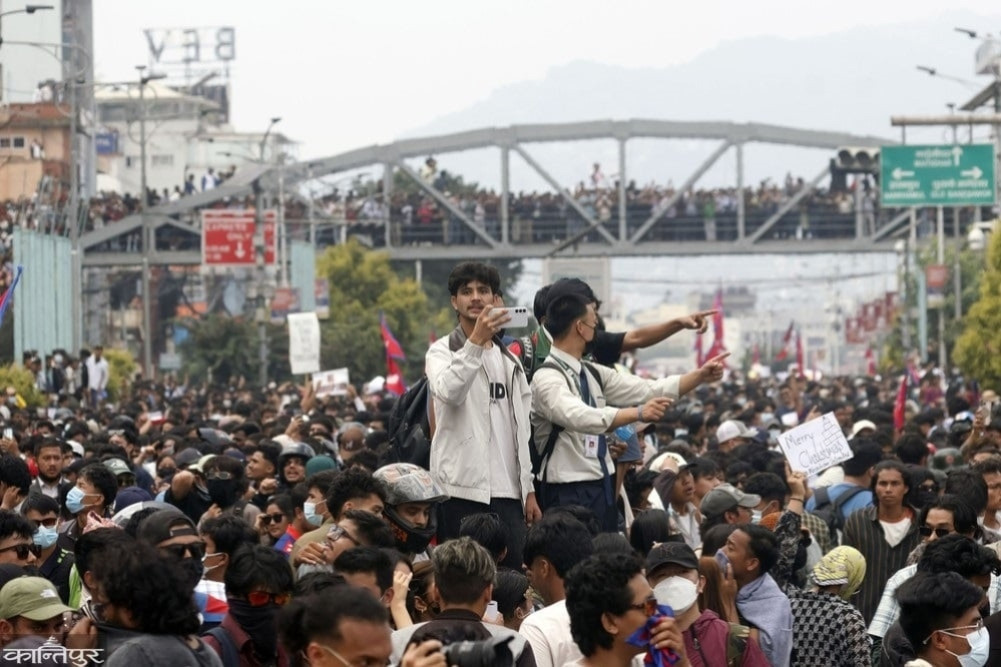
If we count from the movement of 2036, the country experienced its fourth movement on August 23 and 24. This movement, known as the Zen-G movement, may have caused more loss of human wealth than all subsequent movements. The general background of the Gen-G movement began with a demand to lift restrictions on social media. The opinion is equally strong that if the then government had not been stubborn and had negotiated with Gen-Gs or had opened up social media, the movement would not have turned violent. In this perspective, three important messages have been synthesized for state administrators.
An important message has been given by the Gen-Ji movement that the rulers should accommodate everyone and not be unnecessarily stubborn. When the leadership considers itself charismatic, the results of popular uprisings around the world are unexpected. In a democracy, if the rulers elected by the people like Alexander the Great, Napoleon, Fidel Castro start placing themselves in the miraculous category, there is no harmony between the leadership's thinking and the people's sentiments. The right decision at the right time is possible only through the leadership of decision-making based on policy and public opinion. An important lesson of the Gen-G movement is that leadership must have the ability to understand the speed of time and adopt flexibility as needed.
The movement of August 23 and 24 showed that our diplomatic maturity is lacking. Even today, Nepal is not in a different situation than it was during the time of Prithvi Narayan Shah. The difference is that today we are not only like two stones between two emerging neighbors but also at the center of interest and surveillance of other superpowers of the world.
As the effects of the global financial crisis of 2008 wore off, the world shifted towards an inward-looking economic policy. After 2016, it got more intense and by 2025, the world is moving towards economic coercion. If we do not address the interests of emerging powers in our neighborhood and key players in the world order in a balanced manner, our task of maintaining international balance may become challenging.
During the Mahendra period, our neighbors were not economically and strategically different from us, only geographically and demographically larger. Today, our neighbors are surrounded by countries that were called superpowers during the Cold War. Therefore, according to the changing world order, it is equally important that we understand our limitations and maintain a diplomatic balance. The 'conspiracy theories' that came into discussion with the Gen-G movement have further highlighted the need for diplomatic balance.
Another important aspect that state administrators should pay attention to is valuing everyone's self-esteem. The concept of 'megalothymia', the special respect that society gives to such an elite class only because of the position a person has attained, is disappearing from democratic movements around the world. Political thinker Francis Fukuyama has interpreted this as replacing the norm of self-esteem of the common people, i.e. 'isothymia'.
When those who live in the governance system in the democratic system do not understand the far-reaching changes happening globally and present themselves as the heirs of the oligarchy, they fear that not only the governance system but the society will be in a state of disintegration. Today's unexpected transition in Nepal is also a product of this. Therefore, it is preferable for the state administrators to think deeply about history, follow moral values and take into account the changing dimensions of the changing world order.