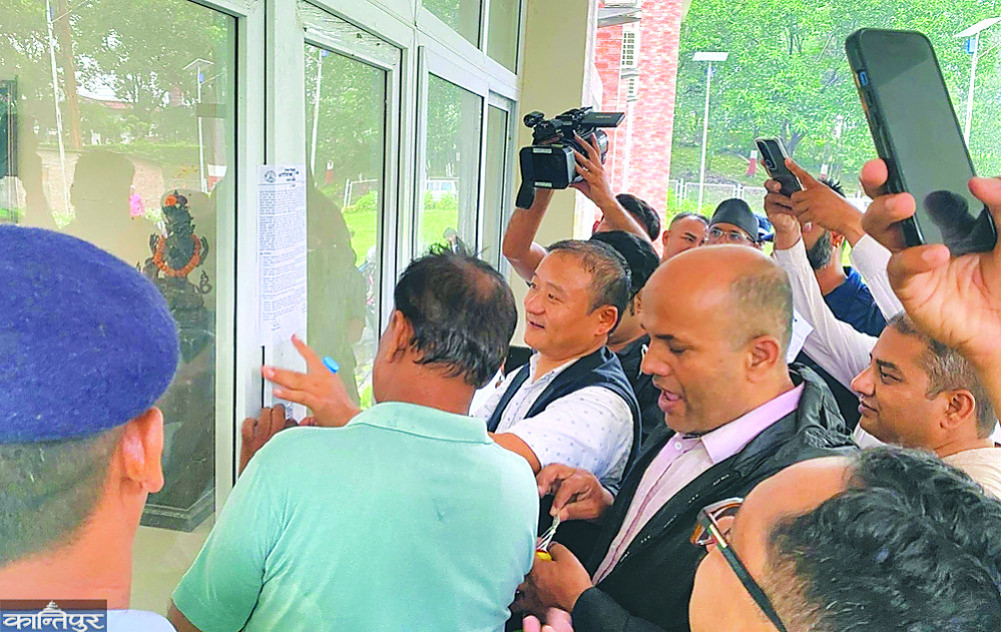
Without turning campuses into party recruiting centers, it is possible to have meaningful student representation and democratic practice there.
We use Google Cloud Translation Services. Google requires we provide the following disclaimer relating to use of this service:
This service may contain translations powered by Google. Google disclaims all warranties related to the translations, expressed or implied, including any warranties of accuracy, reliability, and any implied warranties of merchantability, fitness for a particular purpose, and noninfringement.
Walk into the campus of any major university in Nepal and you will see something deeply disturbing. Spaces that should have been dedicated to learning, research and intellectual development have been turned into miniature versions of our Federal Parliament.
Student 'leaders' spend more time at political meetings than in the classroom. Swabiyu elections look like national elections, which have nothing to do with education.
Now is the time for Nepali society to ask a fundamental question – why are we allowing political parties to establish a colony in our universities? More importantly, what kind of leaders are we producing for the future when we are teaching students that political loyalty is greater than academic achievement?
Campuses as political recruitment centers
Nepal's universities were supposed to be centers of learning. Where the most brilliant minds of the country would develop the knowledge, skills and moral foundation needed to move the nation forward. But they have become recruitment centers for political parties and training camps for pesaver activists. The result has been a generation of 'student leaders' who see every issue from a partisan point of view, prioritize loyalty over merit and see compromise as weakness.
What happens when political parties set up their student organizations on campus? Instead of encouraging students to engage with diverse views, these organizations create rigid ideological boxes, so that one student body cannot embrace the different political viewpoints of another student body. For example, a student belonging to the Nepal Vidyarthi Sangh can automatically oppose anything proposed by ANERASWAVIU (All Nepal National Independent Students Union), no matter how justified it may be. Even simple issues like improving library opening hours or improving the quality of university campus canteens are heavily politicized. It is not education, but the schooling of political parties, which is producing leaders like the present.
The Problem of Professional Workers
The most harmful aspect of student politics based on the party system is that it limits students to being workers of a party rather than responsible citizens of the country. Students who engage in partisan politics quickly learn that success comes not from academic excellence but from performance, organization building, factional conflict management, and partisanship.
These students spend their golden years at university holding political rallies rather than understanding academic lectures, walking on strikes rather than forming study groups, and networking with party bosses rather than professors. By the time they graduate and graduate, they have developed skills that are perfectly suited for professional politics but insufficient to make any meaningful contribution to the country's development. The sad thing is that many of these students are intelligent and well-intentioned. But partisan student politics teaches them that knowledge is less valuable than political positions and that expertise is less important than loyalty. Similarly, they perceive that leadership ability is determined more by party offices than by academic achievement.
From Campus to Parliament: Weak Decision-Making Skills
Leaders who have learned politics from student politics approach even complex policy issues from a partisan mindset. They use every policy debate as an opportunity for partisan gain rather than problem solving.
What is more worrying is that these leaders lack the technical knowledge required for effective governance as they prioritize party loyalty over national interest. How can a student make informed decisions about complex national challenges when his crucial years are spent in demonstration, organization building rather than in-depth study of economics, engineering or public policy?
The False Democratic Argument
Defenders of the current system argue that student politics teaches democratic participation and political awareness. But this argument overlooks an important difference. There is a profound difference between learning democratic values and practicing party politics.
A true democratic education teaches students to engage with diverse viewpoints, make decisions based on evidence rather than partisan beliefs, and prioritize the common good over partisan interests. But party-based student politics does just the opposite. It teaches students to treat politics as vindictive, to view opponents as enemies, and to make personal knowledge a prisoner of party discipline.
Let's imagine how different the campus life would be if there were to be an independent and independent student organization. There students will learn to build coalitions across party lines to address common concerns. They will develop the habit of evaluating policies on their merits rather than partisan values. They will understand that leadership is about serving the community as a whole, not just one's political faction.
International best practice
Nepal is not the only country suffering from the extreme politicization of higher education, but many countries also have good practices of student politics. For example, German universities have strong student representation through independent student councils, which focus on academic and campus life issues rather than national politics. These student councils engage in genuine democratic governance without the influence of external political parties.
Similarly, many world-renowned universities have encouraged strong student politics and democratic values through independent organizations, even though they prohibit political party organizations on campus. There, students participate in democratic practice by focusing on educational missions beyond external political agendas.
These examples show that it is possible to have meaningful student representation and democratic practice without turning campuses into party recruiting centers.
Economic discussion
While analyzing student politics from a political and educational angle, it is equally important to consider economic discussion here. Building human capital is essential to boost Nepal's economy. For this our universities must be able to produce graduates with strong technical skills, critical thinking and professional competence. Student politics based on a
party system undermines all these goals. The educational missions of universities become obsolete when students waste years devoted to rigorous academic programs on partisan politics. The entire university environment focuses on short-term political gains rather than long-term intellectual development.
Countries that have successfully made economic leaps in recent times, from South Korea, Singapore to Taiwan, have prioritized academic excellence in their universities. It is clear from this that nation building is possible only with technically competent and intellectually brilliant graduates.
The Way Forward: Independent Student Councils
Abolishing party-based student politics does not mean eliminating student representation or democratic practices on campus. This means creating an independent student council focused on academic and campus life issues. Such councils will focus on academic excellence. Instead of holding demonstrations about national political issues, student representatives will work on academic programs, library, research opportunities and student welfare issues.
Student Council will develop real leadership skills in students. They will learn to build consensus, manage budgets, solve practical problems and ensure representation of different sectors.
The student council will encourage intellectual diversity. Rising above partisan bias, they will engage in public debate based on ideological values. Will develop the critical thinking skills necessary for academic and professional success. Thus, the lessons learned by the future leaders of Nepal during the formative years of the university will gradually change the political culture of the country.
Reforms are inevitable
The longer Nepal delays this reform, the more it will produce another batch of graduates who see politics as a means of personal and party self-fulfillment rather than public service. Every semester spent in party politics is a semester not devoted to building the human capital that Nepal needs. The world is changing rapidly and if Nepali universities continue to prioritize partisan student politics over academic excellence, Nepal risks falling further behind.
Time for change
Nepal stands at a crossroads. On the one hand, political parties may still limit universities as political recruitment centers, which will again perpetuate a system that produces technically incompetent leaders and academically poor graduates. On the other hand, universities can develop the knowledge, skills and civic virtues necessary for national development while re-establishing themselves in the mission of academic excellence.
It should now be clear what our choice is. Universities should build human capital, not political cadres. Universities should promote critical thinking, not partisan thinking. Abolishing student politics based on the
party system will not solve all educational or political problems in Nepal at once, but it will take an important step towards comprehensive institutional reform. This will indicate that the country is serious about prioritizing merit over party affiliation, quality over loyalty and national development over political expediency.
The sooner Nepal brings about this change, the sooner it will start producing the necessary manpower for the country, who are technically competent, intellectually brilliant and committed to serving the nation.
Now it is time for the universities of Nepal to choose. Limiting itself as a recruitment center for political activists or repositioning itself as a center of academic excellence and human capital development. The future of Nepal will depend on this.