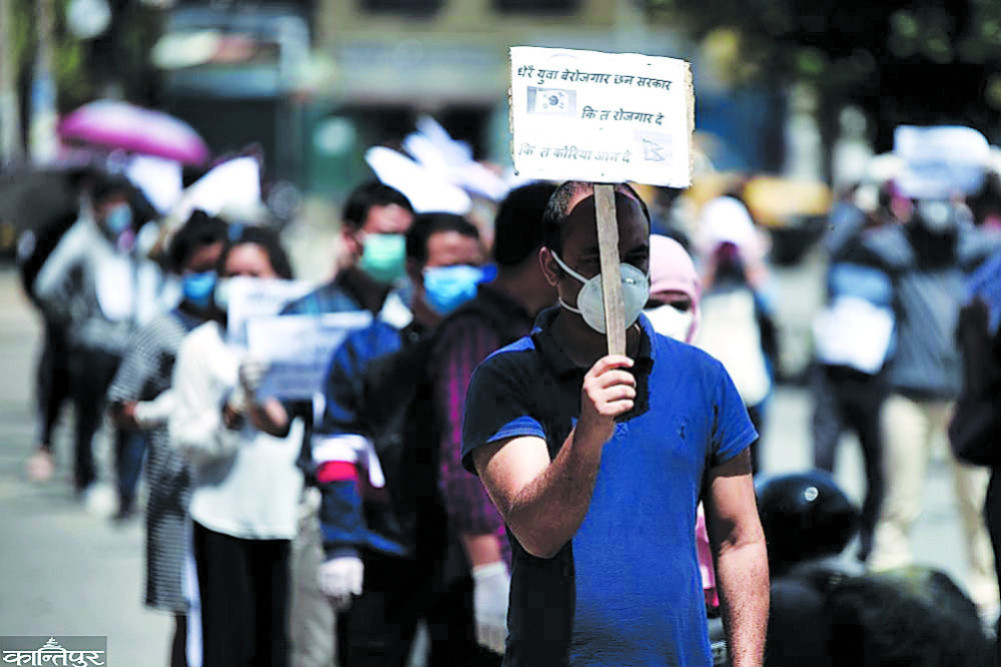
Although remittances have contributed to Nepal's economy, about 40 million Nepalis who have left Nepal permanently or are employed abroad expressed their bitterness on social media saying that the government's work was not good.
We use Google Cloud Translation Services. Google requires we provide the following disclaimer relating to use of this service:
This service may contain translations powered by Google. Google disclaims all warranties related to the translations, expressed or implied, including any warranties of accuracy, reliability, and any implied warranties of merchantability, fitness for a particular purpose, and noninfringement.
'Be it a person or an animal - if there are few ways to save yourself, you don't hesitate to do anything to save your existence...' The current Russian president, who has a left-wing ideology, expressed this statement in the middle of the Cold War.
The British scientist Charles Darwin, who formulated the theory of gradual evolution and became the star of religious institutions at the time, is not different from the main subject of Thomas Malthus's theory of population.
In Nepal, where various political ideologies have a high influence, it is still accused of political upheaval at different times when ideology is protected rather than the social and economic development of citizens. While the upheaval created the constitution and laws, there was no achievement in unemployment reduction and overall economic development. The anger with the feeling of corruption caused the 24th of August due to not understanding that laws and laws do not lead to economic and social development. 'Ako, Hm, Dwio Nasti, neither the past nor the future!' No matter how much arrogance or conscience that says only me and myself, it could not move the country forward! As the World Bank report says, youth unemployment and desperation encourage destructive activities, not Bangladesh, now Nepal is enough.
Poverty and unemployment are not new topics in Nepal. In 1995, the number of poor people in Nepal was about 7.729 thousand, and in 2003, this number was about 7.133 thousand. Similarly, in 2010, the poor population was 6.676 thousand, and in 2022, it was about 5.977 thousand. Looking at the percentage, about 20.3 achievements out of 41.8 are seen. The contribution of remittances received from foreign employment is more than the economic development brought by the government of Nepal. Looking at Nepal's GDP since 1964, there are no years of high economic growth except 1981, 1984, 1994 and 2017.
In the history of Nepal, the growth of about 9.7 percent in 1984 and about 9 percent in 2017 are the highest so far. However, the growth in the said period is an effect of the negative growth seen in the previous year. We also have an example of the gradual decline in the contribution of the manufacturing sector to the Gross Domestic Product (GDP) of Nepal. Since the financial year 2057/58, the contribution of Nepal's agriculture and industry sector has decreased and the contribution of the service sector such as importing goods and services from abroad and selling and distributing them in Nepal has increased, which has had a negative impact on Nepal's labor market.
According to the second and third labor force surveys, about 7.1 million people have migrated from the agricultural sector, and it is estimated that the labor force is involved in foreign employment and informal employment in various economic centers. With a total labor force of 28 lakhs, only about 70 lakh 76 thousand jobs are available and about 1337 lakhs labor force is unemployed, it is like the misfortune of the country. The lack of awareness of the three levels of government to play a role in creating productive employment has led to more despair among the youth.
Due to the impact of the covid epidemic in 2020 and 2021, although it is 12.98% and 20.19% respectively, about 10% of Nepalis are unemployed as usual. This percentage does not include those who do not expect to find employment or students. If we consider only the data of the Gen Z age group, this figure is about 21 percent. Under the age of Gen Z, the labor force in the age group of 16 to 28 years is about 7 million 32 thousand. Lack of employment in the formal and informal sectors and even skilled people not being able to get employment according to their ability or having to go abroad for employment seems to have created anger on the institutions and individuals operating in the state.
Whether it is the situation where people who have master's degrees from Nepali education have to go abroad as semi-skilled workers or the situation where they have to pay bhansun or nazrana to get employment or it is the situation where it is difficult for a person who is not a member of the party to engage in economic activities - all these have become synonymous in the Nepali labor market. After the available entrepreneurship training, the youth directly experienced the situation of not being able to get a loan to start a business or not being able to live with the money they earned. The situation of not getting a job even after higher education or learning skilled skills is creating despair in the Nepalese labor force.
Nepal has also created a commentary that it runs on foreign employment and remittances. It is certain that remittances facilitate the accumulation of foreign currency and foreign trade. Although remittances account for about 25 percent of GDP, no study has been done on how much it has contributed to the economic development of the country. Remittances contribute about 3.4% to GDP in India, 6.5% in Bangladesh, 4.5% in Afghanistan, 7.8% in Sri Lanka and less than 1% in Bhutan. Various studies have shown that remittances have a significant contribution to the stability of the entire economy of Nepal and Pakistan.
Despite the contribution of remittances to Nepal's economy, nearly 4 million Nepalese who have left Nepal permanently or are employed abroad, expressed their bitterness on social media that the government's work was not good. Whether a certain party in Nepal is going to use social media to directly affect the elections, or some percent of the 16 million people who have access to the Internet have become intolerant and misused social media, or the campaign of Nepo Babies, which started from Indonesia, is trying to discourage them from entering Nepal - whatever the reason, shutting down all the platforms at once became counterproductive for the government, as it needs to be regulated slowly, just like Tik Tok. The writer's children said 'Dad! The government will not help the people and ... Why has the government closed YouTube? What did I do wrong ?' The child could not be satisfied with the author's answer to the question.
Nepal's unemployment problem will remain there until the economic development and the country's production and productivity increase. The country is plagued by the pressure to pay the principal and interest of increasing internal and external debt and will continue to suffer from it for the next few years. Due to Nepal's own political conflict and global geopolitics, Nepal's economic sector has been affected for the past few years. This has also brought more challenges to Nepalese employment management.
Due to the financial situation of the government, the work of promoting internal employment through financial and monetary policies has not been able to be widely implemented and it is certain that in the next few years, the budget will come as if it were scattered for job creation. Due to the damage caused to the infrastructure of the private sector due to the recent agitation, the government is also challenged to change the mindset of the investors so that the same thing does not happen again in the future and investment does not sink. Since the birth of
, everyone has been angry that the condition of the citizens, who have been suffering from poverty and unemployment, cannot be improved. The poor do not have the ability to oppose the government and it seems that the government readily accepts the demands of the upper class families. Citizens were expressing frustration on social media, accusing the middle class families and their needs to be difficult to meet and the political and administrative leadership is responsible for creating such a situation.
It's not unusual for Genjis and millennials to feel rebellious against such people when they see them rise from their situation and live the high life. George Orwell, who used a pen against social injustice, said, 'Even if the truth is wrong, the truth remains true'. As Mark Twain said, ``A fool who refuses to accept no matter how much evidence there is'' when he saw that social justice was not maintained, but failed to improve it, the characters who did ``Eko Ľham, Đioo nasti'' were sure to become Ravana in time. As the author himself is a character of laws and statutes, he regrets that he could not explain this matter seriously.
It would not have been a great essay on the seventh constitution of Nepal if it was developed only by writing on the constitution and laws. The question has arisen that the country is not only involved in the game of politics and gaining power, far from analyzing why the country could not progress despite the transformation from royal rule to monarchy, from monarchy to constitutional monarchy and from constitutional monarchy to republic.
Not working for the country and future generations is not a violation of the law, but both the permanent and temporary governments are still accused of being in an epidemic of inaction. They seem to have adopted a policy of non-judgment, seeing that even well-to-do people are in political and legal trouble. There have been 18 political upheavals in Nepal due to the lack of improvement in the situation due to the system and various movements. If youth unemployment and despondency do not go away, it cannot be said that similar upheavals will not happen for the 19th or 20th time.
There is a correlation between the state of Nepal's economy and the number of Nepalese who go for foreign employment. Except during the time of covid, the number of Nepalis going for foreign employment is more when there is a contraction in Nepal's economy. It cannot be said that this is just a coincidence as there is a political crisis in Nepal when there is a crisis in Nepal's economy.
Directly and indirectly youth unemployment has changed the power and system in Bangladesh, Tunisia, Egypt, Libya, Yemen and Romania. Even today, the youth of Indonesia and the Philippines are still struggling. We also have the example of the government of Bangladesh throwing out the implementation of inclusiveness in employment. Not only in South Asia, there have been violent protests in countries like France, Belgium, Austria and Greece due to youth unemployment.
Even if there is a conspiracy theory that Nepal is becoming a laboratory to minimize the role of our neighbors China and India involved in the establishment of WRIX due to the tariff policy taken by the American government, it may be appropriate to pay attention to the fact that it can be re-circulated when away from the real problems of the country.
Chanakya's foreign policy mentions that one should not unnecessarily provoke neighboring countries while always being aware of their rights and interests. If it is only used for political interests and gaining power without paying attention to the highest rights and interests of the country and the nation, it will win for itself, but the country will lose. Instead of doing retrospective clairvoyance to see where we went wrong, let us take the necessary steps to create a future Nepal by breaking all barriers and bonds in the country's social and economic transformation.