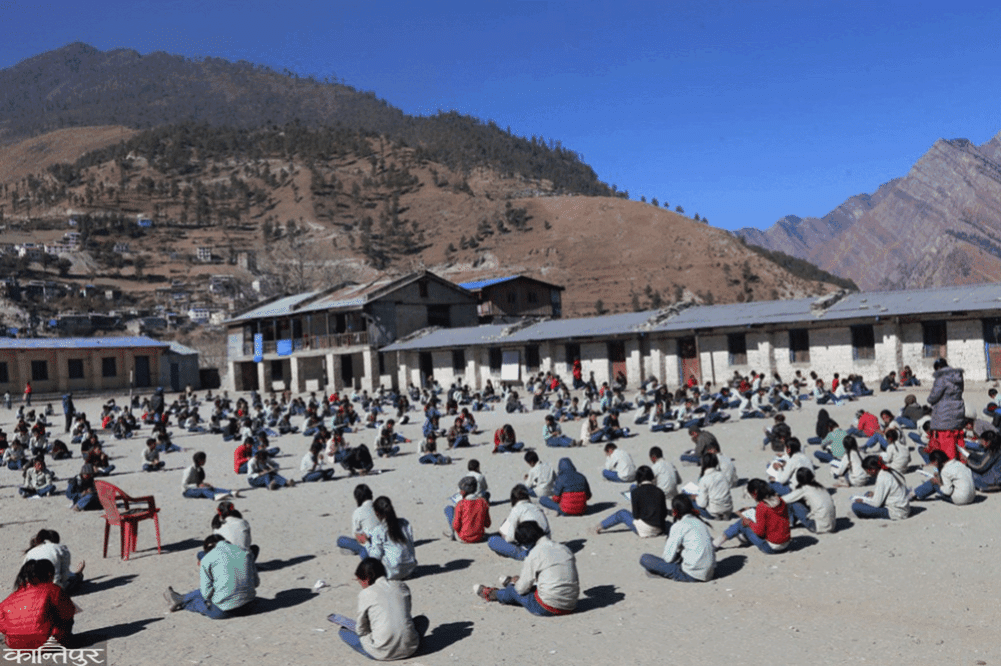
At present, the local government seems to spend minimum on education from its own resources, due to which it is difficult to reach the goal of quality education.
We use Google Cloud Translation Services. Google requires we provide the following disclaimer relating to use of this service:
This service may contain translations powered by Google. Google disclaims all warranties related to the translations, expressed or implied, including any warranties of accuracy, reliability, and any implied warranties of merchantability, fitness for a particular purpose, and noninfringement.
Two years ago, the government registered the School Education Bill, 2080 in the House of Representatives. After that, the House of Representatives discussed the bill and recommended the Education, Health and Information Technology Committee to submit a report with necessary amendments. Looking at the intensive discussions and debates in the committee, it is expected that school education will move forward in a positive direction. But unfortunately! Apart from some general reforms in the bill, the solution to the basic problems faced by the education sector was not presented.
It is natural to raise the question of how much capacity the Education Act, which was made about 54 years ago, has covered up to the fifth generation in education and how much capacity it has to address the aspirations and future of the new generation in education . In the meantime, the country's political structure has undergone a major transformation.
With the implementation of the new constitution in 2072, it has been a decade since Nepal entered the federal democratic republic system of government. Along with this political structure, there has been a radical change in the governance system, distribution of rights and the role of the local level. In this way, it is necessary to advance education from a new perspective and a new direction while absorbing the meaning of the constitution and the impact of global changes in education and learning.
In this context, the concern of how the School Education Bill, 2080 will advance Nepal's education is raised in front of everyone today. However, a series of uproar over the education bill among teachers' federations and private school operators was highly visible . The main reason for this is that their interests are more important than education reform.
Teachers are the backbone of school education. Therefore, the production, construction and selection process of teachers directly affects the quality of education and the possibility of learning . India's famous educationist Dr. According to Sarvapalli Radhakrishnan, teachers are the soul of the country, so educational transformation is not possible without ensuring quality, transparency and professionalism in teacher production, formation and selection.
Teacher production refers to the process by which a university or college supplies teachers. It helps in developing the necessary competencies, skills and professional conduct in the teaching profession . In the past, only the faculty of education in Nepal's universities was responsible for producing teachers. But the proposed bill has opened the way for people who have reached the minimum educational qualification of other faculties to become teachers. Building
teachers is a long-term process. In this, the necessary education, training, skills, efficiency, professional awareness and conduct of teachers are developed . Refresher training, research, exploration and innovation are important aspects of teacher training . In the past, teacher training was promoted through resource persons and resource centers in Nepal, but due to weak government implementation, this arrangement has been removed . But in the proposed bill, the provision regarding teacher training is not clearly visible and it is a big weakness. Education, Health and Information Technology Committee did not pay attention to this.
Teacher selection refers to the process of appointing qualified candidates to the post of teacher by the designated body . In the context of Nepal, its responsibility has been given to the Teachers Service Commission. In the currently proposed bill, there is a provision to select teachers through 60% limited (internal) competition and 40% open competition on the basis of posts. But the Teachers Federation has expressed its displeasure. Many educationists have put forward the idea that 100% selection of teachers should be done through open competition for quality learning. Instead, the selection process can be made more transparent and effective by converting the service experience into points after the working teacher has passed the written test and it is fair to the teaching teacher.
When the state assumed the responsibility of providing school education to all, then the community freed itself from the responsibility of managing education . However, not enough attention has been paid to whether the state is capable of doing so. On the one hand, the state did not want to be able to do this, on the other hand, in the name of ensuring the educational future of children, the school education sector turned into a fertile ground for education investors and the neo-liberal thinking began to dominate the education sector of Nepal.
This deepened the social and class differences and the helplessness of the government was evident. However, when the new constitution adopted the directive principle of regulating private investment by making it service-oriented, then the proposed bill forced school education to be gradually made service-oriented and non-profit.
This became indigestible to large private schools, accustomed to making extraordinary profits, and their umbrella organizations Pabson and N-Pabson started raising noise against the bill, threatening political parties and their leaders . However, it is also true that small private schools are running at modest profit. Meanwhile, in the media, even the leading leaders of the political parties in the government have pledged to reverse it. If that happens, the message will go out that the government is not responsible and accountable to the people. Therefore, the entire parliament needs to be sensitive about this issue.
School education is mostly non-profit in the country because it is seen as a public good and a human right all over the world . According to John Rawls, the pioneer of social justice and a professor at Harvard University, society should choose such structures that give maximum benefits to the weaker sections. In this view, adopting a non-profit system in education ensures equal opportunities for the weaker sections, which strengthens both social equality and justice. For this work, the state needs to be strong . If not, it will be difficult to implement whatever provision is brought in the bill.
It has been about a decade since the country entered into the practice of federal government . However, according to the spirit of the constitution, the local government has not been able to strongly present its role in education, except for exceptions. Currently, the local government seems to spend only a minimum on education from its own resources, due to which it is difficult to reach the goal of quality education.
In this regard, in the proposed bill, first of all, provision should have been made for the local government to allocate at least a budget equal to the amount allocated by the association from internal sources for their schools . But that arrangement was not seen . Arrangements have been made to establish an education development and coordination unit as a reminder of the district education office in the district as a federal representative. However, although the purpose of this unit is to coordinate with the local government, when the system of recommending the award to the best teacher is kept, unnecessary confusion has been created regarding whether the responsibility of the teacher will be at the local level or at the federal office .
There are many problems within the local government itself. It is clear that many local governments have failed to play a role in education according to the schedule of the constitution. Apart from independent candidates, candidates of political parties are leading at the local level in most places . The education sector has been affected due to their party attachment. In such a situation, complaints made by teachers towards the local level seem natural.
The long-term solution to this problem is to rethink the formation process of local government . As in other countries, if the local government is formed through non-partisan competition, then the local government can be established as a fair, transparent and common organization of all. In such a situation, it can be assumed that party influence in the education sector will be minimal and it will be easy to make education quality and accessible.
In terms of maintaining the quality of school education, the proposed bill has made provisions for structures such as Education and Human Resource Development Center, National Curriculum Council and Educational Quality Testing Authority at the federal level. Also, the responsibility of maintaining quality at the school level has been given to the principal.
However, the structure to support principals and teachers in making necessary plans and capacity development is not visible at the local level. Although there is an education development and coordination unit at the district level, since its role is only coordinating, it was necessary to build a separate training structure at the local level to improve the quality of education. However, the responsibility for teacher training, innovation and capacity building has been given to the state government. Therefore, cooperation and coordination between the provincial and local governments is mandatory. The most important aspect is that there is an urgent need for teacher support systems and refresher training at the school level. For that, it seems that structures like resource centers should be established at the local level.
Moreover, the bill adjusts the early childhood development to the basic level and arranges its duration to be two years for all types of schools, which is a welcome step . However, early childhood development activists argue that it should be kept outside the school structure. But from the point of view of its structural management and uniformity, it was appropriate to include it in the school level. They are dissatisfied with this system because the business interests of private schools will decrease.
Generally speaking, this bill has not been able to fully assimilate the spirit of the constitution and the federal structure. Teacher production, formation and selection should be clear, transparent and quality. The provision of hiring untrained teachers can be risky . Therefore, for this, it seems that minimum 'intern training' should be made compulsory for teachers . There is a need to prioritize open competition in the selection of teachers. According to the spirit of the constitution, it is necessary to make private schools service-oriented and non-profit.
The main problem is that the local government does not invest enough resources in the education sector. Likewise, if there is a lack of coordination between the union, state and local levels, the implementation aspect of this bill is sure to be weak.
New structures such as Human Resource Development Center, Curriculum Council, Quality Testing Authority have been proposed at the federal level, but there is a danger that there is no structure for teacher capacity development and training at the local level. Since the early child development has been adjusted to the basic level, there is a possibility of uniformity in such education .
Parliament and the state need to be sensitive and accountable for the expected transformation in the education sector . If this bill goes forward in this form without considering the above mentioned suggestions, it is certain that endless uproar will start .