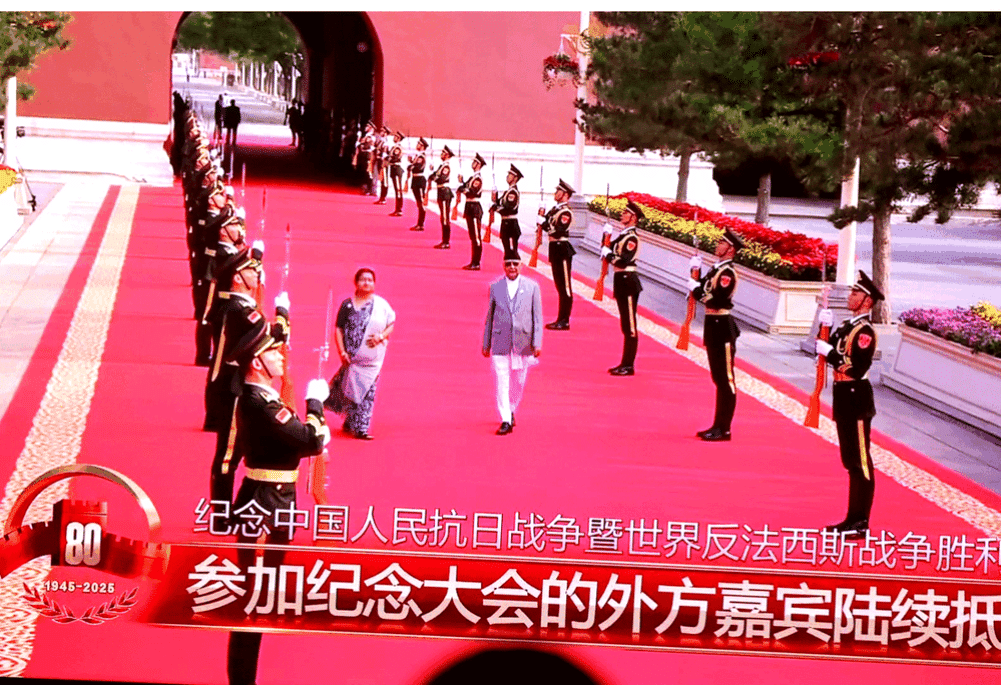
Nepal is the co-creator of the current international order built on the valor of its brave ancestors who fought from the anti-fascist front. Therefore, Prime Minister Oli arriving to participate in the military parade in Beijing is natural beyond logic.
We use Google Cloud Translation Services. Google requires we provide the following disclaimer relating to use of this service:
This service may contain translations powered by Google. Google disclaims all warranties related to the translations, expressed or implied, including any warranties of accuracy, reliability, and any implied warranties of merchantability, fitness for a particular purpose, and noninfringement.
For China, the "Victory Day" of September 3 is not only a memory of history, but also a deep reflection of the current world scenario. For Beijing, the 80th anniversary of victory in the Chinese War of Resistance Against Japanese Aggression and the global anti-fascist struggle is a special celebration of emotions, strength and a new polar world.
In this mode of unprecedented global transformation, China has also shown its reliable international community by inviting the leaders of more than two dozen countries, including Nepal's Prime Minister KP Sharma Oli. The military parade on 'Victory Day' pays homage to the martyrs as well as honoring the historical lessons learned at such a heavy cost. It also emphasizes the preciousness of the peace obtained from a very difficult sacrifice.
Beijing wants to give the world through this historic ceremony that such terrible tragedies will not be repeated only by valuing peace by "remembering history, looking to the future". For that reason, when Prime Minister Oli came to Beijing, there were arguments between sides and opposition in Nepal. But it also gives the Nepalese an opportunity to make their own glorious history. Where Nepal is standing above any 'share of power', it seems to be a natural stakeholder based on the contribution of its own ancestors in the anti-fascist fight.
The value of history
The 80th anniversary of the victory in the anti-fascist war is being celebrated in the current climate of increasing global geopolitical tensions, where old conflicts have not yet been resolved and new ones are also brewing. Through this ceremony, China reaffirms its commitment to peaceful development. But at the same time, he calls upon the international community to collectively oppose all forms of aggression and hegemony. Therefore, it is undoubtedly a picture of a strong Asian world power both internally and externally.
Prime Minister Oli's participation is particularly noteworthy. By participating in the Shanghai Cooperation Organization (SCO) summit held in Tianjin and arriving at the Beijing parade, the Prime Minister of Nepal seems to have absorbed the active role of developing nations in the protection of global peace. Along with that, Nepal's important contribution in the Second World War has been recognized and respected on the world stage.
As a civilization with a history of five thousand years, China wants to share deep knowledge gained from historical texts to the present. Every Chinese has a special love and respect for history. From childhood they believe that history acts as a mirror to understand the rise and fall of nations . Inviting the leaders of countries like Pakistan, North Korea and Russia along with Nepal to the parade is to promote dialogue for peace, not to create a confrontation with anyone. The interest and interpretation of the Western media seems to be completely opposite. While China's project is not at all to incite hatred towards anyone or promote anti-Japanese sentiment. The activities of this ceremony in China are based on honoring the martyrs and reviving the historical lessons for the protection of peace.
The Chinese War of Resistance against Japanese aggression was one of the most painful experiences of the 20th century for the Chinese people. They are remembered as huge sacrifices. Between 1931 and 1945, more than 35 million Chinese soldiers and civilians died or were injured in that war, of which 21 million were civilian deaths. Countless families were devastated by that war, and China's economy was pushed back by decades. That victory was achieved through 14 years of hard resistance under those extraordinarily difficult conditions.
Those sacrifices are not only a mark of Chinese history, but also an important part of the global anti-fascist war. Even outside of China, the importance of these commemorations lies in showing the immense value of the war through history. These days it reminds people to appreciate peace .
China's armor against fascism on the world stage
China's role in the anti-fascist war was important. On the Chinese battlefield as the main eastern front, about 70 percent of Japan's land forces were . As a result, the pressure on the friendly countries of the Asia Pacific and European fronts was significantly reduced.
The Chinese military campaign in the Burma war provided enough material support and intelligence support to face the Axis Powers (the alliance of Germany, Italy and Japan on the world stage) together with the Allied Powers (including the UK, the US, and the Soviet Union). Axis powers supported Japan's dominance in East Asia.
Historians review the events at that time and say that if it were not for China's long resistance, Japan would have conquered Southeast Asia by 1942. If such a situation had occurred, even India and Australia could have been hit hard. That victory was a turning point in the anti-colonial movement for Asia.
The victory in the war of resistance played an important role in shaping the subsequent international order. As one of the founding members of the United Nations after Japan's unconditional surrender in 1945, China contributed to the drafting of its charter. It set the framework for post-war peace and fueled the wave of independence against colonialism. This victory marked the end of Japanese militarism and ushered in an era of peaceful reconstruction in Asia.
The international order after World War II has become the cornerstone of today's world stage. The main principles of which are resisting aggression and maintaining sovereign equality . This commemoration, held in Beijing, emphasizes that those hard-won achievements must be preserved through multilateralism.
Honoring Nepal's contribution
Nepal was an important participant in the war against fascism. The Gurkha regiments of the British Army fought on behalf of the UK in Europe and Asia and made a very sacrificial contribution. During the Second World War, around 120,000 Nepalese soldiers served in the British Army and fought bravely in Burma, Italy, North Africa, Northeast India and Singapore. The fact that half of the 20,000 casualties can be read in history.
The highest British military award, the Victoria Cross (VC), was awarded to 12 soldiers of the Gurkha Regiment in recognition of their bravery and sacrifice. For example, in Burma in 1945, Sergeant Lachiman Gurung received a VC for his contribution in fighting single-handedly against more than 200 Japanese soldiers. Many Chinese still think of Nepal as the first impression of the brave and determined Gurkha warrior, who is still a proud symbol of Nepal on the world stage.
The contribution of the Gurkhas not only helped in the victory of the allied countries but also embodied the anti-fascist spirit of Nepal . These historical facts confirm that Nepal is not only an eyewitness to those historical events but also an active contributor. Therefore, Nepal deserved this honor during the 80th anniversary celebrations of Beijing. Because, Nepal is the co-creator of the current international system built on the valor of its brave ancestors.
Prime Minister Oli's visit to China for the SCO summit and the 'Victory Day' parade is very meaningful for increasing Nepal's presence on the international stage. Its participation in the SCO summit will strengthen Nepal's relationship as a dialogue partner and give an opportunity to elevate Kathmandu's voice in regional affairs and deepen the need for its role within the organization. Being involved in such important regional cooperation platforms will further strengthen Nepal's independence and global status.
that helps Nepal to avoid marginalization or entanglement with big power rivals . Even in the United Nations peacekeeping force, Nepal's leading contribution is a significant contribution to world peace in contemporary times. Therefore, participating in such opportunities and platforms gives Nepal an opportunity to confidently present its image as a global peace promoter.
The creation of new history
The world order is currently facing serious erosion with increasing risks of instability and conflict. In this context, peace-loving countries like Nepal and China are following their common destiny. Being in a strategic geographical location, Nepal should continue to demonstrate its commitment and leadership towards world peace and stability with respectable status of the international community for its peaceful aspirations.
Hard-won peace must be protected through collective efforts, as in the 'Victory Day' parade. Developing nations share a vision of peace and development. That is why Nepal and China should join hands to maintain the basic principles of the post-war international order "opposing aggression and promoting sovereign equality".
A famous Chinese proverb says - 'If you want to destroy a nation, you must first destroy its history.' Believing in this Chinese saying, which is presented as a warning, no sovereign country can go in the direction of decline by forgetting the past.
Such activities to remember the past are not only a tribute to history, but also a guide for the future. Therefore, cooperation between Nepal and China is of deep importance in the midst of global unrest, growing unilateralism and power politics. On the one hand, Nepal can become more integrated in the global economic system by joining the regional cooperation mechanism, and on the other hand, it can contribute to regional stability by increasing its development capacity. Therefore, Beijing's 'Victory Day' parade is also a mirror that gives Nepal an opportunity to look at itself with the aim of contributing to building a peaceful, stable and prosperous world.
– Gao Lang is the Deputy Director of Nepal Studies Center at the Institute of South Asian Studies, Sichuan University, China.