To strengthen democracy, parties must become strong. In order for the parties to become strong, the internal democracy of the parties should be strengthened.
We use Google Cloud Translation Services. Google requires we provide the following disclaimer relating to use of this service:
This service may contain translations powered by Google. Google disclaims all warranties related to the translations, expressed or implied, including any warranties of accuracy, reliability, and any implied warranties of merchantability, fitness for a particular purpose, and noninfringement.
Democracy is the most appropriate system in modern society. Democracy is also a way of life for people. It is the job of parties to make democracy more democratic. However, there is a feeling that the parties themselves are undemocratic. Unless the parties are strengthened by internal democracy, neither the society can be democratic, nor the state system.
We are in the early stage of internal democracy in the party . There has not been a serious debate about this . This may have happened because democracy has not been practiced for a long time.
The problem in the continuation of democracy is not only seen in us, but also in South Asia . We have to practice many things at once . Yesterday, democracy was a system of law and order and protection of human rights. Now in the 21st century, new dimensions of democracy have been seen.
The core spirit of democracy is the supremacy of the people, equal rights, freedom and transparent governance. But, the irony is that in some democratic societies, the form and style of leadership is undemocratic. In this kind of leadership, even though the leaders formally accept the democratic institutions and processes, they show authoritarian tendencies in practice .
It weakens the very backbone of democracy and spreads mistrust, division and despair in the society . The famous American writer John Dahl defined democracy in his book "On Democracy" as follows: Democracy is not an idea but always a moral "principle of democratic equality." He described democracy as a behavioral structure through the pluralist concept, where people's representation, competitive elections, pluralism and civil liberties are important.
Nepal's communist parties talk about democratic centralism. At first glance, democratic centralism is not undemocratic. The Communist Party has a system of making decisions based on popular opinion from the bottom and not being able to disagree when the center implements the decision.
Make a consensus decision as much as possible . If not, make a decision based on the majority. When a decision is made and it is implemented, then there is no objection. This is democratic centralism. However, on the contrary, the Central Committee is controlled by the Politburo, the Politburo by the Secretariat, and the Secretariat by the Standing Committee without the knowledge of the President.
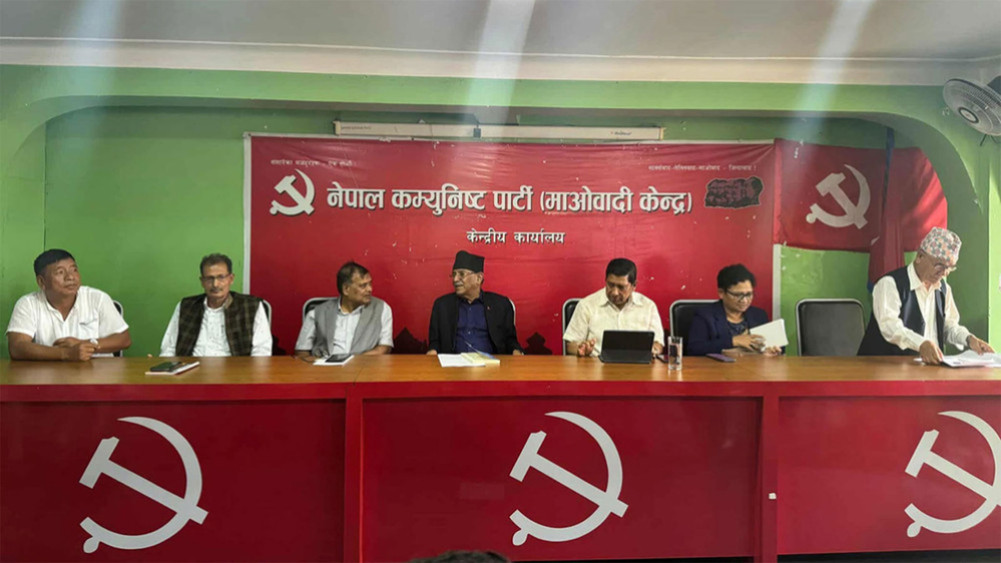
In spite of all this, the person in the leadership of the party tries to make a favorable decision. If there is a party president, he may wish to be the president again. A culture where one person is always the leader concentrates power on the individual. Maoist Chairman Pushpa Kamal Dahal is also one of the lucky leaders who always had the opportunity to be a leader in underground and open politics. This trend is also seen in other parties. But they go to internal competition within the party . Dahal is the only exception, where he has been declaring himself the president .
In almost all parties of Nepal, there is no internal debate within the party. There are so many organized parties but they don't seem to debate on an internal platform . For a long time, the parties have not raised the debate in principle . Neither the parties have been able to create a debate outside, nor inside . This is proof that internal democracy is not strong.
The authority to decide everything is entrusted to the leadership . The party should be institutionalized. All major parties have formed training departments. But they can't even break Cinco without the party president's help . There is an establishment in the Nepali Congress to discuss policy internally. That too is limited only to managing workers . It does not discuss national issues. Without internal democracy, there is unhealthy debate. There are factions and sub-factions, due to this situation, conflicts and divisions occur within the party from time to time. The conflict between party officials and leadership. Conflict between the leadership and the central committee . Conflict between workers and leadership . This is a matter of internal democracy.
Maoist Standing Committee meeting focused on individuals . It was seen that the meeting was focused only on the disaffected leader Janardhan Sharma . What could be more embarrassing than this? Most of the members of the standing committee kept their opinions around the fact that Sharma should self-criticize and Dahal should not. Should a meeting of the standing committee be held for this matter?
It seems that decisions are made by the influence of certain people in every party . This situation exists in the big parties that have committees from the village to the center. There may be endless possibilities of leadership within the Congress, but they are all in the shadows. Similarly, there is a possibility in UML, Maoists too . But KP Sharma Oli and Dahal and others are stopping it .
To strengthen democracy, leadership must be developed from the bottom up. Practices and processes should establish a culture of leadership development. The leadership is supposed to create an environment for the leadership below them to come down ideologically, theoretically, and organizationally, but we are denied. Now there is a commentary that there is no alternative to Oli and Dahal. Which is totally wrong and misleading . In India too, there was a situation that the Congress would end after Nehru . To make one person too influential is to kill the potential of others and not allow others to grow . It is not said that UML will end after Madan Bhandari in Nepal too?
Since there is no internal democracy within the party, a crisis has been created on the system itself. After the democratic practice and culture within the political parties, the result will be seen in the administration of the state . However, here the party leaders were like military dictators. Against whom one cannot even speak . How can a democratic system prosper with such a tendency? Today, questions are being raised about some provisions of the constitution. There is no debate about this between the party and the intellectuals.
What is the current priority of the government? What is the opinion of the party and the government towards federalism? Is there a debate on this? There does not seem to be a debate within the party and even within the parliamentary party. Its channel is not visible in the place where debates and ideas are formed. The party will conduct discussions between the party, parliamentary parties and think tanks.
Internal democracy is weak, the current party is very weak in terms of ideological, organizational, financial management and operational. To strengthen democracy, parties must be strong. In order for the parties to be strong, the internal democracy of the parties must be strengthened.