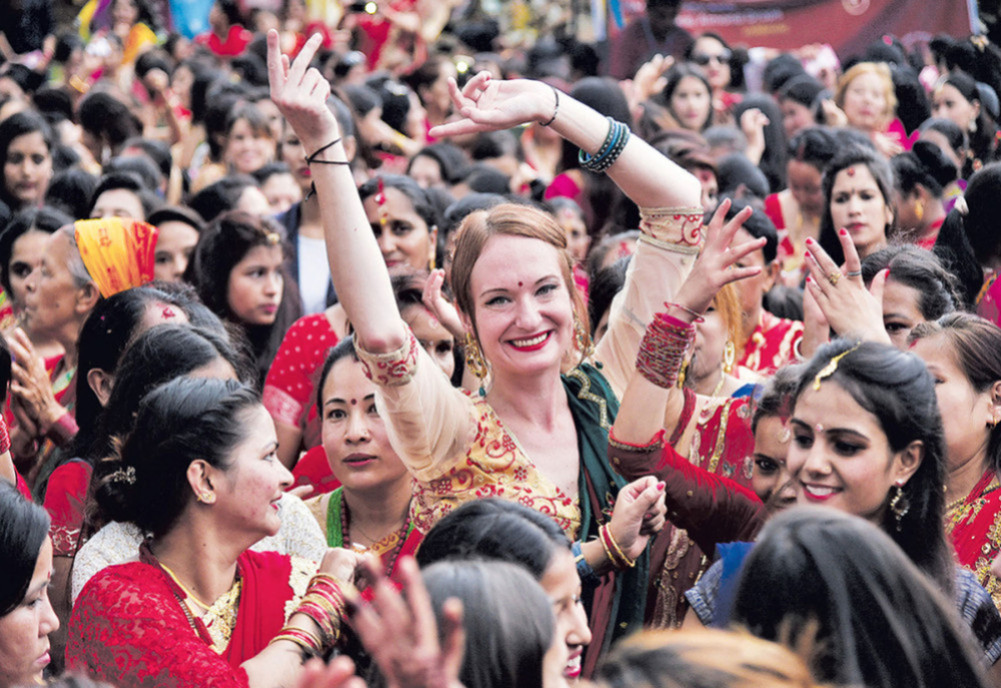
The festival of Teej is not only the worship of the goddess or the continuation of rituals, it is also a festival of women's confidence, social awareness, economic self-reliance and cultural identity.
We use Google Cloud Translation Services. Google requires we provide the following disclaimer relating to use of this service:
This service may contain translations powered by Google. Google disclaims all warranties related to the translations, expressed or implied, including any warranties of accuracy, reliability, and any implied warranties of merchantability, fitness for a particular purpose, and noninfringement.
Today's Teej is not only a fast to get a husband, it has also become a celebration of women's self-realization, self-strength and social consciousness. The atmosphere of Teej has brought a multifaceted perspective of women's empowerment.
In the past, the importance of Teej was limited only to religious and traditional boundaries, but today its circle has spread to social, economic, cultural and political aspects. Women are no longer just subjects of fasts and pujas, but through Teej they are raising their voice, questioning the wrong thinking of the society and speaking for equality. Group dancing, song writing, programs and dialogues focused on women have given a new definition to Teej.
The festival of Teej has become a powerful medium for women to bring themselves into the decision-making process of society, to share their experiences and value their presence. During Teej, women openly bring out their suppressed voices through songs, share their sorrows, pains, hopes and dreams. Such songs are not only for cultural entertainment but also living documents of women's lives.
The festival of Teej has also started contributing significantly to the economic empowerment of women. Women have started bringing products produced on this occasion (eg: Teej decorations, cosmetics, traditional clothes, dishes) to the market. Teej has become an important occasion for promotion of cottage industries and handicrafts. Cooperative organizations have provided stalls, product display and sales opportunities to women entrepreneurs at the Teej fair.
Such actions are also encouraging women to become financially independent, develop business acumen and showcase their skills. But it is very minimal. We are still far from fully understanding the psychology of our religious and festive consumers. On this occasion, India and China have adopted a strategy to make Nepali market very attractive. If we can use our own local products and connect them with religious and festivals, there is an opportunity to get economic benefits.
The festival of Teej has also contributed significantly to the preservation of our original culture. Today, as much as modernity has increased, the threat of extinction of traditional songs, original dances, folk languages and dishes has also increased. The original lyrics of Teej, jhyam jhyam dance, dholak, madal's rhythm and songs sung in connection with mother-in-law are preserving our culture. Local government, schools and cultural institutions should inspire the youth to understand and assimilate their culture by organizing original Teej song competitions, traditional dress exhibitions and mass cultural programs.
The role of men in today's Teej has also become a topic of debate. Women's empowerment is not only women's work, it is a topic that should be understood by the entire society. Men need to understand the meaning of Teej, acknowledge the contribution of women and respect women's independence and self-respect. In some places, men have started cooking for women, organizing events for them or helping them write, sing and dance Teej songs. Such activities increase family cohesion, strengthen the sense of mutual respect and convey a positive message in the practice of gender equality.
The festival of Teej is also important from the point of view of mental health. Throughout the year, women devote themselves to domestic, job, social and family pressures. Teej is the time - where women remember themselves, love themselves and recollect their inner strength and existence. Through group dancing, songwriting, meeting and dialogue, women reduce emotional exhaustion, find group harmony and feel mentally strong.
The organization of special songs, music, dances and traditional performances of Teej can attract the attention of local communities and tourists. This gives an opportunity to present not only the cultural significance of Teej, but also the confluence of traditional and modern forms of Teej. An opportunity to make Nepal a center of cultural tourism can also be gained by promoting the
program internationally. Teej's original culture hub can be made to attract foreign tourists.
In conclusion, Teej festival is not only the continuation of worship or rituals of the goddess, it is also a festival of women's confidence, social awareness, economic self-reliance and cultural identity. This festival has enabled women not only to dance, sing and rejoice, but also to think, speak and transform themselves. Teej is playing a role in mental empowerment through faith, social empowerment through organization and economic empowerment through skills.