The Fifteenth Plan has also announced that Nepal will enter a middle-income country in 2030, achieving the goal of sustainable development along with upgrading from a least developed country.
We use Google Cloud Translation Services. Google requires we provide the following disclaimer relating to use of this service:
This service may contain translations powered by Google. Google disclaims all warranties related to the translations, expressed or implied, including any warranties of accuracy, reliability, and any implied warranties of merchantability, fitness for a particular purpose, and noninfringement.
Many of today's least developed countries were just freed from colonialism in the 1950s and 1960s. Many of the colonies' natural resources, such as mines, were exploited by the colonizing nation. In those colonies there was extreme lack of economic, social, human resources, poverty, malnutrition and backwardness. At this time, Nepal was just freed from Jahanian Rana rule and was undergoing a political transition.
Freed from the shackles of colonialism and emerging in an open and free world, they did not have the means to fulfill their developmental aspirations. Education, health facilities were low and there was an extreme lack of human resources. Institutional capacity, infrastructure development, industrialization and employment opportunities were very less. A special program aimed at them was expected.
resulted in the formation of a separate group of least developed countries in 1971. Even now, the United Nations is implementing a 10-year special program targeting least developed countries. which was last implemented as the Doha Program Action Plan, 2022-31. In addition, a separate office has been opened within the United Nations to look into the case of landlocked and least developed countries.
There is some doubt that trying to provide special concessions is only the philanthropic spirit of the rich country or there was also a geopolitical reason at the time. Because, at that time, the cold war was going on between the capitalist and socialist poles. The communist slogan of building socialism without gaps between the rich and the poor was attractive to poor communities and nations.
The apprehension of the western developed countries that such a slogan should not attract the poor and weak nation and move towards the socialist pole may also be hidden. Because, about a decade before the United Nations formed a group of least developed countries, in 1960, under the leadership of the United States, with the support of other western countries, the World Bank, a multilateral donor organization, had already established a separate international development organization to provide loan assistance to the poor and developing countries with a very low income at a more concessional rate than the rest of the developing countries.
When determining the list of such countries, the United Nations took three main factors, namely the level of per capita income, the human development index and the poor economic and environmental conditions, which, however, remain.
After nearly half a century of being a least developed country, the United Nations has already recommended that Nepal be upgraded in 2026 in 2021. We are upgrading in 2026 as we have a five-year preparation period to manage the transition and sustain the upgrade. The Fifteenth Plan has also announced that Nepal will enter a middle-income country in 2030, achieving the goal of sustainable development along with upgrading from a least developed country.
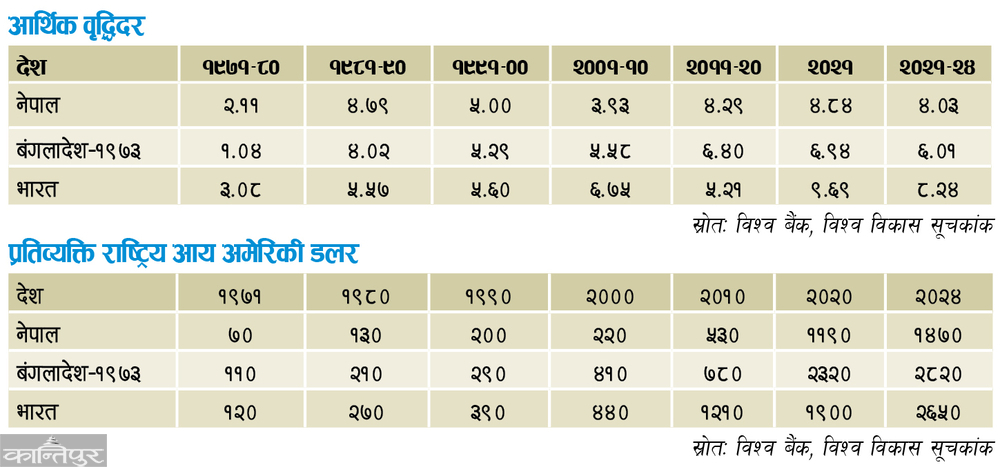
According to the World Bank's Development Index, Nepal's per capita income in 1971 was 70 US dollars. According to June Angus Madison's historical earnings data, In 2007, the US dollar was only around 50. That is, in the 21-year development journey from 2007 to 2028, only $20 per capita income has been increased.
According to the fourth five-year plan (year 2027-32), 93 percent of people depended on agriculture at that time. Even in agriculture, there is an equal amount of semi-unemployment due to lack of full-time employment. The contribution of the agricultural sector to the total domestic product was about 66 percent and the contribution of food products including rice to the total export was 70 percent. Similarly, the average age of Nepalis is 43 years, the poverty rate (based on per capita income of less than 1.90 US dollars according to World Bank 2011) is 77 to 80 percent and according to the national census of 2028, the literacy rate is 13.9 percent. Thus, economically and socially, Nepal was very backward.
The size of the budget submitted to the Rashtriya Panchayat in June 2029 by the then Finance Minister and Prime Minister Kirtinidhi Bista was 1.26 billion. The contribution of revenue to the source of expenses was only 600 million. Similarly, it was estimated that 52 percent of the total cost of the fourth plan, which was being implemented at that time, was 354 crores, which would be borne by foreign aid. The data which confirms that there is an extreme lack of resources in Nepal at that time and the dependence on foreign aid is high.
Currently, the size of the budget has reached 19 trillion 64 billion. It is estimated that 1395 billion i.e. 67 percent of the expenses will be borne by revenue and 287 billion 11 crore i.e. 14.61 percent by foreign aid. If we add the revenue amount of 1 trillion 65 billion to the provincial and local levels, the total estimated revenue will reach 15 trillion 60 billion. By the time of the 16th plan, the expenditure estimate for the plan period has reached 120 trillion 63 billion. Out of which 17 trillion 52 or 14.52 percent is estimated to be borne by foreign aid and 84 trillion 65 billion or 70.17 percent is estimated to be borne by revenue. In this way, it seems that the internal capacity is increasing and the expectation of foreign aid is decreasing. However, it seems that the revenue collection capacity has been declining for the past few years.
The fourth plan for the year 2027-2032 predicted that the economic growth rate would be 4 percent per annum during the plan period. However, in the decade (1971-80) when this goal was taken, the average growth rate of Nepal's GDP was only 2.11 percent. In the following four decades, the economic growth rate is also around four percent. The average economic growth rate for the last four years of 2021-24 is 4.03 percent. Thus, overall our economic growth rate is found to be around four percent.
However, Bangladesh and the neighboring country India, which are going to upgrade with us, have already surpassed us in terms of economic growth since the 1990s. In terms of per capita income, in 1973 Bangladesh and in 1971, respectively, India's income rose from US$110 to US$2820 and India's from US$120 to US$2650, while Nepal's income rose from US$70 to US$1470.
According to the Nepal Living Standards Survey 2079-80, the population rate below the poverty line is 20.27 percent. According to the National Census 2078, the average life expectancy of Nepalis is 71.3 years and the literacy rate has reached 76.2 percent. Which achievement is satisfactory and equal to neighboring countries.
When it was recommended for upgrading in 2021, Nepal's per capita income was only US$1027. Whereas, this income should have been USD 1222. In two consecutive evaluations, the human development index is 75 if it should be above 66 and the economic and environmental index should be below 32, so 24.2, so Nepal is ready for upgrading even if the level of per capita income is not reached. Although progress in human development and social development is satisfactory, Nepal is still weak in terms of increasing people's aspirations.
Nepal also needs to work harder to increase the level of macroeconomic indicators and per capita income in order to sustain the upgrading. In the last review of the year 2024, the economic and environmental risk index of Nepal dropped from 24.2 to 29.7, so it seems that special vigilance and targeted programs should be conducted to prevent the index from falling.
Upgrading means that Nepal is now becoming capable of building a self-sufficient economy from dependence. In the meantime, the Nepali economy has suffered several stages of political upheaval, 10-year-long Maoist conflict, the biggest earthquake of the century and the outbreak of the Covid-19 epidemic. All this is the result of half a century of reform efforts. However, one thing that should not be forgotten is that youth unemployment is rampant. Dependence on remittance income is high. The import-export gap and trade deficit are high. Even in the normal conditions of the last three years, the economy is not able to catch the average rhythm of the previous years. Along with the
, some of the upgrade costs will also have to be met. Nepal will have to lose the subsidized loan assistance that it has been enjoying for many years and the grant assistance that it receives from various funds such as the Climate Change Fund as a least developed country. Scarcity of resources is very challenging to meet the Sustainable Development Goals by 2030. The zero-rate customs facility and the reservation provided by the World Trade Organization will also gradually end. As a result, it seems that there will be an adverse effect on the income from exports. With the current geopolitical developments, it has become more challenging for a small country like Nepal to maintain its foothold in the international market.
Since the National Planning Commission has prepared a smooth transition strategy from the least developed country and 167 action plans have been identified for it, its implementation and regular monitoring from the highest level is essential for sustainable upgrading. To turn upgrading into an emerging opportunity for structural transformation, it is necessary to increase domestic production and productive capacity while protecting the achievements of half a century. Developed international events have also made it clear that internal economic security is a strong pillar of national security.