If they keep a crooked view on corporate advertising and remain silent no matter how much corruption there is in government advertising, the justification of such an organization will also be questioned. Therefore, the advertisement board should clarify its role in coordination between the government of Nepal, advertising agencies, advertisers, media and government agencies.
We use Google Cloud Translation Services. Google requires we provide the following disclaimer relating to use of this service:
This service may contain translations powered by Google. Google disclaims all warranties related to the translations, expressed or implied, including any warranties of accuracy, reliability, and any implied warranties of merchantability, fitness for a particular purpose, and noninfringement.
The media sector, which has the basic responsibility of exposing corruption and corruption practices, has now become an undertaking to institutionalize corruption in the advertising business. The concept of advertising rate and value has been eroded due to the unhealthy competition of media organizations mainly to bring government advertisements.
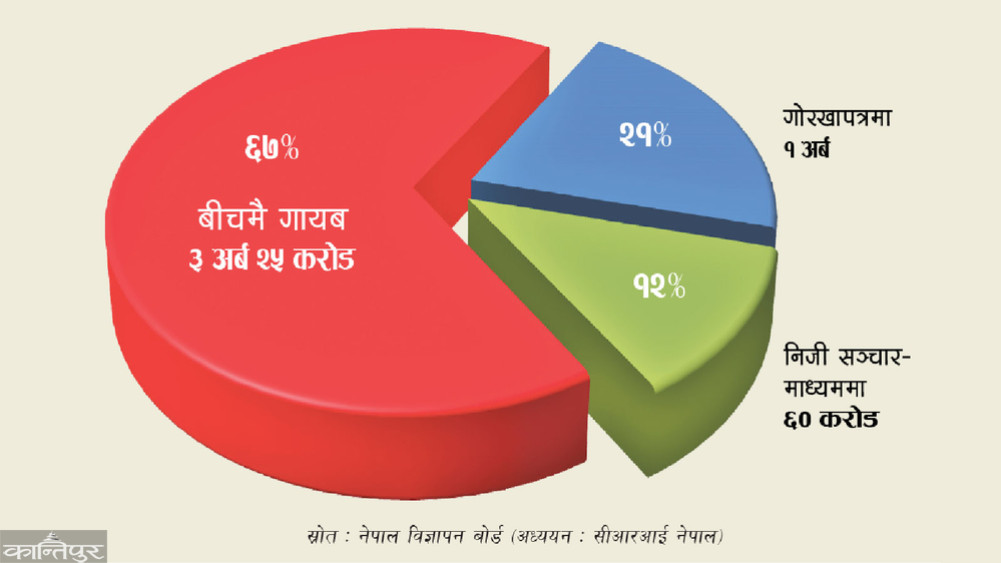
The conclusion of the study is that 67 percent of the amount spent by the government in the name of advertisement, i.e. 325 million, is corruption. The business of government advertising has been brought into disrepute by this practice of 'picking up' advertisements under any conditions rather than broadcasting them.
Some committee workers and advertising agencies have also been fattened by this situation, but the entire communication industry is in crisis. Corruption in the advertising market is not only a matter of concern for the communication industry, it is the primary responsibility of the civil society, parliament and conscious citizens to debate and warn about the looting of public funds collected from the taxes of the common people, while investigating and taking action on it is the legal responsibility of the authorities. For
media, advertising is not a privilege, it is a right. Advertising is the only medium that gives ground to make the media independent, fearless and pro-people. Again, advertisement not only makes the media financially strong, but also ensures the citizens' right to information.
Corporate advertising informs consumers and government advertising informs citizens about their consumer goods, their rights, ongoing development and whether or not transparency is ensured. The first condition of advertising is that its message should reach as many citizens as possible.
Information about public construction and purchase of goods or services reaches more and more citizens. The stronger the competition, the more it reduces public spending and improves quality. However, in recent times, the tendency to hide government information in the form of advertisements has become stronger in Nepal.
is going on to narrow the reach of information so that it does not reach the citizens or even if it reaches a limited number of readers, collusion between government authorities and businessmen and making the media its vanguard is going on. Media organizations have also been underestimating their immense power for limited returns. It has misused the public budget, compromised the responsibility of the media and created chaos.
The size of government advertisements in Nepal is 10 billion 39 million 16 million. It is clear from the study conducted by Advertisement Board and CRI. However, after the official concession by the media, the size of the advertisement is 4.84 billion 4.3 million. This means, about 54 percent discount has been formally given by media houses. Out of 4.84 billion rupees created after discount, 1 billion rupees will go directly to Gorkhapatra.
Private media publishes about 3.84 billion advertisements in the media but the media receives only 50 to 60 million rupees. The rest about 3.5 billion is lost in between. This is serious corruption. The budget that is deducted from the government account and does not reach the media houses is devaluing not only the media, but also the taxpayers, which should be investigated.
It is clear that any media outlet gives a discount of up to 95 percent - the advertising rate maintained by the said media outlet is not fair. If any consumer goods or service industry wants to keep the market price arbitrarily and give arbitrary discounts on it, the media questions, that is also their religion. However, no matter how much the value of their own media is kept and no matter how much discount is given, the media also loses the moral strength and right to question the market.
Therefore, the first responsibility to initiate reform lies with the relevant media organizations. However, institutions with legal and constitutional obligations cannot remain inactive. The Office of the Auditor General has pointed out the error in the report on this matter and the Commission for Investigation of Abuse of Authority has started the action. But the scale of the crisis has become so large that the effect of symbolic action will be weak. In the case of
government advertisements, the first thing that needs to be done is self-reflection and improvement by the media. The tendency to publish news of corruption and advertisements supporting corruption on the same page only presents a double standard of the media.
It is the media's responsibility to ensure that there is no corruption in government advertisements printed in their media, that they are printed through a transparent process, and that they instill confidence among the readers. For that, it is necessary for every media to strictly adhere to the policies and commitments related to advertising. However, there is also a legally established advertisement board in Nepal. But there is a lack of policy and practical clarity about the obligations, responsibilities and powers of this institution.
If the corporate advertisement is biased and if there is any corruption in the government advertisement, if it remains silent, the justification of such an organization will also be questioned. Therefore, the advertisement board should clarify its role in coordinating between the government of Nepal, advertising agencies, advertisers, media and government agencies. Its media, government and parliament should support him.
Government advertising is as much a stakeholder as the media as is the advertising agency. All over the world advertising agency is considered a creative business. It is also their right to charge a fixed commission.
Advertising agencies are also entitled to prestige and respect due to their responsibility to effectively deliver information from industrial organizations or government agencies to consumers and citizens. But the practice of hiding government tender notices and restricting competition, paying the full amount from government accounts but paying only the minimum to the media is commercially unethical and legally punishable.
Recently, it has been confirmed that the Health Information and Communication Center has contracted a rate of 109 rupees per minute for radio advertisements, while the agency has paid a total of 11 rupees per minute to the related radio. No media organization accepts such a situation, even if a particular organization does, the law does not remain silent. Government employees, advertising agencies and media should all be held responsible and accountable for reforms.