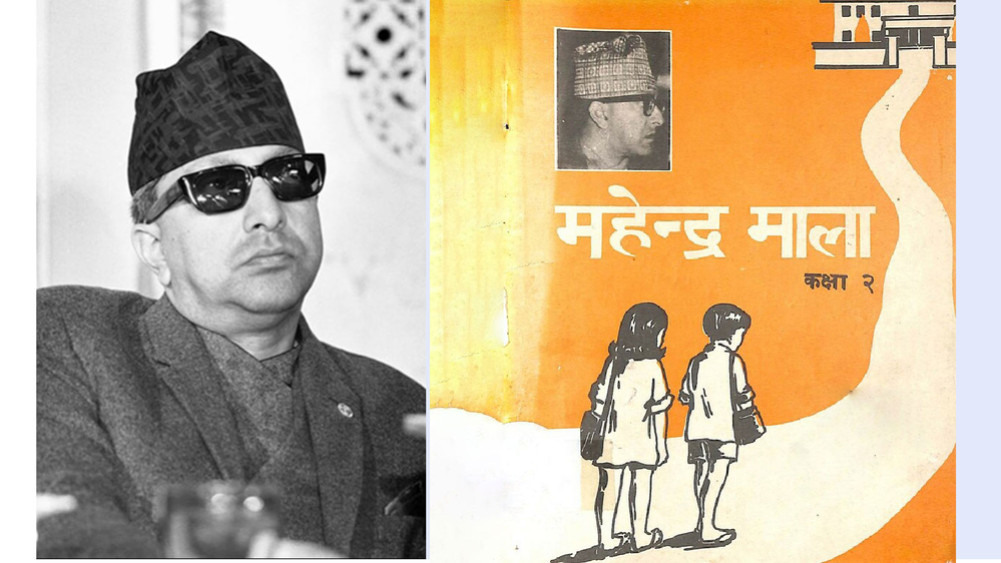
Even before the implementation of the new education plan, those who failed were passed, but those who passed were rarely failed. In the new system, a certain number of students had to fail, but the children of the dominant group of the community did not fail.
We use Google Cloud Translation Services. Google requires we provide the following disclaimer relating to use of this service:
This service may contain translations powered by Google. Google disclaims all warranties related to the translations, expressed or implied, including any warranties of accuracy, reliability, and any implied warranties of merchantability, fitness for a particular purpose, and noninfringement.
We are braveBut we are wise.We are wiseThat's why we are brave!-Bhupi Sherchan
Event 1: Goreto
from Raiti to Citizen The 2007 movement almost ended the reign of the Rana who ruled Nepal uninterruptedly for 104 years. If we take into account the reign of Shah and Rajgaj, which started soon after Rana's place, this change cannot be considered so great. However, the 2007 change is the biggest 'turning point' since the creation of modern Nepal, as people who were previously considered Raitis were accepted as citizens after that change.
It is accepted that the people are sovereign and empowered. Furthermore, the right of citizens was established over land, which was the main source of livelihood. When the constitution guaranteed citizens the right to speak-read-write-print, to be organized and to conduct projects and businesses as they see fit, it brought about changes at the ground level. There was upheaval in the social association-organization, media, school-college-library (i.e. education) etc.
The following reminiscence of Krishna Prasad Parajuli, a writer resident of Amarkot village in Kavre district and author of 'Ramro Rachna Mihe Nepali', gives a glimpse of those upheavals in villages after 2007 - 'The changes of 2007 showed good signs and also raised the feeling that we should give up. The desire for educational light grew in the hearts of the teenagers and young adults of the village and the elders also started to take interest.
...two schools were opened in the village in the year 2008. Literary historian Shiv Regmi has written - "After the seven-year revolution in Nepal, the zeal and enthusiasm of young people to establish a library began to be seen everywhere, as a result, libraries began to be opened in the Toltol of Kathmandu and the same process continued in different parts of the country." Libraries were opened even in difficult hilly districts like Okhaldhunga, Panchthar etc. In the mountains and Madhesh, the relatively well-equipped places would have to live. Apart from that, various foreign countries (America, Britain, India etc.) had established libraries in urban areas including Kathmandu, Pokhara.
Literary writer Parajuli was also working hard to open a library in his village Amarkot, Kavre - 'Along with the background of opening a school, the opportunity to open a library was increasing. Finally, as time ticked by, a long-ago dream came true—in a new glow of enthusiasm. In the year 2013, another piece of knowledge was lit in the village, the awakening library was established.... Then the conch of awakening was blown in the village.... a new sun shone there.'' The wave of public awakening that came to Amarkot village is a reflection of that time. Schools were opening everywhere and libraries were following. Schools were only for students, libraries were for the literate and adults too. The school was on lockdown, the library was open. Villagers used to get together to read a little book, do something, gossip, argue about the matter. These libraries were Nepali 'Public Sphere'! He was becoming a part of the social movement.
Such libraries were registered by the government and some financial assistance was also provided to them. Jagriti Library opened by Krishna Prasad Parajulis was also going to get government assistance from the new financial year after getting government registration. Shiv Regmi writes - 'But this activity almost came to a standstill with the political changes that took place in 17 years.' The end of democracy affected the entire life.
Literary Parajuli has said in his memoirs, "We could not see the realization of our happiness." After Mahendra took power in his hands, the financial support of various public libraries and Kavre's awakening book was stopped. Shiv Regmi writes – 'With lack of financial support and encouragement and government control, libraries began to dry up and often closed down. ...Even opening of public organizations started to become difficult and people started fearing to open such organizations. The number of libraries decreased instead of increasing.
The Manohar-Mohan (later Jan Vikas) library established in Sarlahi in 2004 was popular around Malangwa. After 2007, the land was also acquired by the government to build the library building. However, after the year 2017, the library was closed. Lakshman Upadhyay has written - 'After 2017, the Royal Army and Armed Police were mobilized in the district and district.
Daffa who came to Sarlahi made the house-compound where the library is his residence. A building could not be constructed on the land of the library in the middle market. Those who wanted to make the land their own were looking for an opportunity. They tried to close the library on many pretexts. Local administrators also agreed. With the activism of vested interests, the Jan Vikas library was shifted to the village panchayat building. Instead of running the library, the village panchayat first buried its eyes in its furniture. Later, the existence of the library was directed towards elimination. ...the land of the library turned into a private property.'
Similarly, Purnaprasad Adhikari says about another library - 'Narayani Library was established in 2016 in Narayangadh Bazar of Chitwan with the aim of imparting literary and educational knowledge. ...This library was repeatedly attacked by panchayats because the people of this organization belonged to the Nepali Congress. Around the year 2026, some fierce panchayat disciples vandalized the library and washed the very valuable books into the Narayani River.'
Incident 3 : 'New Education' and the decline of public schools
In 2017, after the end of multi-party democracy and parliamentary system, there were sporadic protest activities by the underground workers of banned parties. Resistance also came from some public schools. However, it was not easy for the government to suddenly close other social organizations or schools like libraries. If the news of the closure of educational institutions by the government that is shouting the slogan of education and development, the legitimacy of the government would be questioned in the eyes of the general public and the international community. Therefore, the state's grip on education gradually tightened. But there was constant resistance from its ground level.
To deal with this unexpected challenge, the Panchayati government intervened in the overall education sector in a deliberate manner. After spending some time and planning in Gupti style, the 'New Education' was implemented from the year 2028. His son Yuvraj Birendra was active in creating the structure of this plan which started under the guidance and leadership of King Mahendra and in finalizing it.
According to the government's claim, a new plan was needed for the development and modernization of the country because the education system before the new education did not reflect the 'reality of the country'. But if we dig deeper into these claims, we can understand the reasons and context behind the new education.
Tribhuvan University's immediate vice-chancellor Trailokyanath Upreti has written confirming the justification of the government's move to introduce a new education plan - 'The education system we introduced before 2007 and especially after this period was not adapted to the country's climate and soil... We started to be disturbed by the terrible situation of becoming a national burden instead of supporting national development.... Social unrest from educational activities that are trying to disorient the youth character. A premonition began to be received.'
American anthropologist Todd Ragsdale wrote - '(The new plan) showed Maharaj's determination to fundamentally restructure education. The riots caused by the students in the mid-sixties and the unemployment seen among the youth who studied humanities indicated an impending crisis and this plan came as a result of the efforts to address it.' Earlier legal changes had brought schools and their governing bodies largely under state control. However, that was not considered sufficient. Schools across the country were nationalized—they became state property. After this, the government downgraded many schools. In other words, teachers would now only be allowed to teach up to Nimavi level, and many Nimavi were demoted and given permission to teach only up to primary level. Some schools merged with other schools.
Earlier classes 1-5 were called Pravi and now classes 1-3 were called Pravi. Many villages in the country had only primary schools. Earlier it was taught up to 5th grade, but now only up to 3rd grade is taught. Because of this decision, young students either had to go to another village far away to study at a higher level or had to drop out of school. This alone prevented a large number of students with potential but no resources from reaching the top level. The position of the colleges was similar. According to a scholar, "Many colleges that were opened to teach humanities and social sciences were either closed or became part of other institutes." Those teachers would be responsible not to the students they teach and their parents, but to distant government agencies! He stopped teaching. With this, the decline of public schools began.
Incident 4 : Factory for producing 'failed' students
The new education scheme deliberately intervened in the examination system to prevent a large number of students from entering higher education. The government plan was to allow only 2 percent of the students studying in Pravitah to pursue higher education (IA and above). Due to the objective of producing only the required number of manpower for the nation, various obstacles were put in place to prevent the students from going to the next level.
Scholar Dharam Veer has written the government formula for planning the number of students in this way - "The rulers added disruptions in higher education with the aim of discouraging those who study higher." However, such restrictions were different from the arrangements made by the Rana rulers. The state did not ask me to go to the college but gave the exam results as per its plan. More than a quarter of students are not given passing marks. In this way, about three-quarters of students are sent home from college.' He thought that if as many students failed as possible, they would not have to be given jobs, so the problem of unemployment (and, through it, the political problem) would be solved.
For example, implementing new education in a district like Kaski was challenging because the ratio of students studying in different levels was already higher than the ratio recommended by the government. But under the new plan, schools would have to reduce the number of students they were teaching before. It was necessary to control the number of students from the lower level to reduce the number/proportion of students studying in the upper level.
Scholar Todd Ragsdale has given an interesting account of how Lakshmi Primary School in a village in Kaski had to fail 6 out of 14 students of class 3 due to the new examination system after the implementation of the new education system and what kind of manipulation took place in it. Dalit students in class one and two scored high marks, and were congratulated by the principal.
A Gurung boy stood first in the infant class. In third grade, 6 out of 14 students failed. Among them, one boy and one girl were Gurung. All but one of the rest were poor Bahun boys from Lamagaon. There was only one Dalit boy in the class who failed along with them. As many of the villagers had information about how such a result came about, he kept it to himself.' A few other students are failed in order for the children of the community's resources to succeed. Utta village Boy Boys failed to the part of a Dalit boy in the village and the village boy in the village and class. & Nbsp; The
was also made to pass even when the new education plan was made, but those who passed the passages were rarely failed. A certain number of students would fail in the new system, but the child of the influential groups of the community were failed to fail. So, the faka became a student who was on the side of my blood in the social ranking-structure, even in blood education studies. Enabled and Javital putting the largest part of the student in the category of the student, the state has entered their soulvinity (self esstim) and mental. Even the state mechanism wearing many trikmas, even the Cavil Students prepared the "fails' generations by the pair.
Provident 5: Government of government-BREAK-BREAK School and the examination of the term and examination of the exam and the examination of the exam was far-ended negative influence on the overall education system. In the 2007 year 2007, Rana rule was raised after the high casualty and resources. However, new education scheme maintained the rects / class dubba! Retained the old situation. The
is opened in the convenience of local engineers before the completion of the new education plan is implemented. Monthly fee to be collected from students was the main source of schools. Being a lot of students meant to be good of school and the teacher was saved at the time. Therefore, the selfishness of both the management committee and the teacher's selfishness;
used to enroll more a student as much as possible in the area. For this, they were not working all the houses in their area. Even after her own investment, even the poor also used to do, demanded to teach their children to teach. The teacher / the Board of Directors were also facilitated to support the house in student.
but when schools were dominated, this relationship between community members and school operators were not surprised. School operators and teachers have now reached home and sent the students to read. Tikaram Koirala of Bhadrakalist School of Pokhara is saying that long before the new teaching applied, as soon as the new teaching was applicable, as soon as we were applicable, as soon as possible, we would have visited the village. In Rama, Kami, Sark Karak, Gurung, Gurung, Gurung, and Muslims called today, were our school students. We got married to take money. Someone also gave a manno's just a muddy. They wanted their children to be read with their children. & NBSP; Was the more student we were. However, after the new education was applied, it returned. We stop talking to them to read children. There was no one that they should send children to read .... After later, the child of these communities started to go to go to go to go to go to go to go to go to go to go. 28 After 28, the number of Dalits and Janajati students declined. When they meet some Muslims today, they would have children, saying, "You have already heard. 'They did not have to send.' They were not a press. So his number has changed. 'The proportion of a major control system by regulating the
of Students The state of a student who could go to the upper level, which re-produced a social-categoriat-structure (Social Hyracker's). That is, new education prepared such structure, which produced a new educated class, but it came from Nepal's resources / via Aat. Just-just got a chance to go to school, motivated access to the access of the society or the society class.
Prices 6: Individual and Nbsp; 'Indactricon' Promise Party-Breakson '
to Nepal, with the 2010 means of making the only one means of them. This process got more power after the Panchayat period. At the beginning, the monarchy was pregnant in the course! A little later, 'Panchashi' was mowkown in the textbook. The campaign of ideological 'Indactrican' in the name of National Institution and National Reconstruction, the campaign in the name of national integration and national reconstruction.
is a major view of new ideas schedule, 'This is a promotion of the new education plan for the campaign for the campaign. Especially the course of social education has been found to completely change. While preparing the course of each level, the objective of preparing a manpower required for the country. '
education did not have another place suitable than the textbook. Therefore, the new course tried to teach the student to realizing a lot of labor and loyalty to democracy well. A Kalila student's mind was dumbling in the minds of a certain genuine to start him with class 3. The main reason for the young age student to read the third age, the new time that only the third age is planned to prevent them from reading it on it.
Panchayat system was implemented in the specialistic textbooks written in National history. Harvesting first in the history of the first history. Some people were tired of vital factors in the case of the event / person, they were annihilated. Further well-known Birisma, "writing about her death on the textbook, he fought in accordance with the heroic domestic family. 'When he fights in the Textbook, he was hidden to fight in the battlefield.' As a national hero, he was consoruated to the National History, was considered to be a national hero. When everything came out of the ball-control student, he made a meaningful statement for his nation or of his loyalty to Nepal, so history was pierced.
has been written by the process, which was not being taught in the textbook before Panchayat, but heroic in the textural national history 'was removed from the textbook. Similarly, there is a wonderful example. Story after 2007, after 2007, 2007, who read the textbooks of the Nepali language, remember Gaje Ghale. The Barpa in Gorkha's Barpak was given 'Victoria Cross' because of his inspired courage in World War II. So the group of heroic was raised in the textbook. However, after the new teaching was the official of the education / textbook, modified, then the story of gased was a story of Gause and the story of the hour. The factory is made by extracting semi-trapped and 'failed,' the semiped and 'failed.'
Majaro: Brabhi-Veriyo, the country was introduced to one another after the agitation of Nepali
2007. Although politics did not follow the expected direction, the common people were paid for themselves and the future of the descendants. However, while fulfilling a psychical of a dictator, run in libraries. After
, schools were attacked in more well-in-aired manner. As the distorted 'Manpower', the schools did not re-producing the social attorney and the social rank structure. Created the situation that could not reach the other levels that would not reach the lower class and social / cultural capitalism. Even if the state-BREAK has so far, the provision of educational intervention has not been killed and dependent on their path. Billions of Rs, there are many metropolitanpalikari and many governments, but there is no brilliant public library in the country. Moreover, the government does not mean that such a lady-caring leader needs such a library. Being born on the last period of Panchayat, millions of students like Municipal students and millions like me have been able to see the name of the name of the name of the public library.
, born on Rana, and reading in the topic tenure, I learned to open a public library in a multi-party aunt. Geophya must have said that a fixed lesson has been changed and after the later generation of the old book, "I have a difficult pen.
(are associated historic & nbsp; socious & nbsp;) Social-Break.)