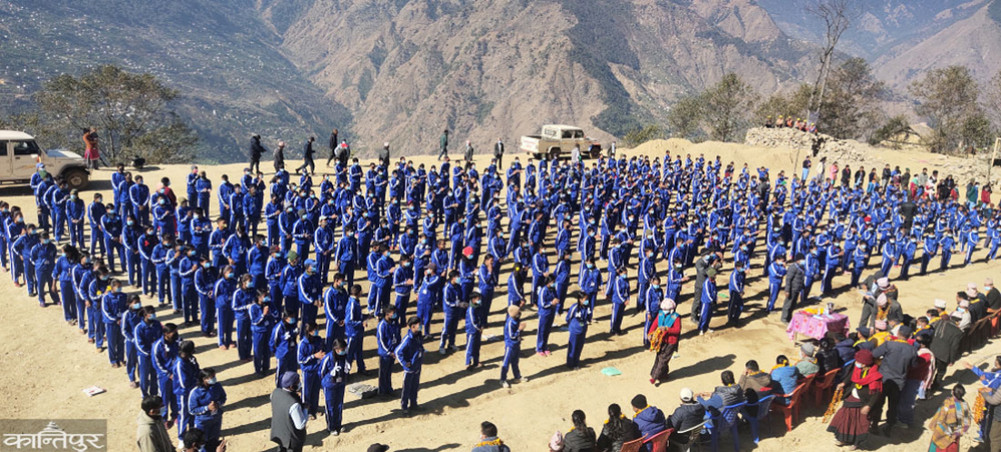
In Nepal, it is necessary to move education towards a non-profit or service model in the long term, for which a solid policy and its implementation is necessary to increase state investment in public education, improve quality and bring private schools into social responsibility.
We use Google Cloud Translation Services. Google requires we provide the following disclaimer relating to use of this service:
This service may contain translations powered by Google. Google disclaims all warranties related to the translations, expressed or implied, including any warranties of accuracy, reliability, and any implied warranties of merchantability, fitness for a particular purpose, and noninfringement.
After the new constitution declared school level education compulsory and free as a fundamental right, a new legal system was expected in this regard. Accordingly, two years ago, in the second week of July 2080, the government registered the school education bill in the parliament. However, within a few days, the government withdrew the bill in 'kidnapping style' and explained that the proposed bill was different.
Then, on August 27, 2080, the revised bill was re-registered in the parliament on behalf of the government. Now the bill has reached the final stage of being passed by the parliament after the discussion is over.
This bill became a subject of great interest and debate among students, parents, teachers, private investors in education and the general public. It remains to be seen how much space these debates and interests will get when the bill is passed. The main thing is that the government and the parties participating in the government have not reached a clear and concrete decision about this. If the bill is honestly forwarded by giving up individual or group interests, putting the spirit of the constitution and education reform as the first priority, then it does not seem to have any great difficulty in making a consensus draft.
Among the various issues of the School Education Bill presented during the discussion in the Education Committee of the Parliament, two issues have been considered particularly important and complicated. First- to make school education non-profit and second- to maintain the quality of education by increasing the professionalism of teachers. It is said that these two issues are the main reason why the bill has not been passed till date. On the one hand, private school operators are using their influence in various political parties to maintain the status quo to protect the interests of investors.
On the other hand, teachers' unions are focusing on how to guarantee their services and personal interests through the movement. In such a situation, it seems that not enough attention has been paid to the basic question of how contemporary reforms in the education sector, the development of a child-centered education system, the dignity of the teaching profession and the advancement of professionalism can be done. The purpose of the bill is to strengthen these aspects and make the education system child-centered and quality-oriented, but the current debate and activities seem to be limited around self-interest and pressure.
Now, looking at the investment and expenditure in education, the state of school education envisioned by the constitution is not yet seen to be completely free. According to a UNESCO study, about 44 percent of the total expenditure on education is borne by the government, while 56 percent is raised directly or indirectly from private sources, a major part of which is borne by parents. Similarly, the share of private student enrollment in school education is also increasing in South Asia. It is clear from this that there is no doubt that the role of the private sector or parents in education is very important.
In the current situation, private education cannot be controlled until the state is economically and qualitatively capable. It is important how to bring them into social responsibility through regulation and monitoring. Education is not only the mainstay of social and economic development, it is also a long-term process of human development.
Likewise, education is for all, not just for a particular class or group. For this reason, education is an important issue under social responsibility. In such a situation, the question arises – can education be made a profitable or commercial commodity or not? If 'doesn't match' then another question automatically arises, what steps should be taken to make education non-profitable? For this, it is necessary to consider some methods of investment in education or operating models.
Constitutional arrangement of investment in education
Nepal's constitution has not specified any clear and concrete policy regarding investment in school education. However, it is clearly mentioned that the state investment in education should be gradually increased. The context of private sector investment in education is clearly defined in the constitution. Under the guiding principles, policies and responsibilities of the state, it is stated in the policy regarding the basic needs of the citizens - "Increasing the state's investment in the education sector, making the private sector's investment in education more serviceable by regulating and managing it." Perhaps this is the reason why the demand for private schools to be run under Guthi through the Education Act has started to rise vigorously. However, one thing needs to be understood, not all problems will be solved just by making provisions in laws and regulations.
How active and honest the government or state is in its implementation is decisive. If private investment in school education is to be discouraged, first of all, state investment in public education should be increased. Also, it is inevitable to take concrete steps to make public education quality and useful.
Neo-liberal thinking in education
Since the 1990s, neo-liberal thinking began to dominate the economic sector of Nepal, the influence of which was also clearly seen in the education sector. Neo-liberalism limited the role of the state not only in the economic sector, but also in the social sector, increasing the role of the private sector and developing a system based on market control.
There is no dispute that it has brought about some positive economic results like job creation and income growth. But in social sectors like education and health, privatization and liberal policies had more negative effects than positive ones.
It deepened the social and class divide. In Nepal, the umbrella organization of the private education sector is strongly advocating the right to do business openly in education citing property rights under the fundamental rights mentioned in the constitution. In such a situation, the possibility that the current behavior of major political parties and the government may go in favor of private school administrators cannot be ruled out.
In this context, American philosopher and Harvard University professor Robert Nozick's statement is relevant. Even Nozick, who is considered to be a supporter of minimal state intervention, said that commercialization in the education system will lead to immoral benefits and unequal distribution, and it will spread inequality in society. In his argument, if wealth has been justly acquired by a system, it must be distributed justly. Therefore, it is imperative to seriously evaluate the role of the private sector in the education sector from this perspective. In this context, it is necessary to know about some models of school management adopted by different countries of the world.
nonprofit model
The concept of education as a public good and a human right is widespread throughout the world. According to the understanding of this model, the school's primary objective is to promote the access, quality and social welfare of education rather than making a profit. For this, it is common practice to run schools as trusts, NGOs or foundations. The key features of this model are equity, inclusiveness, quality education for all, transparency and social accountability.
This model is considered very popular and effective in countries that prioritize human rights and place social justice at the center of policy-making. For example, the success of this model is evident in Finland, Denmark, Norway, Canada, Japan, South Korea, Singapore and Germany. Even in the proposed Education Bill, it is heard that a system has been proposed to set certain limits and operate the schools under Guthi. If a political consensus can be reached on this issue, not only will the risk in education be reduced due to the low budget, but it can also be expected to contribute greatly to the promotion of social justice.
profitable model
In this model, education is primarily conducted with a profit motive rather than a service. This model often operates under a neoliberal market-oriented system, with particular emphasis on competition, quality and innovation. The dividend received from this is distributed among the directors or shareholders. However, this model is not considered suitable for school education due to the lack of social responsibility, lack of inclusive education and promotion of class division.
Varnashankar model
It features both non-profit and for-profit models. Education is viewed as a service but private investors get some benefit as a return on investment. It embraces common goals of social responsibility, quality and innovation. For example, after deducting the annual expenses of a school, a certain part of the remaining amount is given as an incentive to the administrator and the remaining amount is invested in improving the quality of the community schools that are lagging behind. The role of government agencies is important in running these types of schools.
Along with this, the public-private partnership model has also come into vogue. In this, the government provides school infrastructure or policy support, while private organizations are involved in management. The school is not for profit and the evaluation of the service is monitored by the government. Conditional grants are given by the government to extend services with social responsibility. This model seems close to the hybrid (Varnashankar) model in terms of structure and purpose.
community and cooperative model In the
cooperative model, stakeholders (civic groups) including local communities, teachers, parents, and others take over the ownership or operation of schools to promote common interests. These schools are run not for profit, but according to the needs of the community. It prioritizes transparency, participation and inclusiveness. Potential dividends from
schools are reinvested in school improvement. Such schools are operating successfully in many European countries. The cooperative model basically takes the non-profit organization as its model. From the analysis of these different models, the patterns of education operation in Nepal can be easily estimated. Currently, about 77 percent of schools in Nepal are operating as public schools, while about 23 percent of schools are under the private sector.
conclusion
Nepal's school education system is currently in conflict between for-profit and non-profit models and this is considered to be the main reason why the education bill has not been passed. Although the constitution aims to make education service-oriented, a large part of private schools are operating in a profit-making model, which is sure to bring the risk of increasing social inequality.
It is necessary to move education towards a non-profit or service model in Nepal in the long term, for which a solid policy and its implementation is necessary to increase the state's investment in public education, improve quality and bring private schools into social responsibility. This is the only way to build an equitable society by making education equal and quality for all.
The main goal of the state should be to ensure quality, accessible and inclusive education by making it serviceable. It is also our collective moral obligation. If education is to be considered as an important foundation of nation building, its opportunities should be equally available to all. Only in such a situation is it possible to build an egalitarian society.