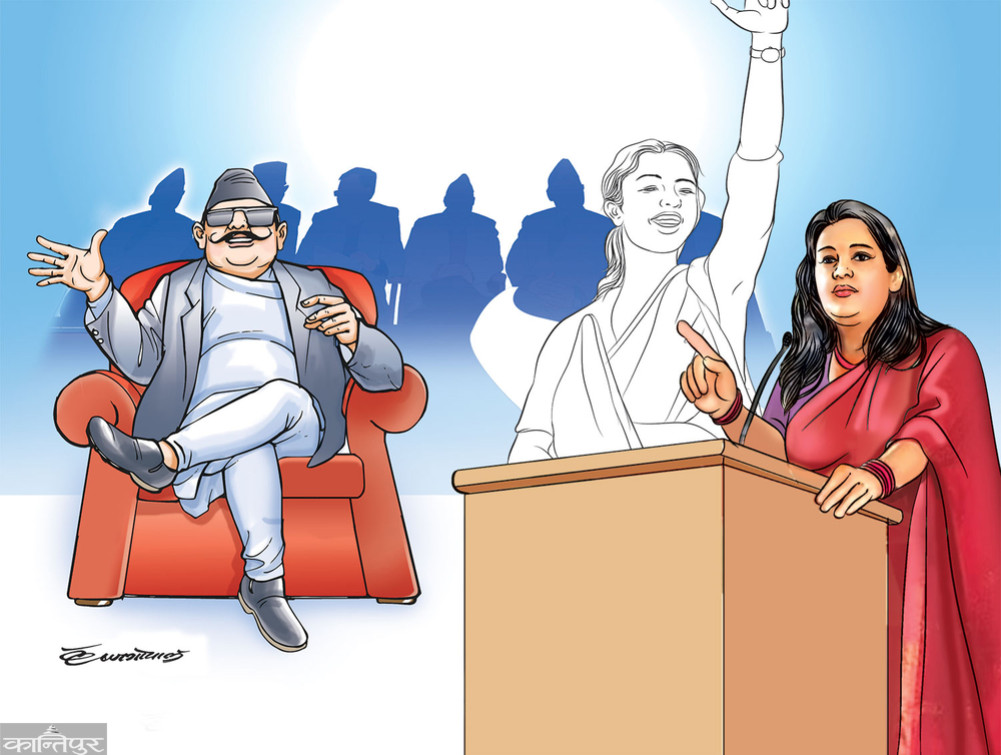
As long as male totalitarianism prevails in political-administrative power, they continue to try to stifle gender rights, weaken the implementation of positive systems and weaken women.
We use Google Cloud Translation Services. Google requires we provide the following disclaimer relating to use of this service:
This service may contain translations powered by Google. Google disclaims all warranties related to the translations, expressed or implied, including any warranties of accuracy, reliability, and any implied warranties of merchantability, fitness for a particular purpose, and noninfringement.
In theory, patriarchy is a government weapon designed to perpetuate exploitation, oppression and oppression of women. It makes men structurally powerful, women structurally powerless and vulnerable. It reinforces male dominance in the family, society and state, making women subordinate or dependent to men.
Deprives women not only of governmental power, but also of economic resources. Establishes a master-worker relationship between men and women. Not only this, it imposes many types of socio-cultural restrictions, forces them to endure injustice, discrimination and atrocities under the pretext of religious and cultural values. Rigid patriarchy over women and gender and sexual minorities is weakening to some extent with the march towards a democratic political system. Due to changes in the system, awareness developed in people, development of science and technology etc., there is a challenge to the patriarchy. However, with the changing environment, patriarchy is also changing its form.
Patriarchy entitles only men to share and lineage. Deprives women of inherited and acquired property. When power and wealth are monopolized and controlled by men, women naturally become helpless. In patriarchy, lineage tradition has male legitimacy. Women's existence is not acknowledged, and after marriage, women are alienated from the clan tradition or identity associated with birth. Where patriarchy dominates, women are not given freedom of decision or even the right to choose. Different kinds of restrictions are placed on wants, desires and needs. Where should women go or not? Who can talk to or not? What to do or not to do? Men are the deciders of such matters. For example, women are not given the right to choose whom to marry.
Patriarchy does not accept gender equality, justice and the sovereign existence of women and gender and sexual minorities. It does not accept political leadership easily, it does not accept the fact that women are capable. Not only this, patriarchy is the protector of casteist and puritanical culture. It contributes to strengthening the wall of discrimination established on the basis of the caste system, while it legitimizes the serial discrimination and creates a corresponding culture.
On the other hand, religious and ethnic puritanical views tend to be inherent in patriarchy. The patriarchy is also defending the puritanism of Brahmanism, which considers menstruation, childbirth, widowhood, remarriage etc. impure. Patriarchy, which does not give women ownership of shares and lineage, puts the burden of protecting the honor of family and lineage on women's shoulders. Thus patriarchy operates the entire state and socio-political structure to institutionalize and perpetuate male dominance. It perpetuates violence, discrimination and exclusion against women and gender and sexual minorities. Regardless of the political system, whether it is feudal or capitalist democratic, a developed society cannot be built without a life with equality, justice and self-respect.
marriage and patriarchy
Marriage in Hinduism is considered as a process of living human life ideally and comfortably. Marriage is considered mandatory to continue family traditions and traditions. However, such religious beliefs tend to strengthen patriarchy and perpetuate violence against women. Examples of this are the question of Rama testing Sita's chastity in the Ramayana or the tradition of giving gifts to daughters. From a Marxist perspective, marriage is interpreted as an institution established by the need for a legitimate heir to private property. This has continued the tradition that women should give birth to heirs of property through marriage, but women are never entitled to property.
In Nepali society, there is a trend of getting married based on the financial condition of the individual or family, social status, caste and class. If marriage is to be interpreted as an emotional relationship or a human need, such grounds should be secondary. It is not that there is no emotional connection between poor and rich people, love between different communities is not unnatural. However, such marriages are rejected in the name of religion, culture or tradition. In a family where there is marriage between people of equal or unequal socio-economic status, the man is decisive, it strengthens patriarchy.
Marriage has always challenged women's sovereign identity. They have had to struggle for many years to give citizenship to their own children, which is a struggle for identity and existence with the patriarchy. Not only this, because of the surveillance after marriage, women are forced to limit their activities such as choice of labor or business, movement, ie marriage often narrows and controls women's sovereign identity and activities. The root cause of this is the patriarchal power structure in the society.
If the patriarchal unequal power-relationship is to be ended, the marriage will be transformed into cohabitation. In such a situation, the identity and existence of women in the family and society are equally accepted. A family is run on the basis of mutual decisions. By ending the monopoly over financial resources, financial dependence on men will end. Religio-cultural slavery and discrimination against women ends and families can be formed with equality and respect. It can play a role in ending the discriminatory patriarchy.
The character of state power
Patriarchy is a theoretical concept that gives a certain way of looking at, understanding and analyzing a question. Social structures, political systems, policies and laws are built based on those perspectives. Especially when the Jamaat guided by patriarchal thinking, approach and psychology is strong in the place of making the policy of the state power, the state power is more focused on making structures, laws and policies that strengthen this system.
Nepali society has been fighting against exclusion, discrimination and violence against women for a long time. Diss. Be it the struggle of Yogamaya Newpane since the 1970s or all the movements for democratic political system, women's struggle for justice, equality and rights has resulted in constitutional and legal rights to a certain extent. Efforts have been made to address issues such as women's political representation, rights against violence, education, health, and employment rights constitutionally and legally.
Patriarchy allowed men to practice polygamy. It is said that Jung Bahadur Rana married 42 people. Men who held the reins of power, authority and wealth were allowed to practice polygamy. As a result of the movement and campaign for the end of polygamy, which promotes violence, abuse and oppression of women due to such a system, in 2075, a legal provision was made in the Criminal Code that men cannot have polygamy. It was stipulated that both those who performed or performed such marriages would be punished with criminal offences.
However, it has been made public that the government is going to amend the Criminal Code so that a second marriage will be maintained in case a child is born due to the relationship of a married man with another woman. The intention seems to be to recognize such marriages especially for the rights of the unborn child. It is a reversal of the historical achievements of the struggle for women's equality. Because such a legal system perpetuates patriarchy and perpetuates violence and abuse against women. The law, which allows men to have unfettered polygamy when the law itself prohibits second marriage, is a journey towards regression. It strengthens the monopoly and supremacy of men, and under the guise of power and wealth, men increase the tyranny of women with weak economic status.
The journey towards gender equality and justice is moving forward with strong movements against the right to political representation, granting citizenship to children under the name of the mother, equal rights to property, violence against reproductive rights and discrimination. Now the movement on the question of women's rights is not becoming so strong. Therefore, when the speed of the movement is weak or there is no strong movement and resistance, the state tries to bring laws and policies that suit its interests. This attempt on polygamy is also a product of that. As long as male totalitarianism prevails in political-administrative power, it will continue to frustrate gender rights, weaken the implementation of affirmative action and weaken women. Therefore, it is necessary to strengthen the struggle against patriarchy.
resistance against discrimination and violence
Movements for social justice and equality are going on around the world. The women's movement, which started with the rights of working women, is continuing the movement for women's political, economic and cultural rights as well as rights against violence. Even in Nepal, the movement for political representation, inclusion and gender equality has continued since the end of sati practice. The fight for equal rights over property continues. The movement against discriminatory gender values and violence also continues. There is also a need for strong resistance against government efforts to legalize polygamy.
Ending patriarchy is a political agenda. Political parties run the government. Therefore, it is important to have political ideas, approaches and strategies to end patriarchy with the political party. Until the political ideology of patriarchy is with the party, the political movement to end patriarchy will not be complete. Likewise, all the political parties in Nepal have female leadership and there are also women's organizations for the promotion of women's rights. Such organizations have been created to hold theoretical discussions regarding women's rights, to force the relevant party to create a gender-friendly policy, and to advocate strongly for women's rights on behalf of the party itself. However, the women's organizations close to the political parties have not been able to strongly intervene politically, make the party women-friendly and conduct a strong campaign against violence.
Women's organizations active in the social sector also need to make integrated and strong efforts. Therefore, in the current situation, it is necessary to build an integrated movement with the ideology, strategy and political action plan of the women's movement so that it can challenge the patriarchy in the party power and the state power. Nepali women also have diversity. There is diversity in terms of caste, language, culture, civilization and power relations.
A unified and strong women's movement cannot be built until the issues, interests and concerns of tribal tribes, Dalits, Madhesi, Muslims and marginalized communities become the central issue of the women's movement. Therefore, it is necessary to strengthen the struggle against patriarchy by making women's diversity and the progressives of the society, gender equality and justice also a part of the movement. Until women get equality, justice and freedom, democracy will not be strong, nor will a just society be built.