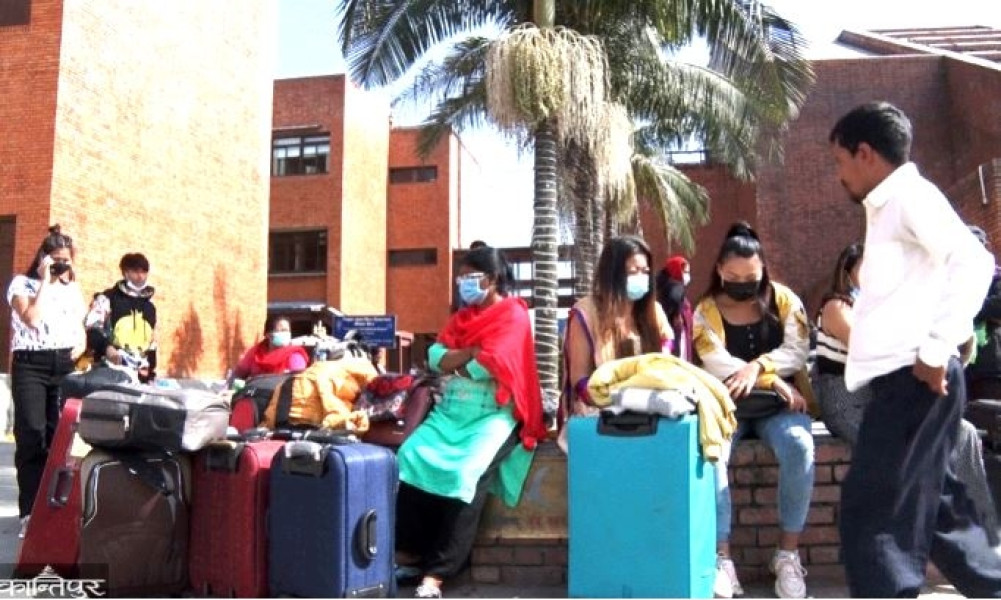
Step by step, the groups that need the support of the state are financially exploited by illegal human trafficking groups.
We use Google Cloud Translation Services. Google requires we provide the following disclaimer relating to use of this service:
This service may contain translations powered by Google. Google disclaims all warranties related to the translations, expressed or implied, including any warranties of accuracy, reliability, and any implied warranties of merchantability, fitness for a particular purpose, and noninfringement.
Foreign employment is a person's desire or compulsion? Is the remittance received from foreign employment productive or is it being spent on non-productive activities? Is it strengthening the country's economy in the long run or increasing dependency? Many such issues are in the national debate.
The issue of women workers is even more complicated. In the case of male workers, foreign employment is relatively organized, but not so much in the case of women. Moreover, the government has been preventing women from going abroad for domestic work for nine years.
The International Relations and Labor Committee of the Parliament had instructed the Cabinet on 20 Chait 2073 to completely stop sending Nepali workers to the Gulf countries until the respective countries enact concrete laws on domestic workers and sign a bilateral labor agreement with Nepal. Based on that, the sending of domestic workers has also been stopped institutionally. However, it has made the problem more complicated.
Practically, Nepali women are going abroad using the illegal alternative of domestic labor. As a result, nearly 200,000 women have migrated abroad illegally in the decade since the ban was imposed. They are also deprived of their legal rights if they have to bypass the government route. They are cheated in the process of leaving, vulnerable to employers, deprived of the right to potential legal battles.
The government report concluded that exploitation and fraud increased when women domestic workers were stopped. Therefore, as it is practically impossible to block Nepali women's access to global labor opportunities and it is also unfair from the point of view of gender equality, the state needs to change its previous policies.
It is the mandatory duty of the state to give citizenship to every citizen, the state cannot deprive citizens with citizenship and passport from the right to freely move, work or do business. Again, the state should protect citizens by giving them opportunities, not by prohibiting them. When the state stops going abroad, but middlemen take them away, problems arise from the process of departure to return.
Women who go abroad for domestic labor are mostly from economically weaker groups. Education and economic conditions are poor. They have no social and political access. Foreign employment has become the last option for them. Step by step, the groups that need the support of the state are economically exploited by illegal human trafficking groups.
In front of the domestic workers who have reached the destination country, the employers have bargained and given cash to the middleman to take them with them, by which the women have to feel that they have been sold. The way to seek justice is also becoming difficult when the workers who reach the employer's house in the buying and selling style are in trouble.
If it were not for the ban of the state, those going to work abroad would have completed the established process. Had access to statutory and official information. Employers were able to be clear about their responsibilities and rights. There was also an updated record about them in the state agency. Joined Social Security and Insurance. had access to welfare funds. In case of
need, they could use contact with government mechanism, rescue could be done easily as needed. He could have fought a legal battle for compensation. He used to get financial facilities even after returning to the country. But the women's journey through the illegal route is separate from this entire chain. While employed in the respective country, the state does not have information and access to the mechanisms.
The behavior of employers from outside the state process towards workers may not be respectful and safe. As a result, some women workers have become victims. Personal-financial security is not guaranteed. If the concerned person is at the bottom, the family will be in more trouble.
It is ironic that the sending countries impose restrictions when the employing countries themselves should simplify the process. After the committee formed under the leadership of former ambassador Ramkaji Khadka, who is also the head of the Gulf region division of the Ministry of Foreign Affairs, concluded that the exploitation and fraud of women has increased when domestic workers are banned, a reconsideration has become inevitable. This topic can be organized with the suggestions given by the
committee and the experience gained so far. The Ministry of Labor has also signed a labor agreement with the UAE and a protocol for hiring domestic workers and has also developed a proposed model project, which was based on the instructions given after the parliamentary committee's on-site study. It needs to be carried forward. It is the responsibility of the respective country to protect the full rights of any person who enters its borders.
Our diplomatic initiative on this matter needs to be coordinated and strong. Therefore, it should be open to send domestic workers by adopting security measures and study the results obtained from it and make it systematic. It is necessary to make the process transparent to make the employment orderly and secure.