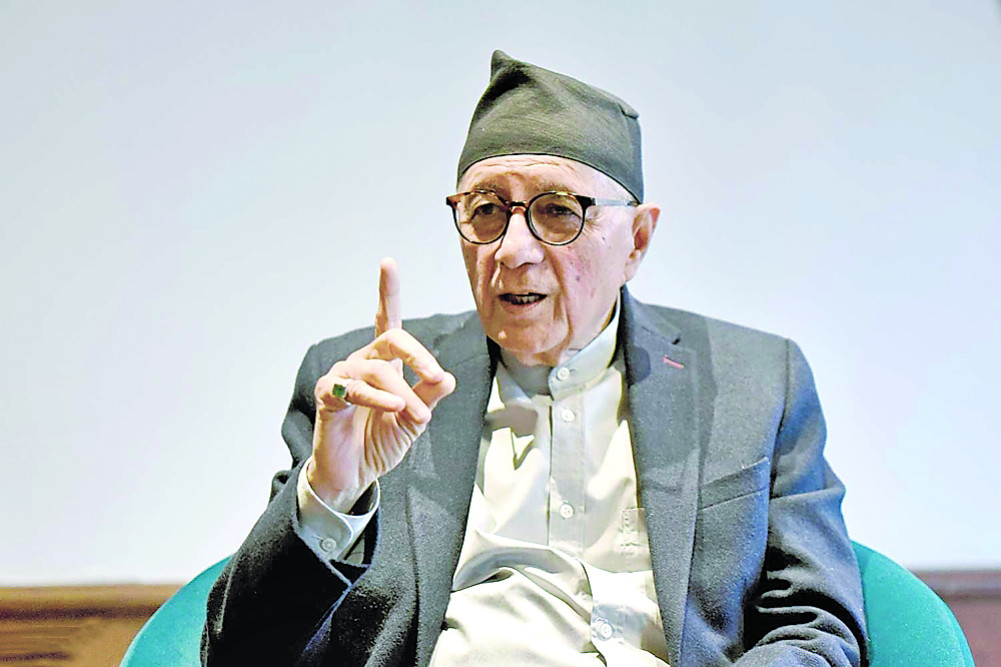
Koirala's desire to keep himself active in the political scene is also a convention-targeted exercise
We use Google Cloud Translation Services. Google requires we provide the following disclaimer relating to use of this service:
This service may contain translations powered by Google. Google disclaims all warranties related to the translations, expressed or implied, including any warranties of accuracy, reliability, and any implied warranties of merchantability, fitness for a particular purpose, and noninfringement.
Last week, two main references in Nepali politics became the 'talk of the town'. First, his protest against former President Bidya Devi Bhandari's renewed membership after the UML Central Committee revoked it. Second, opposition leader within the Nepali Congress Dr. Shekhar Koirala's sudden rise in political activism.
There have been many comments on the first reference. Former President Bhandari's active political comeback was becoming a subject of criticism. Despite that, when he entered the political arena after leaving all the benefits received as a former president, it caused a great shock within the UML. And, it became a matter of serious interest even for the ruling coalition.
Congress president Sher Bahadur Deuba asked Prime Minister KP Sharma Oli to 'stop' the entry of a person who has become the supreme commander of the army into active politics. Ever since Bhandari's entry into politics started, Rust Oli canceled his membership from the Central Committee and blocked his way to join the UML. However, Bhandari countered and claimed that she was in the UML saying that the membership given by Madan Bhandari 45 years ago cannot be taken away from Hool Hujjat. In other words, the 'Oli-Vidya conflict' that has been growing in UML will not end immediately. It will be known in the coming days where the outcome of this conflict will be.
This column will focus on the second context i.e. Koirala's latest political forays.
Koirala's latest activism shook not only the Congress, but the entire political circle. There were reports that he was trying to form a new alliance by referring to his meeting with Chairman of the Maoist Center Pushpa Kamal Dahal (Prachanda), former President Bhandari and others. Koirala called a meeting of MPs/leaders near him. The leaders near him also hinted that another front blockade is being attempted against the Deuba-Oli alliance. Some even announced that he is the 'prime minister after Oli'. Although Koirala's 'move' made waves for a few days, it has now subsided. However, why did Koirala suddenly become politically active? Why did meetings and consultations begin outside the party circle? The questions are still alive.
Koirala, who has a weak mathematical balance within the parliamentary party, was really practicing another government's blockade? Or what was the message he wanted to give by increasing political activism? To break the story, critics also comment that Koirala's activism is an instigation of power interests who want to create 'controlled instability' in Nepali politics. However, he has tried to convey three messages by increasing political engagement.
First, he wants to make the ruling coalition leaders feel the pressure. He was constantly speaking in public on the issues of corruption and misrule. He also opined that Congress should take the leadership of the government. Koirala did not understand that the coalition government will not fall unless there is bitterness and disagreement between Deuba and Oli, who are exercising almost sole power in Congress and UML. However, he wanted to create pressure on the ruling leadership by discussing the alliance and its functioning with the leaders of the opposition parties. It seems that the pressure was felt somewhere when Deuba asked him not to distrust the alliance after meeting him.
Second, to make a sense of your presence in national politics. Koirala is in opposition role within the party. Even in national politics, he continues to oppose the activities of the government. Despite this, he was not able to play the role of making waves in national politics. Earlier, when the Congress-Maoist coalition was in power, he had made his presence felt by the 'Koshi Rebellion'. Koirala showed his status by making Kedar Karki, the leader of his group in Koshi state, the chief minister with the support of the then opposition UML. Which was termed as 'Koshi Rebellion' by the leaders of his group.
The fact that the government was formed together with the opposition UML when the government was in alliance with the Maoists was a violation of party discipline. He was also criticized for violating discipline within the party. However, he was not prosecuted. Instead, Deuba and the then Prime Minister Prachanda met him and jointly signed a memorandum stating that they were 'committed to the alliance'. The Congressmen of the Koirala group were excited by that incident. A leader close to him says, "Koirala wants to show his influence and presence through the current activism." There is no decision in the Congress that cannot be made during the fifteenth session. However, Koirala has already reached the convention. Who will be the next leader in Congress? The question is very important and important. The law does not allow Sher Bahadur Deuba to be a candidate for the chairman again. Therefore, the debate and interest of Deuba's successor is more in the Congress circle. All the leaders who are in a certain way are busy in their own ways in the preparations for the convention. After Koirala was defeated in the fourteenth, he is waiting for the fifteenth Congress. He has been constantly raising his voice that the convention should be on time. Koirala's desire to keep himself active in the political scene is also an exercise aimed at the convention. Koirala, who suffered an honorable defeat in the fourteenth Congress, has considered himself a natural contender for the upcoming Congress.
But, the important question is, will he reach the original leadership as Koirala thought in the fifteenth Congress? What will the convention be like for them? Is the current activism and running for his political goals meaningful or productive? These and other such questions related to his political future are further topics of consideration.
Koirala's political destiny will depend on the future balance of power within the Congress. Like, now there are mainly three groups in the Congress. A Deuba group, which is the strongest in terms of mathematical power balance. Second, the group under his leadership. Dissatisfied and estranged leaders from Koirala Deuba like Balkrishna Khand, NP Saud and others are expanding their group. However, Chief Minister Gagan Thapa, who was with him in the fourteenth Congress, has stayed away. Especially Thapa's third group is becoming different. However, Thapa has been saying that there will be no factionalism and that he will end the factions. However, the number of people who want to see him as the next president is increasing within the Congress. Along with the countrywide movement, Thapa is becoming a unique group.
However, Koirala and Thapa supporters insist on bringing these two leaders together. Thapa has not officially said that he has left the Koirala group. However, judging from the coldness in the relationship between these two leaders, it will not be a new scenario if Koirala and Thapa become each other's candidates in the upcoming convention. Therefore, Koirala's political future will also be determined by how his collaboration with Thapa develops.
The strongest 'asset' of Koirala, who aspires to be a future leader, is the votes he got in the fourteenth Congress. He was a strong competitor of Deuba. His close association and relationship with some leaders who are now known as Deuba supporters are also seen in a meaningful way within the Congress. Another advantage to him is that he belongs to the Koirala family. However, BP's son Shashank Koirala has also aspired to become Deuba's successor. It is difficult to say how much Shekhar will get the benefit of the family inheritance when there is not only one candidate from the Koirala family. However, he too has the legacy of the Koirala family. Congress leaders themselves say that Deuba has sometimes said in informal conversations that the next leadership will be returned to the Koirala family. In such a situation, he can also be a claimant. However, these compatibility alone will not be enough to reach the leadership.
Koirala also has its weaknesses. Like, Koirala's presence in the Parliament is not the same. Parliament is the place where national issues are debated. It is a place where policies and laws are made. Everyone is interested in the views of the aspiring leader of the country's major party on national issues. Koirala's parliamentary role is weak. He rarely attends Parliament and casts his votes. Secondly, he is a true follower of BP Koirala. He advocates democratic socialism. But what is the political program of the Congress? Will BP refine the democratic socialism now? How much more debate and discussion is necessary? Even in this area, Koirala's role has not been seen and felt. For example, General Minister Gagan Thapa has raised the debate that the Congress should carry the political program of social democracy while refining democratic socialism. What is Koirala's opinion on that? Or what is his political program? Koirala needs to address these questions as well.
In a recent meeting with Koirala, he was saying, 'I am thinking of increasing my presence and role in Parliament. I used to raise political/ideological matters in the internal forum of the party. I meet with friends of the younger generation so that new thoughts and ideas are exchanged. A close aide says, “He is missing out on media mobilization, interaction and activism on social media, collaboration with the younger generation within the party.
Koirala is a mild-tempered, moderate leader who does not get involved in controversy. However, he becomes so soft that sometimes he fails to take firm decisions. A close associate is dissatisfied with him, seems compromised when he is confused about his ability to make decisions or tries to appear too balanced. They are particularly flexible with the establishment of the party. However, he tried to show himself as a dynamic leader by holding a meeting of the group after the 14th Congress. He also showed parallel activism with the aim of keeping the party leadership under pressure. However, Deuba did not wear a tail. Some of the important meetings were sidelined by not moving.
There was a time when Koirala was accused of going to Deuba camp. After seeing Deuba and Koirala on the same stage in various district level programs, such a rumor spread within the Congress circles. The opposition leader within the party has been accused of changing the rhythm towards the establishment. Now the scenario is different. Koirala is visiting the house of the leader of the opposition party. Sometimes Prachanda reaches his residence and expresses his anger about the functioning of the government, sometimes he accepts the political arrival of former president Bhandari. It is not that the leader of one party should not meet the leader of another party, nor should they have a dialogue, but as Koirala met former President Bhandari to Prachanda and then there was another front blockade against the government, and it did not last even two days. The question arises, Koirala, who is known as a 'moderate strategist', has made a political run worthwhile?