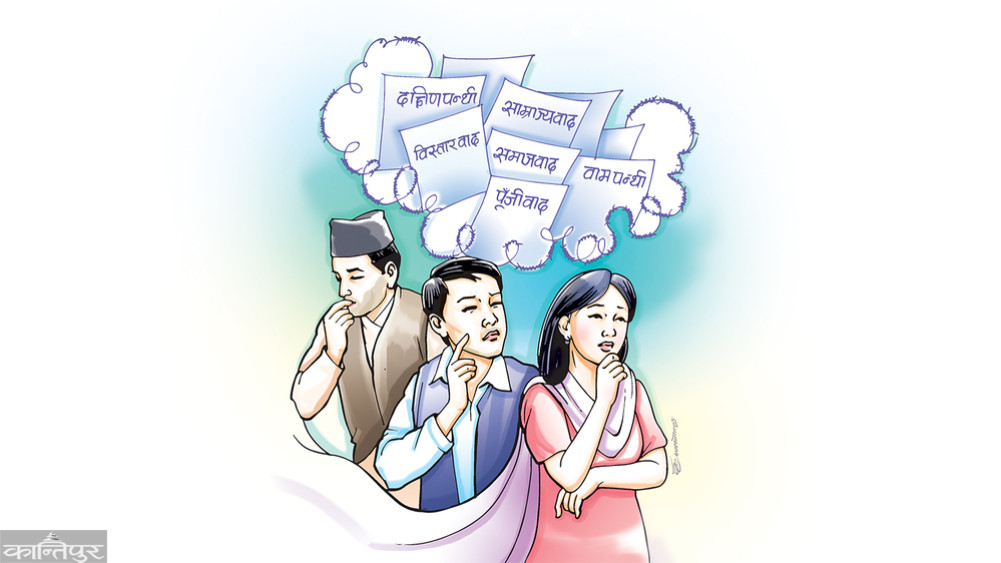
Even the Nepali 'conscious' society has been poisoned by the use of political terminology to a large extent, because it has stopped seeing what is in front of its own eyes, the mind structure made up of such ancient vocabulary does not have the ability to think and understand what is needed in the present time.
We use Google Cloud Translation Services. Google requires we provide the following disclaimer relating to use of this service:
This service may contain translations powered by Google. Google disclaims all warranties related to the translations, expressed or implied, including any warranties of accuracy, reliability, and any implied warranties of merchantability, fitness for a particular purpose, and noninfringement.
Although the 'size' of this article will be longer than usual, I am in a hurry to get into the main topic. So let us make it clear at the outset that 'Nepali thought' is meant to refer to the political parties and the circles around them, who are different from each other but not different in their thinking.
The existing 'Nepali way of thinking' is generally an obstacle to understanding how the structure and role of 'government' is changing around the world. And, let us also say that I do not see the possibility of Nepal returning to monarchy. On the contrary, I found it unnatural that the Nepali intellectual society discussed the monarchist 'movement' with an 'obsession'. Nepali society is "obsessed" and the "very urgent" public issue is another, on which I have a point of view.
Social-political issues like 'dominant' have been 'dominant' in Nepal from the past few years to recent months, based on that, I don't see our country taking the path to become a respectable nation in the near future. Two or four arguments cannot be made to see what is happening positively. But even if it is not fun to write that I am becoming more and more 'convinced' that the destination we need to reach is not on the highway we are currently traveling on, it has to be written. Now, if this work is done in this way, do not expect rain of measures to submit that Nepal will immediately become a country worth introducing. Because I don't have them. But there is an idea that I will keep now that the journey towards that destination does not begin without starting from a place.
may sound strange at first, but it would be a term rather than a new ideology or theory to begin with. Like many other developed countries, the common Nepalese aspiration that they could be citizens of a respectable country has fallen into a 'trap' when it comes to the current stage of history. Much has been written internationally for a long time about why some countries 'succeed' and others 'fail'.
is due to civilization or culture, geography or geo-politics, ideology or leadership, sociology or countless other coincidences of history, theoretical 'frameworks' have given us rich insights. All of them, while useful, are insufficient because the characteristics of every society are fundamentally different from others. Based on all this, it is necessary to discuss some logic about what are the 'dominant trends' of Nepal that have been going on in the recent decades that make us think that our destination is not on the current highway. But before that, let's give a little background on this approach.
The speed of the world: Nepal's progress
Between intense interest and anticipation, I recently read the international bestseller book 'The Coming Wave' on 'Artificial Intelligence' or 'AI' during a trip. Mustafa Suleman, the chief executive of Microsoft AI, is one of the leading names in AI leapfrogging in the coming years. AI is developing in such a way that it will surprise even the leaders of this field
is fast. I had plenty of time during the fourteen-hour flight to read two or four of Mustafa's 'bold' sentences about this upsurge, at what speed it is changing the world we live in, and what kind of potential future and risk the world is facing.
A book that begins with the wave of AI coming, ends with the wave having already arrived. This is where one of the main points of this article comes into play. The world is moving so fast that changes in certain important areas that would have taken 50 years a hundred years ago now take less than five years. The character of the market economy is changing to a surprising extent now than ten years ago. The very nature of labor is changing radically. The geography of where the skilled manpower resides and the geography of the work they do do not have to be the same. The use of liberal 'cryptocurrency' is emerging as an alternative to a government-backed currency.
ing technologies are becoming so powerful that they are changing the character of states, their relationships with each other and the very TOR of government. Governments of rich and powerful nations are themselves racing to keep up with the pace of technology. The time it used to take for a country or society to become rich or poor is getting shorter. The field of competition between nations is now different from what it was 20 years ago. But while reading the book while pondering about the political 'trends' of our country, what struck me the most is that the topics and debates which are considered extremely important in Nepal, are all irrelevant, 'outdated' and even to the world.
Until a few years ago, I thought that even though Nepal was behind in terms of economic development, it was in a good position in terms of political awareness. There is a makeshift democracy and republic. But apart from that, I think Nepali society is "backward" even compared to other countries in terms of understanding what it means to go to the government and run the state in modern times. Here comes the argument that our highways are upside down. Thinking why the characteristics of Nepali society were not included in the wave of 'The Coming Wave', I came to the conclusion that we should start with nothing else but vocabulary.
How many of you must have thought – Why is the presence of its members in our Parliament always thin? There are many reasons for that, but in my opinion the main one is one. That is, there is nothing worth hearing. The 'Honorables' themselves have been testifying about each other's level of speaking and subject matter. The staff 'cooling off period' showed how carefully the legislators read and passed the law. If you look closely at the topics spoken by our parliamentarians in the past two decades, it can be seen that they only repeat the terminology. Then it can be compared to where the world is going and where our characters are.
Vocabulary problem Do not generalize the
issue, because the problem of Nepal is not the level of Parliament and MPs. This is just a symptom. To find its source, let us now look at the agenda of the meetings of the central committees and other temporary-permanent structures of our major political parties in the last one year. Let's see the vocabulary of all these office bearers-former office bearers. Let's look at the topic of 'meet-talk' between 'leader-leader'. And let's look at the 'content' of our media through which all these things get a medium. While reading these sentences, the picture of what is being said may not immediately come to your mind. It happens even if it is stuck at the same time. And if you think about it, where is the vocabulary that carries the 'content' of the policy of running the state, how is it?
I don't see much there except for their party running, office management, frustration and vocabulary that has been spoken for decades, which has become irrelevant in the context of modern state management. And, really, what an incompetent, outdated thinking leader thinks and says about another such leader, whether it is a secretariat meeting or a central committee meeting, reading that news is a kind of inferiority complex. You have to ask yourself, why am I interested in this? Isn't the structure of my thinking also worn out? That I still think it's all that important?
The reason behind this is obvious. Because they accepted the democratic system early, many of us thought that the leftist circles in Nepal are more 'dynamic' than the communists in other countries of the world. But my view on this has changed recently. Systemically, they are in democracy. But their 'Dixon' is 50 years old even compared to countries like communist China, Vietnam, and Russia, which they consider to be political gurus. Even now, their understanding of what it means to go into government to run a state is the same as it was in the 1960s and 70s. At least more than half of the party members and parliamentarians in Nepal may still have people who believe that the country's lack of progress is due to 'imperialism' and 'expansionism'. Even if they believe in
imperialism, they do not have the ability to understand in a simple sense how much it has changed in the meantime and how it works. Will imperialism go away on its own because someone wants it? Will he be 'smart' to use the available worldly situation for the benefit of his country? If Nepal is backward because of what they said, then it will be accepted that Nepal can never move forward, right? If you expect that one day India will become what Nepal wants, then there is no need to write anything after this. He, being what he is, to 'deal' with
You have to increase your ability. And capitalism is going to disappear from the world because you don't like it? And who will not admit his worthlessness in the capitalist competition, instead of cursing him instead? For them, capitalism is a 'country' with which they have to contend. While in political terms, the countries that belong to their fathers and grandfathers are worshiping the same capitalism, and they are gathering day and night to see what kind of agreement with every country in the world will benefit them.
Let's think for a moment, out of the 195 countries in the world, how many countries are there at the present time where the names of the parties of the main parties that run the government and are in the opposition have the names of Lenin and Mao, who are considered 'controversial' to many, from another country? How many countries are there where there are still political parties who are still getting votes in the elections saying that they will build the country according to the organization and ideology of Lenin and Mao?
Years ago, there used to be a lot of discussion about why it was necessary to change the full name of the party named Lenin and Mao when going to the world stage, but now that has also slowed down. Having seen it since birth, some people may think this issue is very common, but if you stop and think for a moment - is this a small symptom? But let's say again - this is not the problem either. Their is their party, name it whatever they want.
And, the special problem is that the Nepali 'conscious' society has become poisoned with the use of political terminology to a large extent. Because he has stopped seeing what is in front of his own eyes. The mental structure made up of such ancient vocabulary does not have the ability to think and understand what is needed in the present time. The vocabulary a person uses is his way of thinking, how contemporary he is. The Nepali political vocabulary has been poisoned by these countless political 'campaigns' and 'movements'. Our society has fallen into the political 'trap' created by that vocabulary. Therefore, the questions he asks have become irrelevant. The problem here is not whether a party or a person is 'left' or not. Even if it leans a little towards the right, there is nothing.
After all, whether it is a democratic country or a dictatorship, the economic policy 'trend' of governments around the world will believe in liberalism, or in 'socialism' (Nepal's socialism is meaningless). Some may be a little more left leaning, some right. Zohran Mamdani, a 33-year-old youth of 'Left Orientation', was elected just a few days ago in the Democratic Party's primary election for the mayor of New York City, which is the center of capitalism and the economic capital of the world.
But Nepal's 'Left' cannot be compared to the vocabulary of 'Left' in America, Europe, Latin America, China and Vietnam. What is called 'left' here and what is understood there are very different. No one needs to take this matter personally. After all, you may have come to contribute to the society with a good purpose as seen by your wisdom. Since this topic is public, the discussion has also been done in public.
How has Nepali society become, now he can enjoy reading the headlines for a year or two to see if Vidya Bhandari will replace KP Oli. He has lost that sense that Vidya will replace KP and think what difference will Nepali society make. It makes headlines that some former congressional officials who were or should have been irrelevant years ago met at someone's house.
because such news sells in society. While they meet and the country's future is better, it has nothing to do with any policy change. What is the common people's interest, which 'leader' will say what, who has become close to whom, who will win in the Congress? Instead of one, the other won, and what difference did it make? Why is Nepali 'conscious' society so interested only in people and positions? Even when I remember it, I feel sad.
government that doesn't understand government
In the middle of the third decade of the twenty-first century, many countries are easily doing things like how the state can be credible in front of the world, understand the limits of their countries for investment, trade and other economic activities, facilitate the areas of possibility and follow the "trends" of technology as much as possible, and let "smart" people make policies around them without being "outdated" like them.
There are many examples in South and Southeast Asia where citizens are doing well in simplifying the services they need. But when compared, he will not know that he is inferior to them, and he will not stop boasting that our nation is great. If our leadership and employees were a little 'smarter', the officials of India would have been less concerned about various 'negotiations'. If you are able to give leadership inside the country that can run the country well and give people hope that it is getting better, then the rest of the world respects you when you go abroad. How many
examples? If I were in a position to decide, I would immediately abolish the civil service system of thirty-thirty years of permanent service. Why should the state carry the weight of a person for decades for having passed a public service exam, if there are candidates in the market who have many times more technical skills than him? 20-25 percent were kept permanently, otherwise, if new people were hired on a five-year contract, not only the ability, but also the culture would be brought in.
Be it the Ministry of Finance, Foreign Affairs, Science Technology, Commerce or Industry, how many technically capable citizens are out there who have no interest in public service. And if their work was good, they were added, if not, the new ones were contracted again. Why is 'Rashtrasevak' wanted in all ministries except for administrative work, while what is needed is 'specialist'. But the structure of our social vocabulary does not favor such topics.
new language era
This article is not written for them to read and understand. Its 'intended audience' is a broad range of civil and intellectual society that feels under-represented in the current political structure, which in my estimation has somewhat fallen into the 'trap' of that terminology but can still correct itself. The time for politics to change society is over in Nepal. Now is the time for society to change politics. This is the place where Nepal's next 'The Coming Wave' can start.
The potential of intellectual ability, technical skills, 'innovation' is within Nepal and as much as Nepal can enter. Yes, the difference is so much that the line does not understand the current political vocabulary. Because it is not understandable. There is nothing to understand. Listening to such 'outdated noise' that line that the rest of the world has seen, may feel inferior. So he is 'disconnected'. is absolute. If
begins with a vocabulary that 'connects' that broad line of not political history (which is good) but the future and expands, the structure of our politics can change. Then suddenly what should not seem 'normal', it stops seeming 'normal'. And the world is treading on the wave, at least one can go around it and be sanctified by its splash.