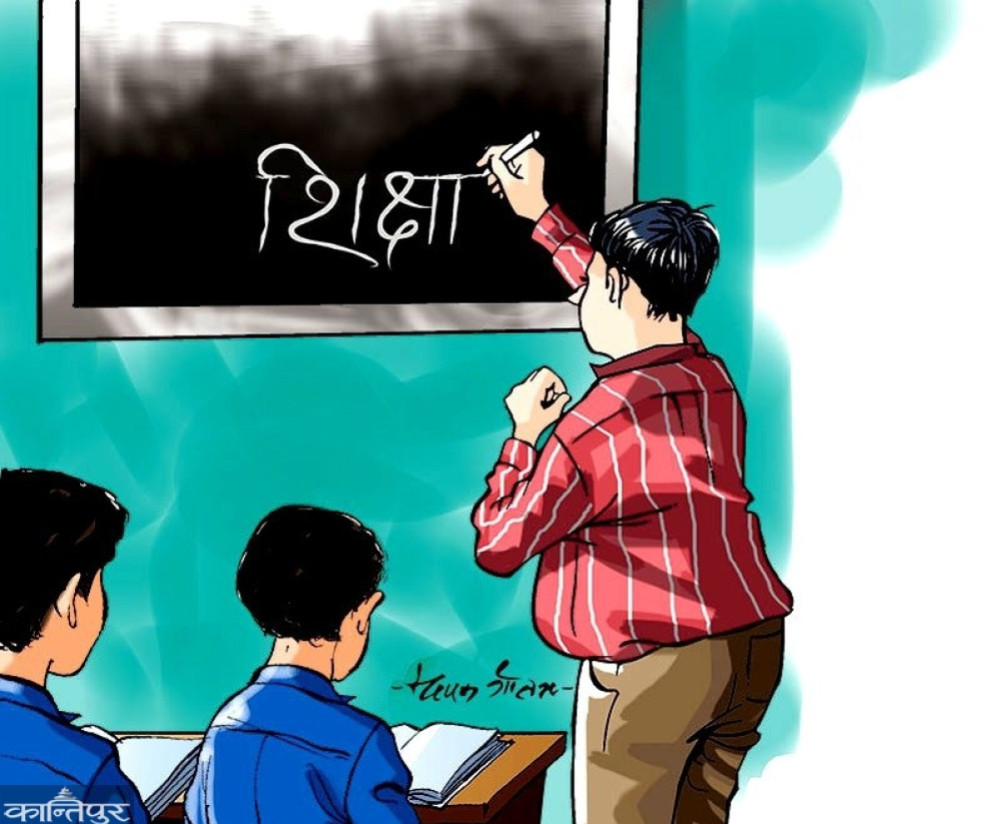
The provisions of the Nepal Law and Professional Council (Legal Education) Regulations attack the autonomous rights of open universities
We use Google Cloud Translation Services. Google requires we provide the following disclaimer relating to use of this service:
This service may contain translations powered by Google. Google disclaims all warranties related to the translations, expressed or implied, including any warranties of accuracy, reliability, and any implied warranties of merchantability, fitness for a particular purpose, and noninfringement.
Modern education is basically based on three theoretical concepts. It should be accessible, efficient and efficiently delivered. No country, society and civilization can be imagined without education. The importance of higher education is even more important. Because the supply of human resources is possible only through this.
The present time is truly an epochal time for education, a time of radical change. By the year 2030, it is estimated that machines will be superior to humans in all dimensions. Machines have already taken over most of the low-level jobs from humans. In developed countries, machines are taking away the upper-level 'white collar jobs' from people. How to create jobs for people after 2035 will probably be the first challenge of the world.
What kind of radical changes in education should be made for humans to move ahead of artificial intelligence, from primary school to higher education, this debate should be resolved within this decade. The change it will bring may not have been estimated by anyone yet. We should also be the carriers of this change. The ability to absorb the changes and adopt them in time should also be made. And only we can move forward together in the step of improvement.
Despite decades of efforts in Nepal, the age group's access to higher education has reached only 17 percent. Developed countries have increased it to 55 percent. In a country like Singapore that lacks natural resources, the efforts of giving first priority to human resources have succeeded in making it a unique place among the richest countries today. In 2073, the Government of Nepal established the Nepal Open University through the Nepal Open University Act, 2073, after absorbing this deficiency.
The purpose of this act is to 'provide high-level study, teaching and research in various subjects through the latest teaching methods and technologies of the open education system, and to provide access to higher education to the general public and produce manpower with knowledge, skills and technology'. In order to fulfill this purpose, in the current era of 'Earn and Read', this university has been increasing access to higher education by targeting the working, remote people and those who could not go to university. It is also clear that this university is not a competitor but a complement.
Accordingly, this university has been conducting various programs in the fields of management, law, science, health and technology, sociology and education. But the Nepal Bar Council has issued a notification that the law graduate students are barred from sitting for the professional examination from this university under the open education program.
Based on the same information, the Nepal Legal Practitioners Council (Legal Education) Regulations, which started on March 1, 2077, the standards of legal education mentioned in paragraph 2 of 2077, as well as the provision of Rule 17, "Legal education may not be conducted without approval" and the opinion provided by the chairman of the legal education committee of the council on July 18, 2079, the council allowed those who graduated in law education from Nepal Open University on July 19 to the 30th advocate level examination conducted by the council. The decision that it is not appropriate to join was unanimously passed.
Nepal Open University has been teaching undergraduate legal education for three years since 2075, but the provisions of the Nepal Legal Practitioners Council (Legal Education) Regulations issued in 2077 have attacked the autonomous rights of the university.
During the hearing of a writ petition filed before the Supreme Court (Constitutional Bench) against the legal education regulations issued by the Council of Legal Practitioners and the decision to exclude those who graduated in legal education from Nepal Open University from participating in the advocate level examination, an interim order was issued during the hearing of the petition filed before the Supreme Court (Constitutional Bench).
as a result managed to achieve the best position in the 31st supplementary examination of the advocate level. In addition, an interim order has been issued by the Supreme Court (Constitutional Bench) on 2nd January 2081 during the writ hearing.
After the release of the Nepal Legal Practitioners Council (Legal Education) Regulations, 2077, the Nepal Open University immediately revised the previous curriculum regarding the teaching of legal education subject and informed the council about it and while the council is fully aware that the legal research including the experimental practice court is being taught on the basis of all technical subjects, the legal education being taught by this university has been questioned and the students who have studied from the university have been discriminated against to be included in the bar exam. This tendency of the council has challenged the open policy adopted by the government of Nepal in education at the present time. And, it doesn't even seem fair.
Today, efforts are being made to make education accessible, simple and flexible all over the world. This is not only after the 'Covid' outbreak. For example, in the year 2015/16, the world-famous Harvard and MIT universities have created a massive online and open program (Mook) and are training many students through it. Many other traditional universities are also running their programs through the open method. After the year 2030, more than half of higher education will be covered by this method, and it is certain that this method will be the mainstay of education in the near future. There also appears to be wide variation in the understanding of the
open method. We have not yet adopted a fully open (no daily reading) method. We have been doing daily reading through distance education technology and necessary practical activities in physical form. In
open methodology, we have not compromised on quality. The evidence of this is also clear from the results of the second time of the Council of Legal Practitioners. The students of this university achieved the highest position in the first entrance examination, while in the second examination, the success rate of the Bar Council was around 23 percent, and the success rate of the Open University was more than 66 percent, which proves the quality of our education. Honorable Prime Minister KP Sharma Oli's announcement on June 14 that the main reason for the improvement in results in the SEE examination this year is due to the coaching done through distance education technology also makes it clear that this technology is important and effective at any level and field.
Therefore, the Nepal Lawyers Council has a special request for an open university - not only to increase access to the general public and maintain the quality, but also to improve it, no longer discriminate in the educational system. It is necessary for the Council to support the educational development of the country by paying attention to educational quality and returns. Let's not make the mistake of going backward instead of being forward. If you are still unable to embrace the change, there is no time to stand and knock on the wall due to the compulsion to shrink in a limited area.