As a less developed country, there is also a risk that the access and competitiveness of Nepali goods and services in the world market may decrease if the benefits and concessions obtained from multilateral and regional agreements and unilaterally are lost.
We use Google Cloud Translation Services. Google requires we provide the following disclaimer relating to use of this service:
This service may contain translations powered by Google. Google disclaims all warranties related to the translations, expressed or implied, including any warranties of accuracy, reliability, and any implied warranties of merchantability, fitness for a particular purpose, and noninfringement.
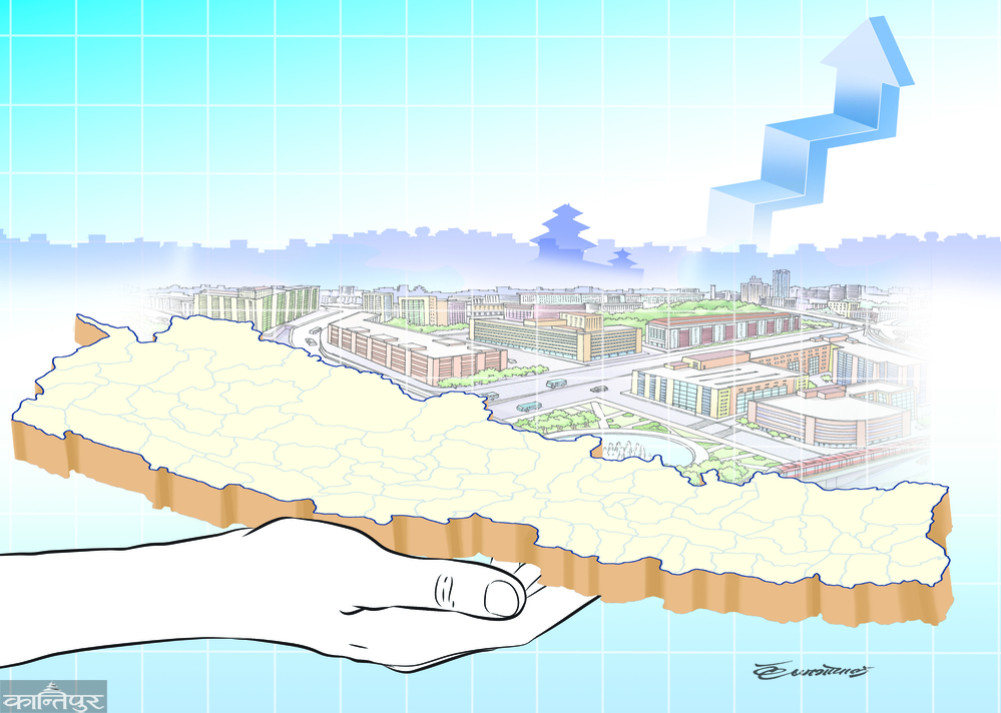
Nepal is being upgraded to a developing country from November 2026. This seems to be both an opportunity and a challenge for Nepal. As a developing country, it seems that foreign investment should be attracted by establishing a new identity and confidence of the country in the world community.
To face the challenges created by this, we should prepare and work in an integrated manner . Therefore, the government has developed a strategic plan and proceeded with the work .
The United Nations Development Policy Committee evaluates every three-year interval regarding the upgrading of least developed countries to developing countries. The committee has defined countries with low per capita income, low level of development of human assets and economic and environmental risks as least developed countries. If the standards set by any two of these three indicators pass the three-year review twice in a row, or if the total national income per capita triples after 2024, the standards for upgrading will be met.
Nepal was included in the list of least developed countries by the United Nations in 1971. After 55 years of being in the list, Nepal is being upgraded. Based on the three three-year reviews in 2015, 2018 and 2021 and the minimum level achieved by Nepal, the United Nations General Assembly approved it in 2021 according to the recommendation of the United Nations Development Policy Committee for upgrading Nepal and the approval of the Economic and Social Council. In all the three mentioned three-year reviews, Nepal has fulfilled the necessary standards of the human assets index and the economic and environmental risk index.
According to the economic survey, although the per capita income requirement of upgradation was exceeded, it was not completed in the three-year review of upgradation . Therefore, it seems that we should increase the per capita income, further improve the human development index, and reduce the economic and environmental risks and intervene based on the index to make the leveling up in the developing country sustainable and permanent.
impact on the commercial sector
In the developing country of Nepal, it seems that various opportunities will be created by upgrading. Investment attraction in economic development, competitiveness will be developed . It seems that the overall image of the country will improve and Nepal's reputation in the international community will increase. Entering the category of developing country from least developed country will also improve the current credit rating of Nepal . Which will help in the development and expansion of intellectual property such as patents, copyrights, trademarks, geographical indications, etc., which will increase the trade in goods and services. It seems to provide Nepal with new opportunities in the field of tourism. The number of foreign tourists will increase. Also, after the improvement in creditworthiness, the possibility of cheap and flexible loans will increase. Which will help the development projects to move forward at a faster pace . As Nepal expands its access to development finance, it will also enable the construction of large and long-term development projects. This will contribute significantly to the development of the private sector and poverty alleviation. As a result, overall employment will increase and per capita income will increase as well as improvements in the fields of education, health and infrastructure . In this way, upgradation in developing countries will create multifaceted opportunities and overall economic and social improvement for Nepal.
Nepal's upgrading will also create some challenges. Discussions with stakeholders at different stages have also drawn the same conclusion. It seems that the world trade system will be affected by the tension, commercial and strategic conflicts seen in recent days. As a least developed country, there is also a risk that the access and competitiveness of Nepali goods and services in the world market may decrease if the facilities and concessions obtained from multilateral and regional agreements and unilaterally are lost.
Tourism, Information Technology and Business Process Outsourcing in Nepal, There is a huge potential for the export of services including electricity. The contribution of the service sector to the gross domestic product has reached about 63 percent. However, due to the expected development of the tourism sector in Nepal, the number of tourists and tourism income did not increase, it was not possible to create and encourage a favorable environment for the export of the information technology sector, it was not possible to limit foreign employment by sending skilled manpower, attention was not paid to the export of construction services, policy and institutional arrangements including transmission lines and sufficient production for the export of electricity were not made. By solving these problems, the government has emphasized on start-up entrepreneurship and technology development and transfer to achieve sustainable upgrading while contributing to employment and economic prosperity from this sector, which has great potential.
Nepal's export trade is centered on India and the share of the industrial sector in the economy is decreasing. The high risk business structure is due to the lack of coordination between macroeconomic, investment, industrial and trade policies and subject area policies, lack of inter-agency coordination, inadequacy of economic infrastructure including trade and industry, low use of international market access, lack of market research and promotion, stability of exportable goods and weak competitiveness, lack of international level laboratory and certification facilities, complexity of supply and value chain, etc.
Ministry's efforts
The Government of Nepal is trying to determine the course of action for trade and investment by closely monitoring the various types of challenges that can be brought by the mentioned activities and other ups and downs affecting world trade. Significant work has been done in policy and legal reforms to improve the domestic and foreign investment environment.
To address the challenge of growing trade deficit, the government has adopted diplomatic measures for the continuation of the facilities Nepal has received in major trade partner countries and multilateral and regional trade forums. Taking initiatives . The talks and discussions for this have been positive. Efforts are also being made to continue preferential market access and facilities received from major trading partners. Increasing the per capita income by improving the index of human assets is only possible through the enhancement of industry, trade and investment . For this, it is necessary to strengthen the business sector and increase the contribution of the commercial sector in the economy.
In this regard, a policy and strategic plan related to the commercial sector has been created harmoniously so that the facilities and concessions obtained by increasing the productive capacity will be continued for some period even after the upgrade. It is necessary to engage in strong partnership with the private sector in resource management, institutional strengthening, and development of the value chain of goods and services. In addition, the issue of creating an environment for business-oriented economic development by adopting measures such as business infrastructure construction and trade facilitation is the first priority of the ministry.
A detailed study of the effect of the upgrade on Nepal's business sector, especially on exports, and various treaties, agreements, commitments and practices related to the commercial sector. After analysis, the strategic plan of the commercial sector 2081 for easy upgrading as a developing country has set a detailed future course of action regarding the steps to be taken in the commercial sector. For this, strengthening the market access of goods and services, strengthening the production, productivity and quality of exportable goods and services, improving business infrastructure, logistics services and trade facilitation, increasing the competitiveness of Nepali products by mobilizing customs and non-customs measures and domestic aid, emphasizing on strengthening service trade and digital trade, increasing trade, investment and involvement in the global value chain through economic diplomacy, increasing the institutional and systemic capacity of the trade sector. Basic strategies have been adopted including .
The Ministry is implementing the strategies, tactics and activities proposed by the strategic plan in coordination and cooperation with the concerned agencies. Regular monitoring of the implementation of the strategic plan has been arranged by the relevant ministries, departments and central agencies under their respective jurisdictions. Export trade enhancement is not limited to the priority and work area of the Ministry of Industry, Commerce and Supply. The strong interrelationship of various government, private and consumers makes it dynamic . For the effective implementation of this strategy, the ministry has coordinated with the agencies identified in the action plan and proceeded with the implementation. For timely implementation of the activities identified by the
strategy, it is necessary to ensure coordination between the commercial and investment programs of the three levels of government in the mobilization of resources. While monitoring and evaluating the implementation of the strategy, continuous analysis of business-related facts and trends of international trade will be carried out and based on that, post-upgradation strategies and tactics will also be revised . As a strategic preparation before the upgrading of Nepal to a developing country in 2026, the ministry believes that the activities and programs identified in the plan will be implemented effectively and the upgrading will be sustainable and uplifting.
– Bhandari is the Minister of Industry, Commerce and Supply.