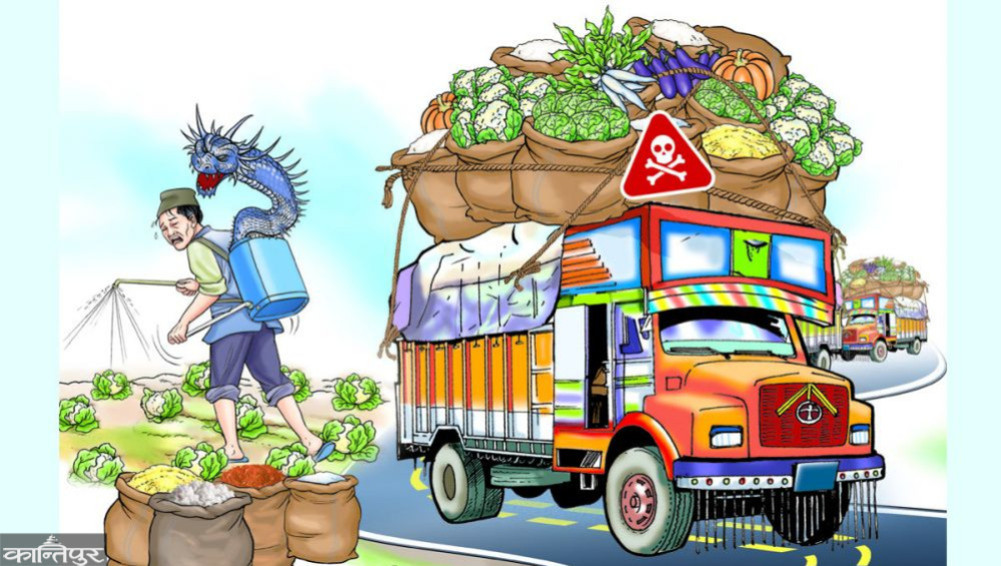
The use of pesticides has not decreased even though the idea that more pesticides are applied will result in higher yields
We use Google Cloud Translation Services. Google requires we provide the following disclaimer relating to use of this service:
This service may contain translations powered by Google. Google disclaims all warranties related to the translations, expressed or implied, including any warranties of accuracy, reliability, and any implied warranties of merchantability, fitness for a particular purpose, and noninfringement.
It is said that food is medicine. The kitchen is the pharmacy. The cure for all diseases is the kitchen.' But what is cooking in our kitchen now - 'Vegetables or poison?' Actually, this is the serious question of today.
It is natural to increase agricultural production and productivity by preventing diseases, insects and weeds. However, now the use of pesticides is increasing commercially in the name of vegetable farming. It is also widespread in some areas. Farmers especially in hilly, high mountain and Himalayan areas do not use a significant amount of pesticides, but the use of pesticides is found to be widespread in the areas near the market. Studies have shown the possibility of pesticide residues in agricultural products due to its indiscriminate use, abuse, excessive use and non-compliance with technical recommendations.
There is a statement - if a cook cooks food without looking at the number of people, either it will be less or more . If there is little, it can be re-cooked but if there is too much, it will be wasted . The context of pesticide use without any calculation is exactly similar to the above example .
An average of 396 grams (special poison) per hectare is being used in Nepal, which is higher than the previous record of 142 grams per hectare. Compared to other countries, the use of pesticides per hectare is low in Nepal. At a glance, the problem of pesticide use may not seem serious, but if we analyze the place of use, the crops used, the amount used, the method used, time and storage conditions and the pesticide market, the problem has become serious . To put it bluntly, the lack of biological pesticides as an alternative to pesticides, lack of sufficient knowledge about the production, use and sales distribution of biological pesticides is also a problem. The use of pesticides has not decreased while the idea that if more pesticides are applied, more agricultural production is prevalent among the farmers.
History is a witness that the farming method of our ancestors has demonstrated the principle of friendly and holistic coexistence between humanity and nature . In the kitchen of our ancestors, healthy food was cooked without pesticides and there was no environmental imbalance in the context of Nepal. It is no exaggeration that that period was the golden age of life. It would not be inappropriate to say that our kitchen has become a bag of pesticides due to the tendency to increase the production of vegetables and rush to the market by using pesticides for temporary profit.
is now becoming a dumping site for kitchen pesticides. There is a lack of information about the local and imported vegetables and fruits that are consumed daily, where they come from, how, who uses what kind of pesticides and how much. There is no provision for checking it anywhere . Consumers are forced to eat untested vegetables without knowing their quality and whether they are edible or not.
The advice of agricultural experts that the amount of pesticide residue can be reduced by soaking the vegetables bought from the market in salt water for a few minutes before cooking has not reached the majority of consumers . Usually vegetables and fruits dipped in pesticide solution look fresh, smooth and shiny . We have not been informed that the shiny vegetables and fruits available in the market are demented. If you look at the nature and condition of vegetables and fruits and consume them only a few days after they are bought from the market, you can avoid even a small amount of pesticides. In order to solve the problems caused by the misuse of pesticides, if we choose less toxic but effective pesticides and manage crop enemies only according to technical advice, our kitchen would be prevented from becoming a poison bed even to some extent!
The quality of local produce or imported vegetables and fruits should not be compromised. Although it may sound unnatural, the bitter reality is that no one should be allowed to deceive consumers. In the end, we must not forget that all pesticides are poisons, they are not medicines. Therefore, whether domestically produced or imported, no license should be given for the sale and distribution of any crop without pesticide testing . In this regard, a strict monitoring campaign should be started by the union, state and local governments. The government has not made a legal arrangement to regulate pesticides. But implementation is flat .
Not knowing how to use pesticides in the right way, not even paying attention to the minimum precautions to be taken while spraying pesticides in the fields, the health of common consumers is in danger. Doctors say that long-term consumption of crops with high levels of pesticides can cause health problems. Although the residue of the poison does not affect people immediately, if it enters the body in a continuous amount, after a long period of time, the collective effect of the poison appears . As a result, they cause toxic effects such as reproductive system, fetal development and physiological disorders of newborns, impotence in humans and animals, genetic changes etc. Pesticides can cause serious health risks, especially for children and pregnant women. What is even more frightening is that due to this, the possibility of getting complex and fatal diseases like cancer in the human body is increasing. Due to the serious effects of pesticides, people even die.
Therefore, maintaining quality crop production and environmental hygiene by being cautious about the environmental problems emitted by chemical pesticides and the impact on human health is becoming a serious challenge today .
– Former Joint Secretary (Technical) of the Government of Nepal Palikhe is a pesticide expert