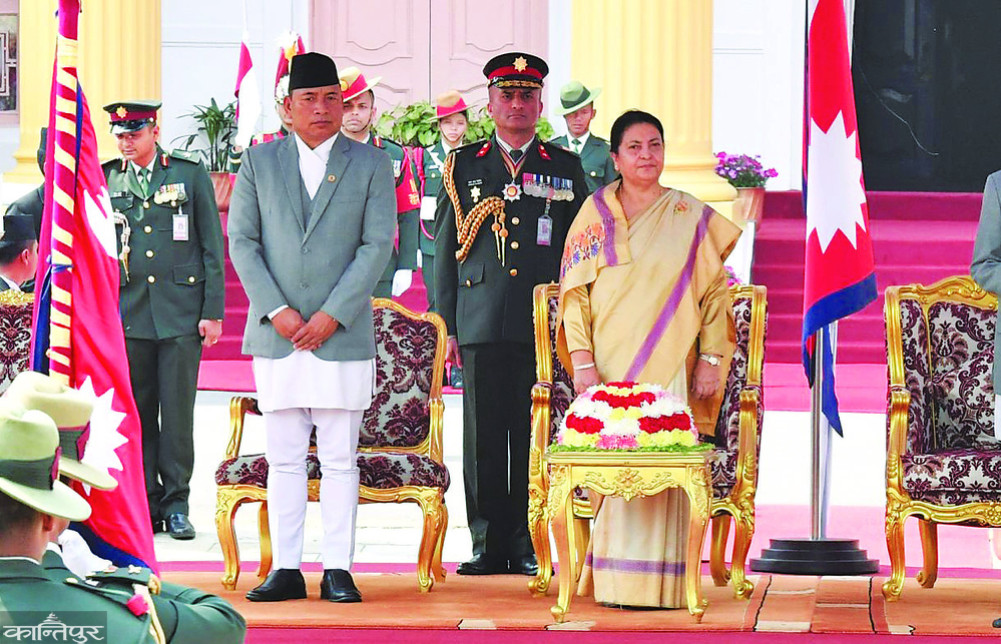
People like ex-president and ex-vice-president trying to enter politics and China giving public indication of the same intention will not only worsen Nepal's internal political balance, but may also increase interference in foreign policy.
We use Google Cloud Translation Services. Google requires we provide the following disclaimer relating to use of this service:
This service may contain translations powered by Google. Google disclaims all warranties related to the translations, expressed or implied, including any warranties of accuracy, reliability, and any implied warranties of merchantability, fitness for a particular purpose, and noninfringement.
The post of the President has been created very respectfully by the Constitution of Nepal. That post does not belong to UML, Congress, Maoist or any other party. It is the 'symbol of the unity of the nation', it belongs to everyone.
The constitution considers the presidency as a symbol of unity in this sense, because its justification is achieved in the highest position of party absoluteness, neutrality and national interest. When the person sitting on the president's chair starts behaving like an agent of a particular party, then not only the dignity of that position, but the essence of the constitution is hurt, the constitution itself is damaged.
Bidyadevi Bhandari's past two terms as the head of state were controversial. Incidents such as insisting on non-cooperation on a sensitive issue like the Citizenship Bill, showing favoritism on the issue of National Assembly elections, and ignoring the judicial neutrality while accepting the recommendation to dissolve Parliament have already answered the question of what his role was.
The President should not only be in the formal role of signing the recommendations of the government but also in the role of guardian of the constitution. But Bhandari was never ready to be subservient to this role. His interest was heavily entangled in the political equation of parties changing governments. Not only that, she was justifying herself despite the adverse decision of the Supreme Court on constitutional issues.
After leaving the presidency, his desire and efforts to return to politics have become public. Her political activism, appearances at party events and expressions show that she still considers herself the guardian leader of UML. This tendency ignores the constitution and the republic. Regarding his return to politics, the presidency is only his 'internship', his permanent role is in UML. In this situation, what will the people think about the presidency?
Strategic realignment
There is one aspect of the current political landscape whose restlessness is becoming public. That side is the Maoist center. Although it has become a decisive force in the cycle of power, today the Maoist party is not in the government. Neither is in a position to form a strong opposition. It seems that the Maoists are now adopting a two-pronged strategy. On the one hand, there is a strategy to topple the government by breaking the UML-Congress alliance and form an alternative alliance to come back to the government. If that strategy fails, the aim is to continue trying to create left unity under the leadership of 'non-KP Oli'. Former Vice President Nanda Bahadur Pun's return to the Maoist party is a part of the plan to make it easy and natural for Bidya Devi Bhandari to enter politics. This strategy is supported by Bhandari's party loyalty, staunch party favoritism while sitting on the president's chair, and unannounced disagreement with Oli.
This is not the end of the possibilities. The Maoists are also looking for another equation internally, that is the upcoming electoral alliance with the National Independent Party. Especially in urban areas, the middle class and the youth, the influence of RSVP is increasing, the Maoists want to create a new base through electoral coordination with RSVP. This tendency to break stories is an extreme form of opportunism. Where reaching power does not require any ideological purity, historical value or organizational dignity. Political morals have been openly traded with hateful political messages that are ready to wear any flag if they get seats. But the Maoists don't care about that. Since the
, the power struggle within the UML has also become complicated. Internal dissatisfaction with KP Oli's leadership is increasing. Many leaders in the background are looking for alternatives after Oli. But that option is not in a position to wake up within the party. As a result, Bhandari's name is becoming active again. Looking at Oliji's chair, it seems that - on the one hand, the decreasing mandate, the confidence that has flown in, and the 'bag campaign' in all these developments, the searchers of alternatives have now found a new left brand. In response to this, Bhandari's photo is again being removed from the album.
This clearly indicates that some within both the UML and the Maoists want to move the former president forward as a 'neutral but familiar face' for new uses. Although she is constitutionally inactive, she is considered to be a character who can still become an 'active card' politically. It can be understood from this, the communist leaders of Nepal consider the constitution as a 'poor farmer's land' more than a 'tree sapling', they have nothing to do with the high moral content of the constitution.
A non-communist power
A democratic republic is not only an institutional arrangement, it should also be imbued with the flavor of moral and ideological commitment. It is the people in office who spread that fragrance. Their personal aspirations cannot be above the dignity of the institution. If that happens, there will be a distortion in the system. The presidency is the character of the country. Maan Ho, San Ho. Where values, not individuals, should have won. It is the responsibility of the incumbents to protect this value. But unfortunately it did not seem to be safe from the people who reached the highest place.
Bhandari's political reactivation is making a mockery of Nepal's republican values. The greed to climb the ladder of party aspirations by overriding the structure and spirit of the constitution is anti-spiritual behavior of democracy. It can also push the current president to partisan interests. If the current president starts active politics, what will be the result? can be easily guessed. Therefore, the status of the former president needs to be tied with diplomatic seriousness and political dignity. Respected people who should remain independent from politics are presented as the party's ideological generals and become automatic from the outside, it is not only a matter within the limits of internal politics, it also raises questions about Nepal's independent foreign policy, balanced behavior between its neighbors and our universal decision-making ability. The reaction of the non-communist parties to such trends will certainly be sharp. Congress, which led the writing of the constitution, is today witnessing the depreciation of that constitution? Congress will now either have to protect the constitution by playing a strong role, or find a solution to the political instability through the mandatory path of constitutional amendment.
Parties like the RSVP, which have allegedly become representatives of 'thoughtless change'. If they also get involved in possible seat sharing, it will have a long-term impact on the country's democratic ideology. From this situation, there will be a new polarization debate within the non-communist parties, the Congress must have kept an eye on it.
China's interest
China's foreign policy has historically been based on 'indirect intervention' and 'reform-oriented cooperation'. However, under the current President Xi Jinping, this policy appears to be aggressive, preemptive and strategic.
China's strategic interest in Nepal is not new, it wants stability in Nepal, but that stability means the stability of China-friendly parties. From this, it can be understood that they are continuously trying to unite the communists in Nepal. Recently, Bhandari was invited to visit China as a UML leader. The views expressed by Chinese officials at the forum were well thought out. Such expressions make two things clear. First, China has already accepted Bhandari as the leader of UML. Second, she has lost the neutral image she was supposed to project as a former president.
The high honor he received in China and the Chinese messages can no longer be considered just a normal meeting. This is an attempt to convey the message that China is looking for a 'new left leadership'. It is clear from this that China is working to reunify UML-Maoist in Nepal. He wants a stable and controllable government to be formed in Nepal, suspicious of India-West and friendly towards China. This highlights China's latest diplomatic formula of 'operation' rather than 'cooperation'. To achieve this objective, China does not shy away from indirect involvement in any internal political game. This situation is a sign of Nepal's diplomatic malaise. In this situation, Nepal now needs to create a prudent foreign policy. Which shows neither complete inclination towards India, nor complete surrender towards China. As foreign interference in Nepal's politics increases, the question of national independence becomes complicated. People like Bidyadevi Bhandari trying to enter politics and China giving public signals of the same intention will not only worsen Nepal's internal political balance, but it seems that interference in foreign policy may also increase. In this way, foreign interests are tied to the equation of domestic politics and may eventually become a threat to Nepal's democracy and sovereignty. The need for
review
The Republic of Nepal is now walking with the danger of being limited to the equation of power. Presidency, left alliance, seat sharing, China's interests, what is the destiny of our politics with all these events? How are we understanding the politics of value? The political re-emergence of former President Bidya Devi Bhandari is not just a personal aspiration, it is a reflection of thoughtless ejaculation within the aspiration for power. When a personality of a neutral position like the President starts indulging himself in partisan aspirations, then the entire democratic journey becomes illusory.
Nepal now needs a review of ideas, values and conscience. There is a need for leadership not only to win elections and hold power, but also to carry the constitution and preserve the spirit of the republic. No matter what party, no matter how many plans are made, if the people, the constitution and the republic are not at the center of it, then that politics will neither sustain the nation nor create confidence in the people. What is needed now is politics of renewal, leadership of conscience and respect and commitment to the Constitution.