Yesterday, the royal family, their entourage and limited leaders looted the resources of the state. The party that is in power today, its leaders, the people of the leaders' families have done the same.
We use Google Cloud Translation Services. Google requires we provide the following disclaimer relating to use of this service:
This service may contain translations powered by Google. Google disclaims all warranties related to the translations, expressed or implied, including any warranties of accuracy, reliability, and any implied warranties of merchantability, fitness for a particular purpose, and noninfringement.
Recently, in Kathmandu, some youths of left-wing ideas held a short discussion program on the topic of 'Republic that has come and the Republic that we want'. As the various monarchist groups began to demonstrate continuously, the need to discuss in favor of the republic must have been felt. The main purpose of the program was to create a narrative in favor of the republic, which was intended to discuss between the generation that fought for the establishment of the republic and the generation that was born during the republic.
The manner of questioning of the youth in the program, the volume of the questions and the scope of their knowledge that emerged during that time greatly impressed this columnist. In the student politics of 25-30 years ago, this kind of discussion was rare. The
environment and subject matter made the writer somewhat nostalgic. 25-30 years ago, when Rowekar was involved in student politics in Kathmandu, there was a dispute between Akhil and New Union. The slogans used in the processions at that time were funny. The friends of Navy Sangh used to say - 'One day Nepal will wake up with the slogan of Jai Nepal'. In response, Akhil's friends used to chant - 'Dukh payo Sarale, Jai Nepal narale'.
At that time, Trichandra Campus was the stronghold of the Navy. Akhil was in possession of Ratnapark's wall and Ratoghar. From time to time there were clashes between the two sides. When Singh Darbar was in power, sometimes there was a fight between the Congress and sometimes the UML. As competing parties fought in the House, we students used to raise slogans on the streets. Sometimes we used to fight. But times have changed. Both the rival parties cooperated and brought about the republic. Today they are in power. At this very moment, the republic is being questioned. Anti-republicans are also gaining support. It has become a matter of concern for republican leaders. The said discussion was the result of the same.
How the situation has developed today, the leaders who fought for the republic have come to power. They want the common people to come to the streets and protest against the monarchy. However, ordinary citizens are not in a mood to go to the streets immediately. It does not mean that they are in favor of monarchy. Common citizens are silent and want to remain silent for a while longer. They have countless questions and grievances with the republican leaders and their parties. In the program, the leaders who fought for the republic said - we brought the republic by fighting, eating sticks, shedding blood and sweat. In this country, even when the king was given many opportunities, he did not want to improve. He was determined to kill power many times. Keep trampling on democratic rights. Therefore, there is no scope for any form of monarchy in Nepal.
The generation born and raised after the republic also accepts those things. Ordinary citizens who participated in the fight for the republic also accept it, but there are three questions: Even if the system has changed in the country, why has it not changed in our situation? Why is there no job creation for the youth in the country? Why didn't migration abroad stop? Why did the young people have to go to the Arab countries? Why did not reduce unemployment in government offices? Why did not stop bribery in the Malpot office? Why has violence against Dalits and women not reduced?
Why was it not easy for them to get justice? Education was expensive for us, now it is more expensive, why? Why did not improve the educational level of public schools in general? Why do common people have the same idea of educating their children in a boarding school? Why is the farming done by our fathers becoming more expensive? Has there been an improvement in the availability of fertilizer and irrigation? Why farmers do not get fair price for their produce? Why does the government's investment and subsidies in agriculture not reach the target group? Why is there a lot of corruption in grants? Why did not improve the quality of government health services? etc etc. The question of the youth who spoke at the
program was – Why is the process of leadership transfer in parties constantly blocked? The whole party revolves around those few old leaders. Paths to new leadership are either blocked or blocked by conspiracies. And what difference did the republic make? The king who lived in Narayanhiti was gone but the presidents of every party became kings. Life tenure? Do not speak against him? We did not seek such a republic.
The mentioned questions were asked by some of the speakers on the stage and some were told during the informal discussion. On the whole analysis, it seems that there is a big difference in the view of the republic between the generation of leaders who fought for the republic and the young generation born after the republic. The leaders think everything about bringing the republic, they say that. They try to reap the benefits of the struggle they did during that time. They think that we cannot be questioned. Young people who were born after the coming of the republic want to question why the way of working of the state did not change during the republic period, why there were no positive results.
These two things are the main conflicting topics of today's Nepali politics. Republican leaders and ordinary citizens do not agree here. To understand this contradiction more clearly, we must go back in time. We should talk a little about the old problems of the Nepalese state. There were basically two types of problems in the Nepalese state since its creation. First on the structure of the state and second on the functioning of the state. The structural problems were threefold. Monarchical system of government, unitary state structure and non-inclusiveness in politics and personnel system.
As many political movements as there have been in Nepal, these three structural problems have been solved. The movement for democracy in 2007 was for reducing the power of the king and increasing the political space of the parties. The king did not approve of that. He re-established his supremacy by imposing the Panchayati system. Parties were banned. The main agenda of the movement in 2046 was the restoration of democracy in which the power of the king was curtailed and the space of the parties was increased. At that time, nothing was done about the centralized structure of the state, the inclusivity in the state and politics.
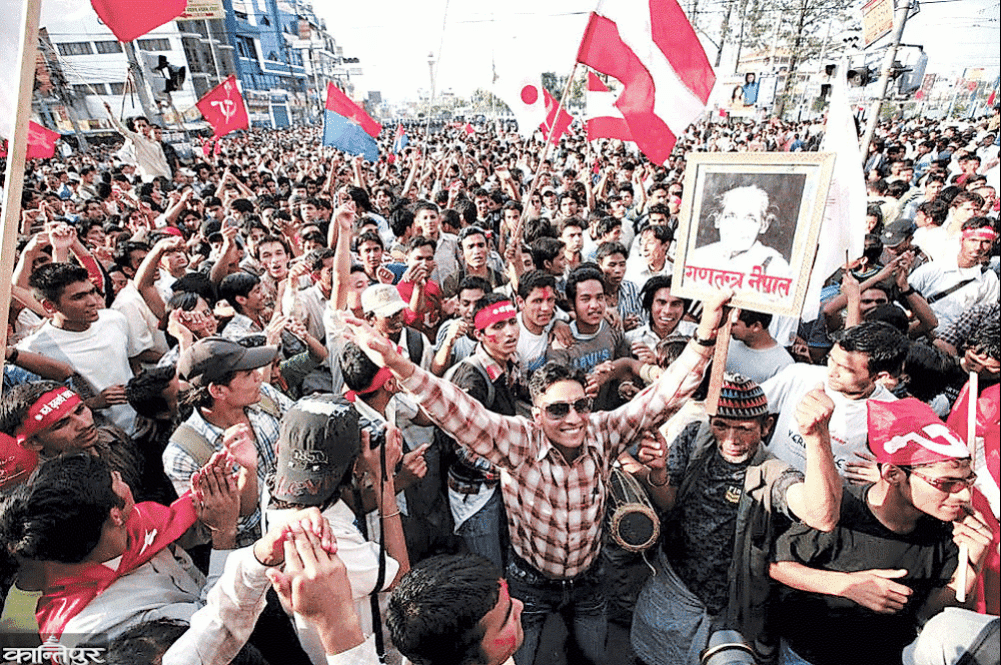
Therefore, the main agenda of the Maoist People's War was the restructuring of the state, saying that the same structural problems should be solved. The Second People's Movement of 2062/63 replaced the monarchy with a republic. It guaranteed to federalize the centralized state structure. Proportional election system was adopted to solve the inclusivity in politics and reservation was started to make government services inclusive. Thus, the second people's movement and the new constitution have largely solved all the three major structural problems of the Nepalese state.
This new system has largely controlled the power of the king and his subordinates, the Purpanchas, over the resources of the state. It has increased the reach of marginalized communities even though it is small. It has established the supremacy of big parties like Congress, UML and Maoists. Therefore, the common citizen does not seem to go against this system immediately.
But the question arises, then what is the complaint of common citizens?
This is a matter of serious thought. The grievances of the youth in the said program or the general citizen are related to the way the state works. Which is the old problem of Nepali state.
Since the creation of the Nepali state, it has worked with the mindset of serving the society, exploiting the resources rather than providing security and ruling the society. Therefore, corruption and procrastination have become the character of the Nepalese state.
Let's not talk too old. From the Panchayat period till now, no matter which government is formed, within six months to a year, some major corruption scandal is public. There is talk of corruption in government operations from Kathmandu to villages. Even bigger problem is corruption, no development plan is completed on time. It has become common for us to see two years of work take four years, costing much more than the original estimate. These are the problems seen in the functioning of our state. In English it can be called 'functional problem'. The problems raised by the youth in the
program are related to the functioning of the Nepali state. No jobs were created. Who will do this? By the government. Government policy increased corruption. The standard of government education did not improve. The quality of health care did not improve. Corruption did not stop at the customs office. The exodus of young people did not stop. None of these problems are questions of state structure. Everything is related to the way the government works. A
question may arise, why is this problem not solved?
Because Nepali politics did not make these problems their agenda? The parties of Nepal have never taken these problems seriously? No matter how much a problem exists in the society, unless a political agenda is formed, the parties do not start a debate about it, they do not make it the agenda of the movement and the election, until then it is difficult to solve the problem.
When the debate on such issues starts, Nepal's parties, leaders, former ministers start telling stories of old struggles. If he is a Congressman, he talks about BP. He talks about the struggle during Rana and Panchayat. If they are communists, they start talking about Marx, Lenin etc. Maoists directly emphasize people's war and class struggle. Madheshis raise many issues of racial, linguistic and caste discrimination against them, but they do not like to discuss what they have been able to do and what they have not been able to do while running the government.
Corruption has expanded especially in Nepal. It has spread its roots to the lowest level of society. In the days after the establishment of the Republic, the process of spreading corruption has intensified. This has happened due to some policy and some structural reasons.
Under the new structure, we have empowered all levels to collect taxes, formulate budgets and make laws. When there was a unitary state structure, Parliament only made laws. Since the executive authority rests with the Council of Ministers, only ministers and staff were involved in budget formulation and its implementation. When there was an irregularity, the involvement of employees was more visible than the political leadership. We made two structural changes to that system. Then the scenario of implementation of the budget changed.
We arranged that the implementation of the construction plan with a budget up to a certain limit would be done through the consumer committee. After many anomalies appeared, the public procurement act has been amended several times, but the situation has not subsided. Bann is said to be working through the consumer committee, but that is a way of feeding the workers. Leaders make plans in different levels of budget so that their workers can have two money as much as possible. This has made the entire budgeting process retail and distribution oriented.
It makes the worker dependent on the leader. Even if the leader does something wrong, the workers silently support him. If they oppose, they think that they will not get the plan. The entire cadre of workers has become followers. This has led to the development of a unique 'baggage trend' within the party. This disease has spread from union to municipal level. Development works are taken up in the name of Consumer Committee, but they are mainly completed through contractor companies. This method of budget distribution benefits leaders, their workers and contractors and employees involved in the payment process. This Nexon has developed very strongly, across the country.
The second thing is that we have also arranged budget mobilization for the MPs selected for the work of making laws. Earlier it was done in the name of Parliament Development Fund. After the Supreme Court put a stop to it, now a scheme equal to a certain amount is allocated in the name of each parliamentarian with the agreement of the government and the House. The implementation of that plan is done as the MP said. It is in continuous practice in all states since union. This has changed the role of MPs. Now they are less interested in law making and more interested in budget allocation and mobilization. This has also led to the development of a new type of protectionist tendency in democracy. MPs and leaders above are protectors and leaders below MPs, activists have transformed into protected groups in the hope of getting budgets and plans.
Both the mentioned changes have left the political activists busy with budget allocation from the center to the wards. If there is a powerful, accessible or vigilant leader, the union, state and municipality alone succeed in making their own favorable plans. Some leaders and activists insist on keeping the same plan in two or three levels of budget. There is wide variation in implementation. It has flourished as a business. Those who manage to keep two/four schemes in the red book of the budget every year are making a lot of money. That is why such leaders are called 'Bajetiya leaders' in Mofsal.
This is the distortion seen at the level of MPs and workers below that. But in today's society and politics, there is widespread dissatisfaction with ministers and even higher-level leaders. Corruption at the ministry level basically involves four things. In the procurement process, in the contracting process, in political appointments and in the transfer and promotion of employees.
The leaders who fought for the republic have also become ministers. Today, when the republic is being questioned, those leaders do not want to talk about the mentioned works (procurement, contract, appointment, transfer, promotion) when they were ministers or when their party was in government. It does not talk about the manipulations that take place in it. If he speaks, he only eats so much jelly, eats sticks, etc., etc.
People are dissatisfied with the working style of the republican governments because these things have not been improved in the government work after the republic. They say that our standard of living has not improved despite the advent of the republic. The king is gone, but the behavior of the monarchy is still the same. The royal family, their entourage and limited leaders looted the resources of the state yesterday. The party that is in power today, its leaders, the people of the leader's family have done the same.
The above is just one part of the common citizen's discontent. We discussed how the representatives of the society are mobilizing the resources of the state, but what kind of relationship do those leaders and workers have with the market? This is the subject of a separate analysis. Today's youth, who were born after the republic, may not be aware of these things. This practice has started since 2046. It flourished especially after the privatization of education and health sector but during the republican period.
Many hydropower companies, private schools, private colleges, large private hospitals, industries have been making the young leaders of the ruling party as employees or silent partners for administrative convenience. Such employees will not be able to work but will continue to receive salary. Silent partners are not allowed to invest but can enjoy limited profits as partners. Such leaders have been getting quota while being admitted to various courses in various colleges. If the businessmen face any administrative complications in their related transactions, they are easily accessible to their party leaders and provide assistance as needed. Such activities will make political activists the intermediaries between the state and the market. Such leaders who eat commissions are called middle leaders in Mofsal. In this way, the agent of the market is also expanding in politics, which many people do not know about.
With this nexus of market and politics, common citizens, i.e. society, have to face high prices and black market. This is also one of the major reasons for growing dissatisfaction in the society. All this is a functional problem of the state.
There is not much discussion about these problems in the political circles. It is not heard that any party in Nepal has made a solid plan for improving education, increasing the quality of health, and solving unemployment. Protesting is something else. No party wants to destroy this developed relationship between the state and the market. All these things are linked to service delivery. Service delivery issues have not become an agenda in Nepal's politics.
Even now in our politics, the ideas and principles of Marx, Leylin, Mao, BP are becoming the subject of political discussion. While the topic that should be discussed is the issue of Giribandhu Tea State? What is the issue of fake Bhutanese refugees? How was the Patanjali scandal created? What are the basic problems of education and health sector in Nepal? How did these basics become so expensive? etc etc.
Leaving all these matters to the media and NGOs, the political circles either talk abstractly or focus on budget allocation and distribution. Which has changed the very nature of our democracy. We want an 'argumentative democracy' where we can argue, but our politics is bent on making workers a bag and leaders patronizing, which is particularly a 'petrogenic democracy' i.e. a protectionist democracy.