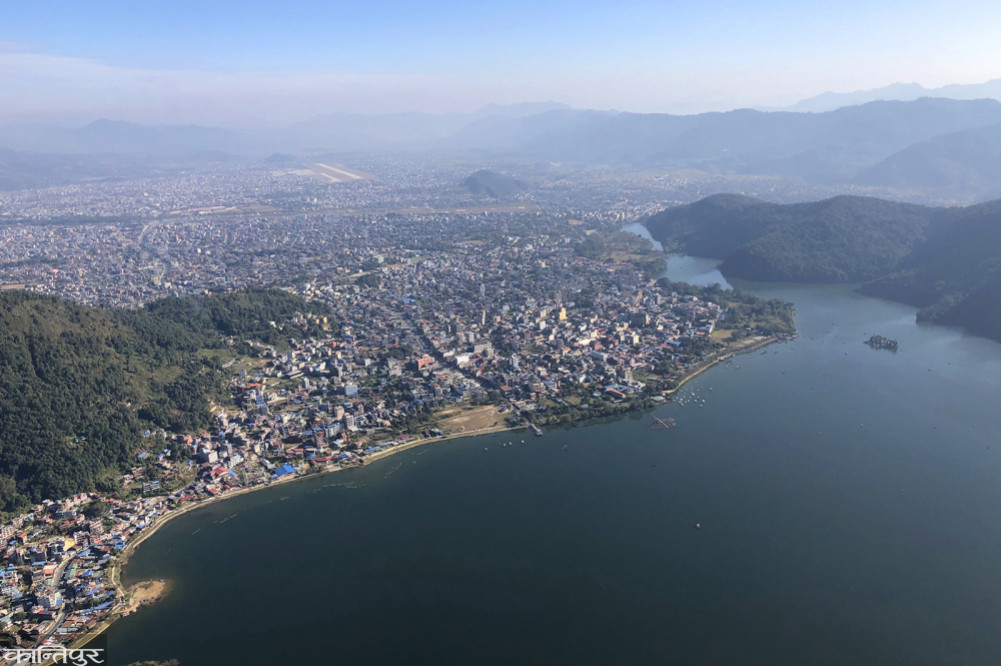
The economic progress of Nepal does not seem easy as a large part of the survey expressed the opinion that there is no opportunity in the country and the youth have left and there is no environment to become entrepreneurs.
We use Google Cloud Translation Services. Google requires we provide the following disclaimer relating to use of this service:
This service may contain translations powered by Google. Google disclaims all warranties related to the translations, expressed or implied, including any warranties of accuracy, reliability, and any implied warranties of merchantability, fitness for a particular purpose, and noninfringement.
It is often discussed that there are no opportunities in Nepal and talented people have left. In the last 10 years (2015-2025), two big earthquakes in Nepal, India's economic embargo, and the impact on the economy due to the corona epidemic also affected opportunities and employment. On the other hand, since the new constitution was issued and federalism was implemented in this decade, Nepal has also seen a leap in social, physical and institutional infrastructure and technology.
Looking at the changes brought about by the development of technology in the nature of work, the demographic situation and the changes in the nature of the economy, it seems that the issues of opportunity are discussed in different ways.
In order to understand how the citizens of Gandaki province, which is ahead in social and economic indicators in this serofero, have taken the question of opportunity, a survey was conducted among 1 thousand 67 people from 9 districts of Gandaki (Kaski, Syangja, Tanahun, Gorkha, Lamjung, Myagdi, Parbat, Baglung and Nawalpur) from last December 12 to January 11. The results of the survey have been summarized in the article with the expectation that they will represent the national situation to some extent.
The disappointing investment environment According to the
survey, those who are satisfied with their profession/business (70.3 percent) are less satisfied (18.4 percent), i.e. almost 4 times less. Thus, the survey showed that although the majority of citizens are satisfied with their current profession/business, they are very dissatisfied with the investment opportunities, entrepreneurship and employment situation in the country.
Almost twice as many disagreed (61 percent) as saw new investment opportunities (30.7 percent), indicating a lack of investment climate. Based on this assessment from day-to-day experience, it seems that the economic condition of citizens has reached a state of 'neither deteriorating nor improving'. Which can also be taken as an excellent example of the paradox of stability (Stagnation Paradox).
One of the main reasons why citizens do not see the investment environment and economic opportunities as dynamic can be considered the weakness in investment freedom. Also, one has to face a very complicated process in starting and operating a business in Nepal.
There are many agencies of the state involved in the registration, regulation and management of businesses, which have different types of customs, legal and policy ambiguity. Based on that, the public opinion obtained from the survey has agreed with the opinion that investment and economic opportunities are low in Nepal due to the obstacles, disruptions and the burden of taxes on the middle class.
Majority of the respondents have seen obstacles in running the business. Which has also exposed another aspect related to investment freedom. Compared to those who do not see any obstacles (25.9 percent) in carrying out business, the number of people who see obstacles (60.4 percent) i.e. more than twice shows that the common people are worried about syndicates/cartels etc. Those who do not see such an opportunity (70.2 percent) are almost three and a half times more than those who see an opportunity for business/business to flourish (21 percent), reflecting the disappointing state of the business and professional environment. The fact that the
survey has shown is that the old investors in an area have taken the form of a cartel due to which it is very difficult for new businessmen to come in and it is also difficult for them to survive.
Those with small capital hesitate to make new investments because they have seen/experienced such a situation. The majority of respondents (61 percent) who do not see new opportunities for such investment during the survey have confirmed the same. The opinion of a large part of the common citizens has come to agree with the fact that the state has complicated the process of investment and has not been able to create a comfortable environment for new investors.
shrink opportunity
According to their skills, abilities and knowledge within the country, compared to those who see job opportunities (18.4 percent), those who do not see such opportunities (77.7 percent), i.e. more than 4 times, it seems that the job opportunities are greatly reduced. Compared to (18.6 percent) who say that the environment for becoming an entrepreneur is good, the number of people who disagree with it (69.8 percent), that is, almost 4 times more, does not seem to be conducive to entrepreneurship.
In terms of educational conditions, there is an interesting fact that they agree that there are job opportunities within the country according to their skills, abilities and knowledge. It is an ironic situation that the more educational degrees, the more skill, ability and knowledge the job opportunity is not seen.
It seems that people are becoming dissatisfied with getting opportunities for economic activities after the increase in educational qualification. Graduates (80.9 percent) and those with post-graduate studies or above (86.4 percent) are more dissatisfied with access to opportunities than those who have studied Proficiency Certificate Level/Class 11-12 (77 percent). Thus, the survey shows that educated people are not happy about getting opportunities.
Along with this, another fact indicated by the survey is that there is no match between the education being acquired by the person and the demand and needs of the market. Not only is there a deep gap between educational qualification and market demand, but also there is no synergy between formal education and employment in the context of Nepal. Even though vocational training is not enough, youth unemployment seems to be increasing. Despite these kinds of structural challenges, even if people find employment, they may remain dissatisfied due to limited growth opportunities. Not a
opportunity but abroad
10.4 percent of the youth are satisfied with the migration and 87.9 percent of the respondents are not satisfied. Compared to the number of those who say that youths have emigrated due to lack of opportunities in the country (86.8 percent), the number of those who disagree is only 11.1 percent, which is almost 8 times less. Common citizens are not happy that a large number of young people have emigrated, they are also not happy that their own family members are going abroad.
There are almost twice as many people who disagree (41.3 percent) as compared to (21.9 percent) who are happy that their family members can go abroad. Though this has a positive contribution to the family's income and expenses to some extent, the psychological notion that their family members did not get opportunities in the country and had to go abroad for the sake of opportunity is deeply ingrained in them.
The findings of the survey are also consistent with the commentary that youth are leaving Nepal due to lack of opportunities. In spite of this, 21.9 percent of the respondents are happy that their family members have gone abroad, which shows a certain degree of foreign fascination.
Since there is no opportunity in the country, the youth have left and there is no environment to become entrepreneurs, the majority of the public opinion stands in favor of Nepal's economic progress not only does it not look easy, it also seems to be consistent with the idea that the economic growth will be limited and because of that the frustration will increase. Although the desire to invest in the citizens and the ability to save to some extent have increased, due to the unfavorable policies, structures and the overall environment, those investments have not been able to be made in the productive sector and the result is the paradoxical state of economic stability (Stagnation Paradox).
young hope and confidence According to the
survey, youth in the age group of 18 to 25 are very optimistic. Compared to other age groups, this group has seen not only fewer barriers to business/business but also flourishing conditions. This group is also ahead in seeing job opportunities according to their skills, abilities and knowledge. This group has seen the most in the environment of becoming an entrepreneur.
Probably people of this age group have not been 'exposed' much to the personnel system, i.e. they have not experienced the complicated behavior of the personnel system and they have not faced the difficult and unclear policies that are not investment and entrepreneurship friendly.
That's why they may be optimistic about this matter. Also, they have seen little investment opportunities. This may be because they lack capital (funds). However, the hope that is seen in the young generation that 'something should be done' is also a kind of confidence seen in them.
On the one hand, there is more hope and confidence in the youth group and on the other hand, the same group is more in terms of population. In the case of Gandaki province, the population in the age group of 18 to 25 years is about 15 percent and the survey also shows that this group is the most optimistic. To utilize the opportunities of the demographic dividend currently available to us, all three tiers of government can further encourage this hope in the younger generation by making policies conducive to investment, entrepreneurship and employment.
Also, although the government has announced from time to time that it will increase entrepreneurship, it has not been seen in practice. The government needs to be clear not only about what to do, but also about what not to do so that an investment-friendly environment can be created in the country. By saying this, it is important not only to decide what to add in terms of making investment-friendly policies and laws, but also to remove what are currently obstacles.
Entrepreneurship flourishes based on indicators such as easy access to capital, guarantee of investment security, barrier-free environment for doing business and access to markets. But entrepreneurs and businessmen have been saying that there are many policy challenges for that. In order to remove such problems, comprehensive policy reform is necessary, and an environment of trust is also necessary.
Mainly, with the commitment of policy/rule making and the government moving forward in its implementation and practice, common citizens can not only be optimistic about investment, entrepreneurship and opportunity, but can also be confident.