Social media operators have accidentally become rulers of the 'digital space', but this 'digital space' belongs to us citizens.
We use Google Cloud Translation Services. Google requires we provide the following disclaimer relating to use of this service:
This service may contain translations powered by Google. Google disclaims all warranties related to the translations, expressed or implied, including any warranties of accuracy, reliability, and any implied warranties of merchantability, fitness for a particular purpose, and noninfringement.
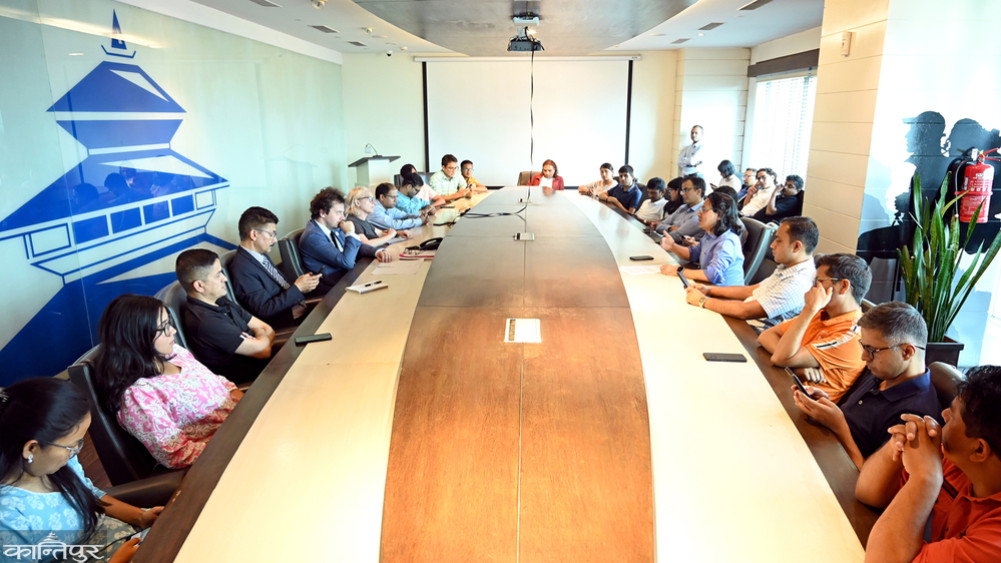
Reporters Without Borders (RSF) Director General Thibaut Brutin and South Asia Director Cellier Mercier participated in an interaction with journalists at the office of Kantipur Publications when they came to Nepal mission last week. An edited excerpt of the views they expressed.
Our concept and definition of press freedom is the protection of journalists. But, unfortunately there are many countries where journalists are being jailed and targeted. In Nepal, a cameraman of Avenues TV was killed during a protest in support of the former king.
We think freedom of the press is more than security. It is also the belief of the people and stable social conditions. We value your relationship with the people. This is really important, because people can get away very quickly. This may be due to fatigue of the same type of news or distrust of the press.
safety, trust and a stable media economy are important. But under pressure, the media can also behave in ways that are not beneficial to society or quality journalism. When journalists are under financial pressure, they may turn to politics. May join other professions of communication and engage in other types of activities. We need to uphold ethical journalism.
Therefore, the economy, security, social context, and legal and political conditions determine whether journalism is conducive. Many countries still have problematic laws. I know there are concerns about the future of digital journalism in Nepal. We need to address these challenges and analyze the law, so that they do not present problems for the press. Absolute freedom of the press is more than security. We need to work on this different dimension.
Another important point, freedom of the press and freedom of expression are not the same. Freedom of expression is the possibility to express one's opinion. This is also important and we should appreciate it. But freedom of the press is an institution. You have the ability and environment to work without any hindrances or interruptions. We need to have information laws to protect
sources. We need to have the ability to publish information of public interest. So this press is an agency. This is a responsible job. In some cases, freedom of the press is understood as an extension of freedom of speech in the newsroom. Especially not that. What journalists do is different. It has added value to society. We must avoid the situation that leaders like Donald Trump are trying to create.
They may try to provide a society where freedom of expression is guaranteed, but journalists cannot continue their work. It is very dangerous. This is kind of a new problem.
So we need to build a credible and sustainable press. Nepal is ranked 90th out of 180 countries in the Press Workplace Index. It falls right in the middle of the index. We think there are some obvious issues from a security perspective. We have to address it and see what happens. In recent years, we have the first example of a journalist being killed in the line of duty. But we think the situation can improve if the legal and financial challenges are also addressed. Even to get all that, journalists need to continue their work. We must say that we are here to serve you and the general public.
The situation of journalists in Nepal is a matter of concern. To build the future of journalists, we as citizens must work together with other professionals to create better conditions. Because today we are facing problems due to new dimensions that have developed in every sector of society. We have to gain the trust of the people and build a strong economy. At the same time, regulation of digital companies is also necessary.
Nepal's position dropped to 16th this year. Earlier it was ranked 74th now it is ranked 90th. What are the reasons for the fall of Nepal? The
workplace index is based on a survey of media experts. It is really important to say that, this is a qualitative survey with subject matter experts. Those we ask questions answer yes/no. But in some questions they also have to give evidence about their opinion. Which we will check later.
So in this year's survey, the results from Nepal were lower than last year. We specifically survey 5 parameters economy, social, legal, political and security. This year, Nepal scored 220 points in security. It was only 109 earlier. So it's a decline. Similarly, it scored 80 in economy, up from 52 earlier. We saw a sharp decline in that too. The decline is due to the economy and security . It's more complicated than any arithmetic. But I think it's a good thermometer to measure the temperature of press freedom.
...
Political leaders must be responsible in their speech. We must call upon them to be responsible with their language. At present they may like social media. But they also need a free press. When they make a statement targeting a particular newspaper or journalist, the entire news industry needs to stand together against it. The news business is like any other business. It's competitive, there are divisions. This is normal. But we encourage everyone to stand together when media outlets and journalists working there are fingered without proof. It is also important that we respond legally.
magazines are responsible for the content they publish. Politicians should not accuse newspapers of publishing fake news without solid evidence. They must also face the responsibility of the bad deeds they have done. If politicians or people are not satisfied with the work of media, they can go to court and submit their claim.
Also, we think the news industry should be open to the public, more transparent. The media can be more open about who they are and reveal their biases. And, I think there should be transparency at the same time.
...
Israel's atrocities against Palestinian journalists are also a matter of concern for us. We are suing Israeli Prime Minister Benjamin Netanyahu in the International Court of Justice and the International Court of Appeal. Because we think that about 44 journalists have been killed in Palestine for doing their job. However, even though some journalists claim to have been killed, it does not seem so. Some of them are ordinary citizens. After filing a case in an international court, it is our responsibility to prove it. Therefore, we must first determine the circumstances in which the person to be killed was killed.
The number of journalists to be killed in Pakistan in 2024 is high. Which is problematic. The largest number of them were killed by the Taliban, mafia or local terrorist leaders. We also see authoritarian trends in India. Which is considered to be the largest democracy in the world. But the state is taking the help of anti-terrorism laws there to control journalism. There is a big problem especially in Kashmir. It is also difficult to get information about what is actually happening in Kashmir.
We fear a system where hate speech against journalists, especially women journalists, is spread on social media on a massive scale. Such expressions can promote any kind of physical attack. If a leader insults a journalist in his speeches day and night, that journalist can be attacked at any time. That's a big problem.
Some countries are also trying to curb the financial aid they receive internationally to silence the voice of independent media. Because
Independent media are not following orders from major politicians.
...
Social networks are trying to avoid regulation. For example, the European Union has tried to subtly regulate social media, including Facebook. However, the operators of social networks are trying to ignore those efforts. Their commitment to the rules is as strong as their professional interests. Generally speaking, the work done by Mark Zuckerberg and Meta Group is very dangerous. Zuckerberg has not played a positive role. He is backing away from his commitment to support fact-checking. He has played a big role in making anti-journalism opinion through video.
Social media companies trying to equate censorship with journalism is a challenging issue. It cannot be considered correct in any way. So we don't want them to be editors. Editors are at responsible media outlets, who are doing journalism.
The operator of social media has accidentally become the ruler of the digital space. But this digital space belongs to us citizens. Social media is just a consumable like gas or water. They are just providing a service. They should be forced to guarantee digital services. In some cases what they are doing may even be for the benefit of democracy today. But in the long run that is not beneficial for democracy. And, we need to reverse that, because they've gone to that position.
They come to that power, because we let them do it. I believe there should or could be an alternative to Facebook. If we want to regulate the existing, we have to spend our time trying to create alternatives, which we don't want to do.
We don't believe in media regulation. But we believe in social media regulation. We think they are manageable. That is the difference between freedom of speech and freedom of the press. The press should be able to do its job without interruption.
Freedom of expression is the ability to express one's opinion. So these two are intertwined. But we need to make people understand that journalists are not just expressing their opinions, they are uncovering facts for society.
So today we have come to a situation where we talk a lot about freedom of speech but not about freedom of the press. But I want us to talk more about a free press. These two should be in harmony. We don't need more free press and less free speech.