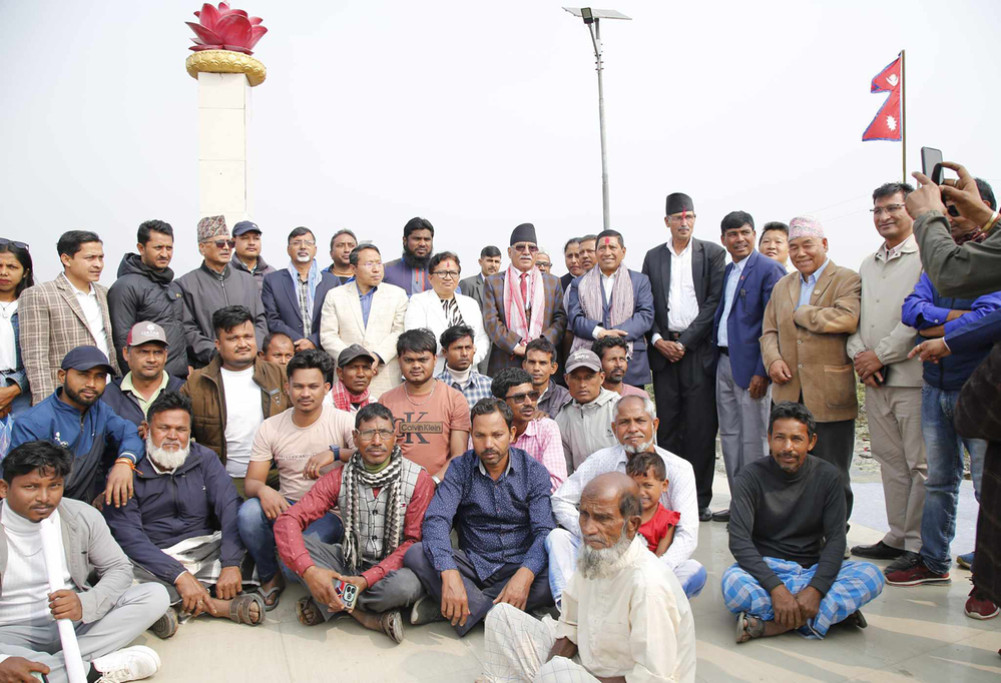
Maoist's 'Tarai-Madhesh Awakening Campaign' is not just a political journey but a historic initiative to raise the voice of the oppressed class and lay the foundation for social transformation.
We use Google Cloud Translation Services. Google requires we provide the following disclaimer relating to use of this service:
This service may contain translations powered by Google. Google disclaims all warranties related to the translations, expressed or implied, including any warranties of accuracy, reliability, and any implied warranties of merchantability, fitness for a particular purpose, and noninfringement.
The 'Tarai-Madhesh Awakening Campaign', which started from Kachankawal in Jhapa on February 12th, centered on the postal route, reached Mahendranagar in Kanchanpur and ended. This campaign has given multifaceted messages. Maoist Central Party leaders and workers got a rare opportunity to understand the real situation faced by the people, learn from the people, answer their questions, dedicate themselves to service and support them in their joys and sorrows.
On this journey from Jhapa in the east to Kanchanpur in the west, the opportunity to deeply understand the aspirations and pains of the people was truly wonderful. meeting and discussing with the family members of the
martyrs made us emotionally closer. We were also moved as they shared their pain and suffering. Hearing the pain and agony of more missing families made us unable to hold back and we cried together. At that time, we informed about the efforts made on behalf of the party for the families of martyrs and missing persons such as: Truth and Reconciliation Commission and the creation of the Act on Disappearance of Persons and its provisions. When they heard this, their faces showed hope. Especially the discussions with the families of the martyrs and the missing left a deep emotional impact on us. During the
campaign, hundreds of small and large meetings were held, where there were direct meetings, dialogues and interactions with nearly one crore people. The masses attending these meetings listened attentively to our words. In some places, due to the pressure of time management, people were anxiously waiting for us even for 4-5 hours. Their patience made us feel responsible. All vigilance meetings were conducted in a grand and attractive manner. Dozens of interactions, dialogues, public dialogues and brainstorming sessions were held effectively. Almost all the programs asked poignant and poignant questions about contemporary issues such as economic development, education, health, development, social discrimination, injustice, oppression and exploitation. As sharp as the questions were, we tried to answer them simply, clearly and honestly. They asked questions freely and confidently. Through these dialogues, a strong foundation for mutual understanding and understanding was formed between the party and the people.
Meanwhile, there was an opportunity to communicate directly in the slums of marginalized communities like Dom, Dusadh, Musahar, Chamar etc. We were deeply saddened to hear the incidents of discrimination, injustice and atrocities against the Dalits of Terai-Madhesh. These dialogues gave a vivid impression of how social differences have taken root in Terai-Madhesh. This experience has inspired the Maoist party to raise the voice of the oppressed class, move more firmly for social justice and equality. During the
campaign, we used to go out for a 'morning walk' every day. During the 'Morning Walk', the spontaneous presence and enthusiastic reception of the local people at Chok-Chok gave us more energy. Special priority was given to meeting and interacting with the families of the martyrs and the missing in the campaign. Also, party president Prachanda always stayed in the house of martyrs and missing families, which reflected his respect for martyrs. We also tried to stay with the martyred and missing families as much as possible and understand their sorrows and joys. These meetings provided an opportunity to express respect for the sacrifices of the martyrs and the families of the missing, as well as to understand their problems and expectations. Therefore, this campaign became a strong link connecting the martyrs and missing families with the party and party leadership. As the
campaign progressed, all the local government representatives along the way welcomed and congratulated. Submitted a demand letter related to development and construction. Not only because he was elected from the Maoist party, but other parties including the Congress, UML, Terai-Madhesh-centric parties also submitted their demands with full confidence to us with local concerns and problems. It seemed as if the executive head of the country had participated in the campaign. During the
campaign, the police administration managed the overall security efficiently and honestly. He did not allow any doubts to arise in the matter of security. From 5 am to 10 pm, various campaign activities were conducted smoothly and safely. This gave a feeling that the police administration was becoming professionally perfected.
The Sixth Plenary Meeting of the 18th Central Committee of the Maoist Party resolved to transform and rebuild the party. The meeting decided to conduct the first phase of the campaign in the postal route centering on the oppressed classes, communities, martyrs and missing families with ruthless introspection. In the past, we reached out to the people, admitting that the class had been neglected and the people neglected. We expressed our firm commitment to effectively discharge our responsibilities towards the people by ending the contradictions in words and actions. With the success of this self-critical campaign, people's faith in our party has been reawakened. When we decided to reach people's homes after some time to break the story, we were open to how people would accept us. However, the 'Tarai-Madhesh Jagran Abhiyan' became a strong link connecting the Maoist party with the people. During the campaign, interaction, discussions and intensive debates with all the oppressed classes, castes, tribes, languages and marginalized communities have qualitatively strengthened the relationship between the party and the people. This campaign further strengthened our relationship with the grassroots.
The oppressed class has realized that when the Maoists are weak, their issues are also weak. This awareness has reawakened faith and trust in the oppressed community towards the Maoists. The campaign provided an opportunity to closely understand the aspirations and pains of the people. This campaign has become not just a political journey but a historic initiative to raise the voice of the oppressed class and lay the foundation for social transformation.
While the 'Tarai-Madhesh Jagran Abhiyaan' was advancing rapidly and densely, the reactionary forces started to stir. They started exaggerating to mislead the public. Ironically, attempts were made to reverse the achievements of change by exploiting the situation of extreme discontent and frustration among the people due to the misrule of the two-party government and rampant corruption. In the initiative of the Maoist party to face this challenge
The leadership of Samajwadi Morcha organized capital-centered mass mobilization against regression and the status quo. In order to strengthen the republic by eliminating the limitations and weaknesses seen in the practice of democracy, it presented to the general public the vision of developing the current republic into a republic with socialist characteristics.
In order to solve the existing class, ethnic, regional and gender problems, it should be emphasized to change the current republic into a people's republic. We must make it clear that the socialist republic is not just a political slogan, rather it is a system that guarantees the dignity, prosperity and freedom of every citizen. To achieve this we need the broad support of the people. The Maoist Party, which acted as the main vehicle for political change, is moving the country towards economic development, good governance and social justice based on its core political agenda. The actions taken by the previous Maoist-led government for economic prosperity, against corruption, in the areas of good governance and social justice have had a positive impact on the people.
We are currently preparing for a campaign that will focus on Madhyapahari Lokmarg. Now, the Maoist party has a historical responsibility to move forward on the path of socialist revolution by connecting it with the hopes and dreams of the people. Therefore, from an ethical point of view, the main task of our party is to focus on the people and prepare for the socialist revolution in a planned manner in political terms to make the party the first political force in the 2084 elections. In the past, clear political direction has earned support and trust with the general public. Even today, the objective basis has been prepared for the party to move forward with the right direction, ideas, vision, policies, tactics and planned programs.