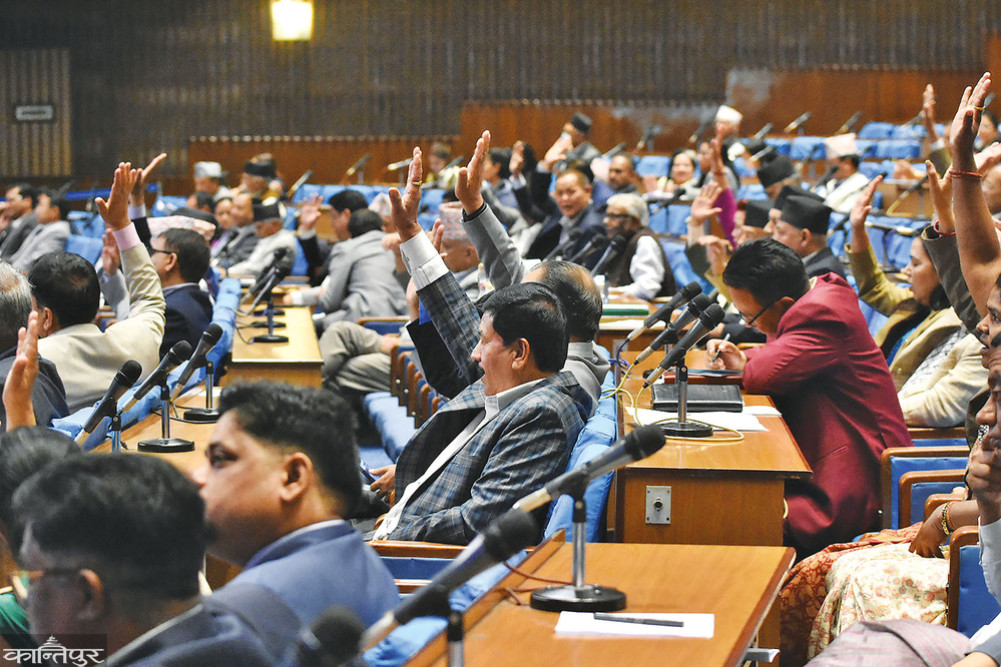
Not even a comma or full stop is changed in policies and programs. If no change is to be made then why waste time, means and resources in long and pointless discussions in Parliament?
We use Google Cloud Translation Services. Google requires we provide the following disclaimer relating to use of this service:
This service may contain translations powered by Google. Google disclaims all warranties related to the translations, expressed or implied, including any warranties of accuracy, reliability, and any implied warranties of merchantability, fitness for a particular purpose, and noninfringement.
The policy and program submitted to the federal parliament every year is a mirror of the government's annual activity goals and objectives. This year's policy and program was also submitted to the parliament and passed on Sunday with discussion. The responsibility of the government is not fulfilled only by presenting policies and programs, but the work to be done according to the responsibility begins.
This time there were less policies but more programs. There are also good and positive programs. But the budget proves its correctness and significance. Dreams are important. It is appropriate for the government to adopt the philosophy that the greater the gap between commitment and implementation, the more dissatisfaction will spread.
slogans and songs do not confirm loyalty. Hope is good. But capacity building for implementation is even more important. There was no firm vision (vision) of increasing the government's capital expenditure in the policies and programs. In the 10 months of the current financial year, capital expenditure has been limited to 31 percent. The government's capital expenditure, which received two-thirds of support, did not even reach one-third even by the time of the new budget.
The search for good governance to free the country from the infamous 'unfair development' is the need of the nation. Policies and programs aimed at providing good governance should be energetic with the will to be results-oriented and people-oriented, rather than being stuck in a process-oriented circle.
The strong government of the first and second main parties should have addressed policies and programs that understood the psychology of changing social dynamics (political, economic, social, cultural, press, public opinion, social media). Such hope does not seem to have materialized. The subject of constitutional amendment is the seven-point consensus which is a policy guide for the formation of the current government. But it is sad to be limited to that slogan, there is no concrete initiative and effort till date.
Judiciary, constitutional organs, universities, diplomatic missions, security agencies, etc., need a strategy of adopting the method of seniority, efficiency and excellence without party division. Constitutional institutions, which are the backbone of the state, defenders of democratic values, systems and the constitution, should not be made a helpless shadow of the executive. Traditional policies and programs that are neglected and forgotten by the government after being presented to the parliament and passed by voice vote cannot contain the dynamics of social change.
From 1992 to 2010, it seems that the government has mentioned the special priority of the youth-centered program targeting the 'Gen-G' generation of the age group of 15 to 28 years. After the 'Gen-G', the 'Alpha generation' since 2010 has come of age. The policy and program remained silent on this. There is widespread disillusionment among the youth of the 'Jen-G' group. There was no search for policies, firm commitment, plans and programs for the tragic situation where 3 to 5 thousand young people are going abroad for employment every day and every day three to five young people are entering the coffin. It happens when the government interprets the wave of the youth going abroad as a sign that they do not trust themselves.
Meanwhile, Nepali Sandeep Neupane was among the 26 tourists who died in the terrorist attack in Pahalgam, India. Ten of our promising students who went to study in Israel were killed in a terrorist attack. Bipin Joshi remains missing till date. Looking at the mysterious death of a Nepali student of Kalinga Institute in Odisha, Princea Sah, Nepalis are becoming victims of terrorism and extrajudicial attacks. India and Pakistan practiced war only a few days ago due to unrest caused by barbaric terrorist incidents. Although India and Pakistan reached a ceasefire after international mediation, there have been sad reports of violations soon after. Ending terrorism is the first requirement for regional peace and stability. There are hundreds of terrorist organizations and global public opinion is strongly united against terrorism and terrorism remains a major threat to world peace. Global peace and regional stability are our imperatives to support and support a resolutely tough policy against any form of terrorism. The black cloud of terror must be removed from the region once and for all with the conscientious implementation of this agreement. For this, it is necessary to present Nepal in a fair and true manner.
The country is suffering from heavy debt and corruption epidemic. But the policies and programs showed a lack of will to ruthlessly curb corruption, misrule, lawlessness and impunity. There is a perception among the general public that the government is the guardian of impunity and corruption. Service workers are victims of being cheated by cooperatives, microfinance and other businesses. The slogan of good governance is seen as meaningless. Reports of several commissions and investigations related to corruption have been filed with the Commission for Investigation of Abuse of Authority and the Singh Darbar. This is the root cause of public outrage. Not in order, but in the present disarray, lawlessness, impunity and corruption are the causes of today's public despair. Ensuring the income and social justice of the neglected and marginalized people below the absolute poverty line should have been the main theme of the government's annual policies and programs. But it didn't seem focused on that.
There is a need to form a high-level impartial investigation commission under the chairmanship of the former Chief Justice to take action on the famous corruption cases. This is a topic that has been brought up again and again. The statement by the leader of the opposition party that strict action should be taken in relation to the policies and programs of the last financial year is fresh in the record of the parliament. It is welcome that today the leader of the main opposition party raised the issue of setting up a high-level commission to investigate the assets of all those who have held public office after 2047.
The Bhairav Lamsal Commission report will be a sufficient basis for the investigation of the assets till 2057. But who stopped the formation of the commission? It was neither done by the then government, nor is it believed to be done now. In the universal parliamentary tradition, it is strange in itself that the ruling party and the main opposition have the same voice but no implementation. Recently, the Chief Commissioner of Authority has made it public that the government is not interested in returning the money of Nepalis who are kept abroad. This is the reason for the extreme dissatisfaction of the common people.
Policies and programs seem oblivious to the sluggish economy and financial risks. There is mention of coordination between banking, monetary policy and financial policy (paragraph no. 2). But it is a serious matter that in a very important financial center like Rashtra Bank, which implements monetary policy, it has not been appointed to a very important position like the governor for about one and a half months. Recently, the newly appointed governor of the Central Bank of Bangladesh. Ahsan H. In addition to regular work, Mansoor is conducting a search for billions of dollars that have been illegally diverted abroad. Let us appoint a similar governor, who can guarantee the right of the people to be informed about the money hidden in foreign banks, from Swiss banks to Singapore, Cambodia, Dubai, Europe, America, etc.
A white paper was released showing a loss of five billion rupees in the Electricity Authority. The figure was given that it was in full profit till a month ago. What is the reason for the extraordinary losses so quickly? is mysterious. Where did such a big manipulation in the data that shakes the credibility and trust of the organization, from the stakeholders of the project to the consumers? The truth should be made public. In our ongoing commitment, it is mentioned to set up an agricultural fertilizer factory. From 2041 till today, it came in policy and program 8-9 times. But it is getting zero. Whatever policies and programs are said about insurance, it is imperative to increase public confidence. Thousands of corona insured have not yet received payment. All these are disruptive complications in the way of good governance.
The policy and program ignored the fact that the International Financial Organization placed Nepal on the "grey list" of money laundering. The strategy and commitment to free the country from the 'grey list' was not seen in the government. The main donor countries - America's current economic policy and its effect on Europe's need to increase its security, corruption within the country has reached a level higher than last year and has been placed on the "grey-list", the international community's trust in the country is decreasing due to widespread economic irregularities and corruption. Nepal is seriously affected by climate change. In this regard, it is necessary to mobilize diplomatic efforts to gather institutional efforts and national-international cooperation.
The need now is for a bold radical change in approach, policy and practice. There is a feeling that truth and democracy are being lost in the struggle of parliamentary votes of 'yes' and 'no'. Not even a comma or full stop is changed in policies and programs. Not only now, but also in the past. If no change is to be made, why waste time, means and resources in long and pointless discussions in Parliament? It would be good if the policy and program could be revised and passed in the parliament addressing the suggestions of national interest from all sides.
It would increase the democratic working style and efficiency of the government and establish a new democratic tradition. The collective intelligence of the beautiful results that come from the friction of argument, counter-argument and dialogue should be promoted. But this is what we lack.